


Ebonised Marquetry Bookcase
An ebonised marquetry bookcase brings dark timber and intricate inlay together to anchor a room with nineteenth-century presence.
Ebonised Marquetry Bookcase
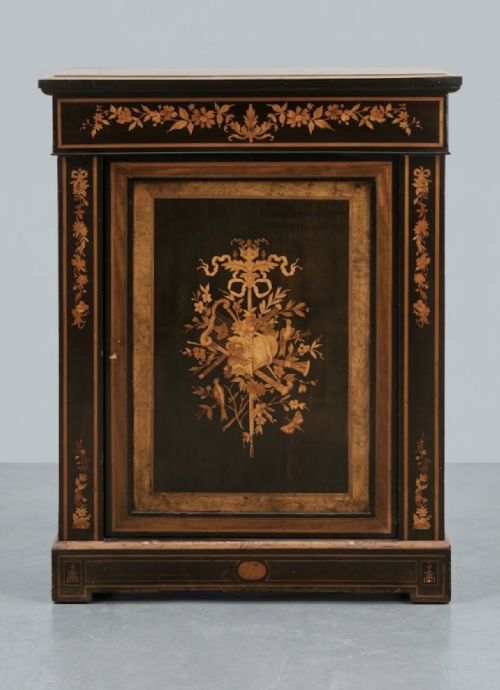
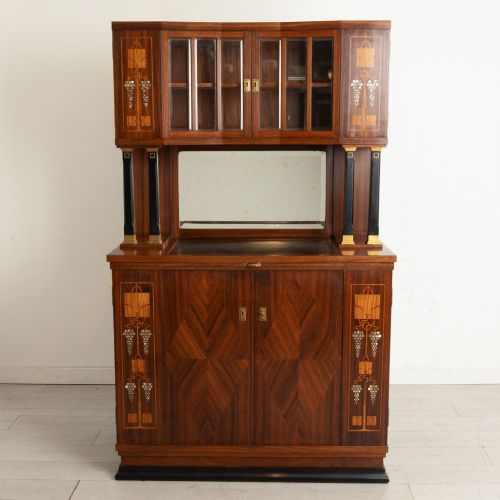
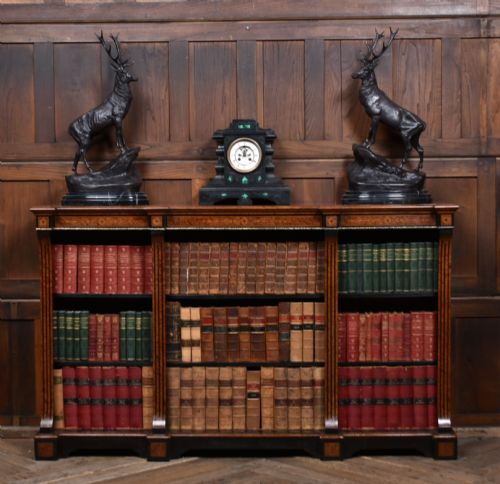
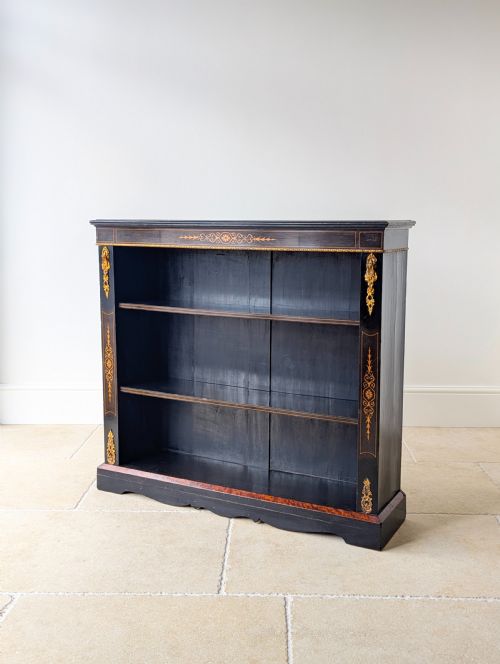
An ebonised marquetry bookcase combines the deep, dark finish of ebonised wood with patterned wood or tortoiseshell and brass inlay. These pieces serve as display cabinets, pier cabinets, and side cabinets designed to hold volumes and display ornaments.
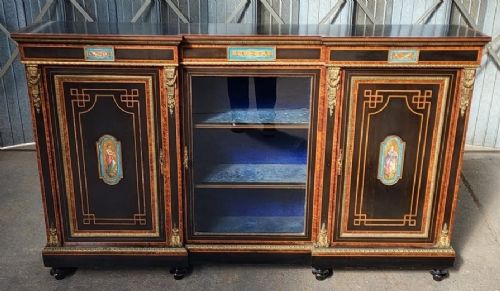
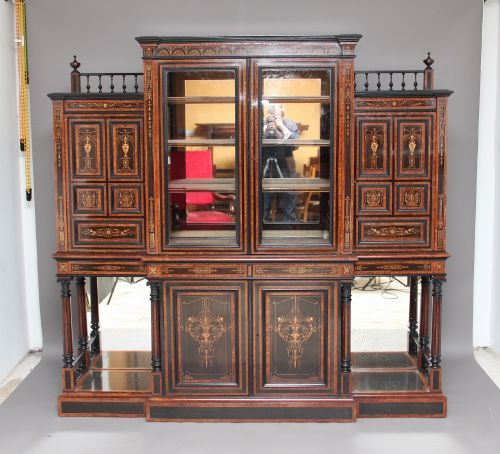
The Victorian period and the French Napoleon III style dominate this selection, frequently featuring glazed doors and ormolu mounts. Buyers meet open bookcases alongside breakfront bookcases and tall bibliotheques from the nineteenth century.
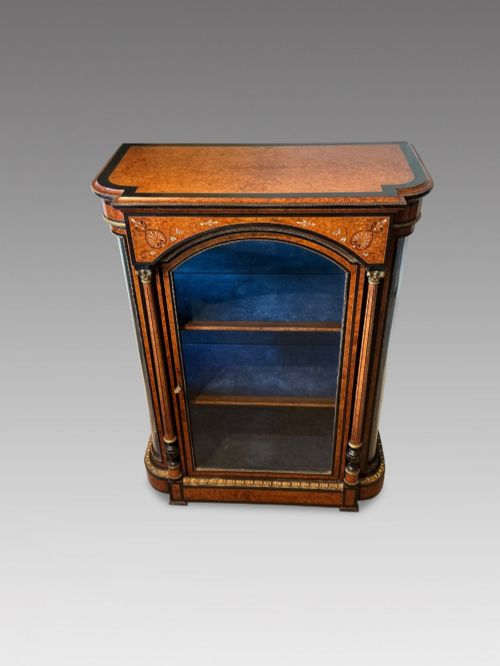
Nineteenth-century workshops in Britain, France, and Austria produced these cabinets using walnut, amboyna, and burr walnut as secondary or contrasting timbers. The aesthetic movement also influences several pieces, bringing distinct decorative priorities to the dark frames.
Materials and construction
Cabinet makers utilised dense hardwoods, applying a dark ebonised finish to simulate ebony while incorporating walnut, burr walnut, and amboyna veneers. Brass and tortoiseshell formed complex marquetry patterns set flush into the timber surfaces.
Ormolu mounts cast in bronze provide gilded decorative accents around glass panels and along corners. Glazed doors protect the interior shelves while reflecting light across the polished marquetry.
Music cabinets share this space, proving that nineteenth-century sheet music deserved a heavily ebonised and inlaid home.
Distinctions in craftsmanship
Superior examples demonstrate precision in the cutting and fitting of brass and tortoiseshell inlay, where individual motifs align seamlessly across doors and panels. Lower quality pieces rely on simpler painted details rather than genuine multi-material marquetry.
The selection of secondary timbers and the crispness of the ormolu casting separate standard production items from exceptional workshop output. Heavier architectural proportions and balanced symmetry indicate higher ambition in the original design.
Lamb of Manchester·August Ungethüm
The Ebonised Marquetry Bookcase Glossary
- Ebonised
- Wood treated with a dark stain or finish to imitate solid ebony. This process became widely popular during the Victorian era for formal cabinet work.
- Marquetry
- Decorative veneer work forming pictures or geometric patterns using various woods, brass, or tortoiseshell. Craftsmen cut these materials together to create tight interlocking designs.
- Ormolu
- Gilded bronze used for decorative mounts and furniture trim. Makers chased the cast metal surfaces by hand to achieve sharp detail before gilding.
- Pier cabinet
- A low cabinet designed specifically to stand against the wall space between windows. These pieces often feature single glass doors and elaborate top mounts.
- Boulle
- A specific style of marquetry using brass and tortoiseshell, named after the French cabinet maker André-Charles Boulle. Artisans cut contrasting sheets simultaneously to produce matching positive and negative panels.
Ebonised Marquetry Bookcase: Frequently Asked Questions
How do I care for ebonised wood?
Dust regularly with a soft cloth and avoid placing the cabinet in direct sunlight or near heat sources, which can dry out the dark finish and crack the veneer.
Apply a microcrystalline wax sparingly when the surface loses its lustre, buffing gently to maintain the deep sheen without building up heavy residues.
Are these bookcases suitable for heavy books?
Many surviving examples function primarily as display cabinets with adjustable wooden shelves intended for lighter volumes or decorative objects. Check the thickness and support of the internal shelving before loading them with dense collections.
Open bookcases generally offer robust shelving compared to glazed pier cabinets, which prioritize aesthetic display over heavy library storage.
What is the difference between a pier cabinet and a bookcase?
Pier cabinets are typically lower, narrower freestanding pieces designed to fit architectural wall spaces between windows, often featuring a single glazed door and mirrored interiors. Bookcases provide broader shelf capacity across multiple tiers or larger multi-door configurations.
Both forms utilise ebonised timber and marquetry, but the pier cabinet serves more as a decorative focal point than a primary library unit.
How do I identify French Napoleon III pieces?
French Napoleon III pieces display heavy reliance on elaborate Boulle marquetry, combining polished tortoiseshell and engraved brass across curved or breakfront surfaces. They frequently incorporate rich ormolu mounts around the glass frames and feet.
British Victorian interpretations tend to feature more restrained inlay patterns and straight architectural lines by comparison.