






Ebonised Marble Table
An ebonised marble table brings together dark timber surfaces and cool stone tops, offering a striking contrast suited to period and eclectic interiors.
Ebonised Marble Table
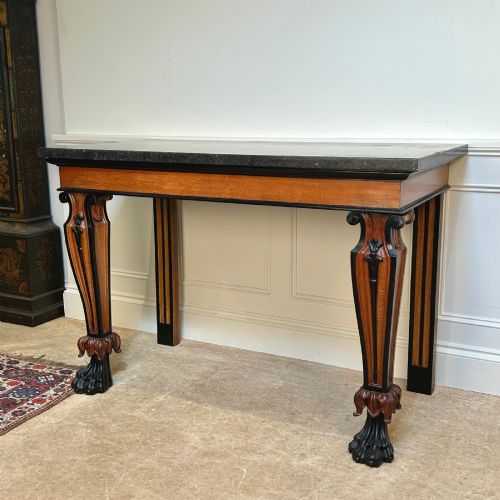
An ebonised marble table combines a dark-finished wooden frame with a stone top, appearing in various forms across the nineteenth century and revival periods. Buyers searching for an ebonised marble table will find pieces ranging from grand centre tables and console tables to compact lamp stands and occasional tables.
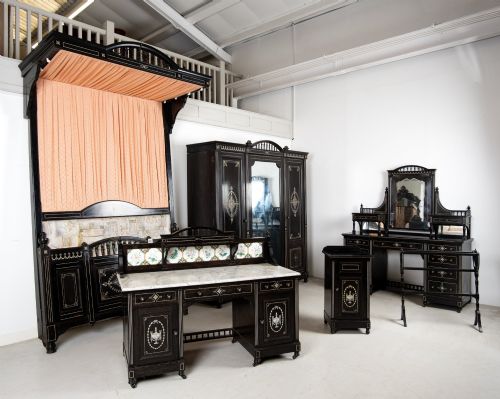
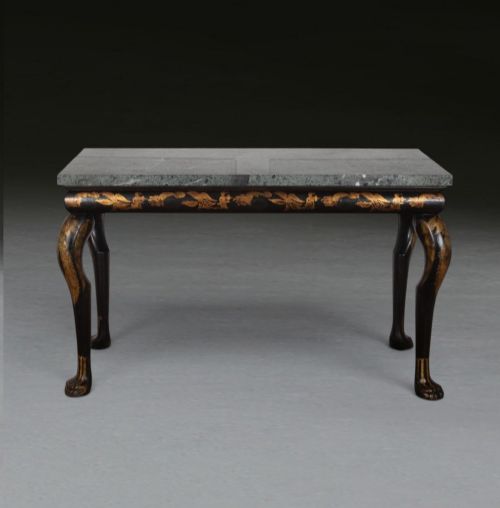
The material combination spans multiple stylistic traditions, from Regency and Victorian Aesthetic Movement designs to French Neoclassical and Chinese Export pieces. Centre tables and console tables dominate the selection, often featuring white, rouge, or specimen marble inset into ebonised hardwood, mahogany, or walnut frames.
Materials and Construction
Woodworking techniques of the period involved ebonising hardwoods such as oak, walnut, and mahogany to imitate costly ebony, frequently paired with giltwood, ormolu, and brass mounts. Cabinet makers applied dark stains or black finishes to dense timbers, achieving a uniform surface that contrasted sharply with polished stone.
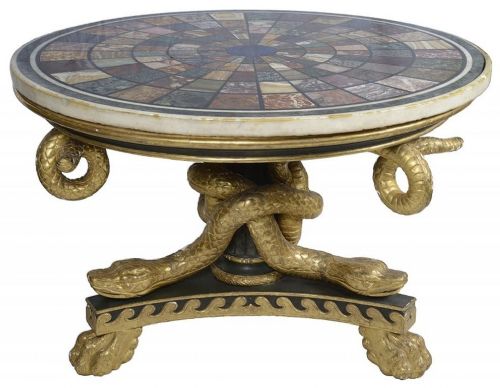
Marble tops, including white varieties, rouge marble, and intricate specimen or micro-mosaic arrangements, were cut and fitted precisely to the wooden frames. Structural details often incorporate turned legs, carved pedestals, and inlaid borders that secure the heavy stone inserts.
Ebonised Marble Table Retail Price Guide 2026
Typical asking prices for ebonised marble table among the pieces listed under this phrase on Sellingantiques today, from the lower quarter to the upper quarter. They describe what is for sale here now, not the wider market.
One unexpected table incorporates an actual Rolls Royce plaque within its ebonised wooden structure.
Design and Execution
The distinction between tiers rests on the refinement of the carving, the complexity of the stone work, and the integrity of the ebonised finish. Superior examples display meticulous joinery, high-grade ormolu or brass mounts, and stones selected for rich veining or pictorial specimen work.
Lesser pieces rely on simpler turned supports and straightforward painted or stained surfaces without secondary metal ornamentation. The precision with which the marble sits within the timber frame and the depth of the ebonised polish signal the original maker's intent and workshop standard.
Paul Sormani·Mathieu Befort
The Ebonised Marble Table Glossary
- Ebonised
- Wood treated with stain, polish, or paint to simulate true ebony. This dark finish gained popularity during the nineteenth century for furniture requiring a uniform, high-contrast appearance.
- Specimen Marble
- A top composed of various coloured marbles arranged in geometric patterns or pictorial designs. Craftsmen pieced together numerous small shards of stone to form intricate mosaic surfaces.
- Gueridon
- A small round table supported by one or more columns or figures. Originating in seventeenth-century France, these pieces frequently feature marble tops and ebonised frames.
- Console Table
- A table designed to stand against a wall, often secured with brackets or resting on front legs. These tables commonly carry heavy stone slabs and feature prominently in hallways and reception rooms.
Ebonised Marble Table: Frequently Asked Questions
What rooms suit an ebonised marble table?
These tables find natural placement in hallways, drawing rooms, and dining spaces where their dark frames and stone surfaces create a strong focal point. Console tables fit against perimeter walls, while round centre tables anchor open spaces.
Compact lamp stands and occasional tables serve alongside seating arrangements or in bedrooms, providing a stable surface for lighting and display objects.
How do I distinguish Regency from Victorian examples?
Regency pieces often display classical proportions, gilt bronze mounts, and restrained neoclassical lines derived from French Empire and ancient models. Cabinet makers working in this era emphasised architectural symmetry and clean structural profiles.
Victorian interpretations, particularly those from the Aesthetic Movement, incorporate eclectic influences including Chinese Export styles and ebonised surfaces with inlaid decoration. These later pieces frequently utilise varied timber combinations and more complex turned or carved supports.
How should I care for the marble top?
Marble requires gentle cleaning with a damp cloth and mild, pH-neutral soap to avoid dulling the polished surface. Acidic liquids like wine, citrus, and vinegar etch stone quickly and must be wiped away immediately.
Applying a specialised stone sealer helps protect porous varieties from staining while preserving the natural lustre of the material over years of daily use.
Are these tables suitable for daily use?
Solid construction and heavy stone tops make these tables remarkably stable for everyday placement in a home. The ebonised finish on the wooden frames provides adequate durability against normal handling.
Careful placement away from direct heat sources and moisture prevents warping in the timber base and protects the polished finish of the stone.