


Ebonised Girandole Mirrors
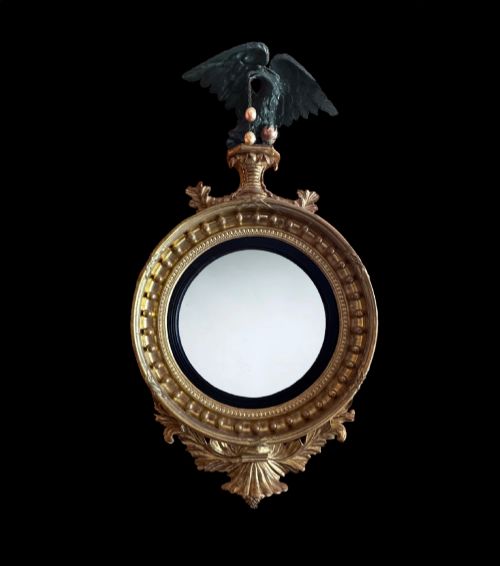
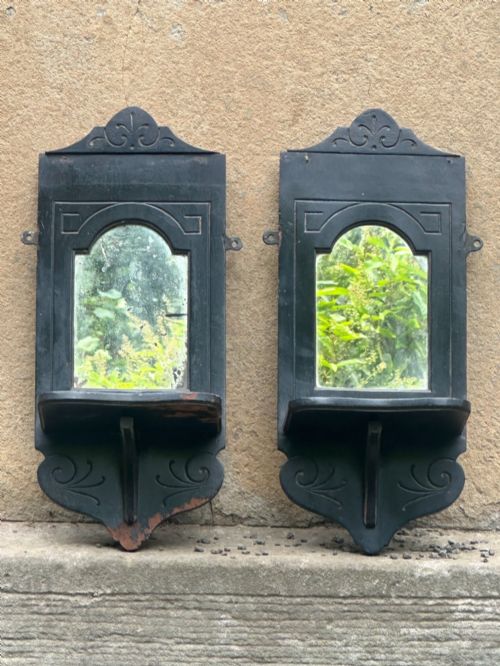
These ebonised girandole mirrors bring intense focus and candlelight to a room, catching the light in curved glass.
Ebonised Girandole Mirrors
When you search for ebonised girandole mirrors, you are looking at convex wall mirrors that often incorporate candle branches, shaped in Regency, Victorian, and later periods. The examples met on this page span the Regency, 19th Century, 1920, and Victorian periods.
Most pieces on display share the round convex format found in Regency and 19th-century designs. They draw the eye with curved mirrored glass set within circular frames.
How they were made
Makers built these pieces using ebonised wood, giltwood, and gesso over a solid wooden base. Brass and iron components often support the candle arms or hanging fixtures.
Mirrored glass provides the reflective surface, curved outward to capture a wide angle of the room. Giltwood details accent the dark ebonised frames to create high visual contrast.
Convex mirrors were once placed in medieval counting houses to keep a watchful eye on clerks without turning around.
What varies in quality
The precision of the carved decoration defines the better examples from simpler work. Crisp detailing in the gesso and wood carving shows the hand of a skilled maker.
The condition of the mercury or silvered glass and the retention of the original gilding and ebonisation dictate the character of each piece. Frames with intact surface finishes hold greater visual harmony.
Cottier & Co.
The Ebonised Girandole Mirrors Glossary
- Girandole
- A wall mirror equipped with candle branches or sconces attached to the frame. These arms project forward to light the room by reflecting the flame.
- Convex mirror
- A round mirror with an outward-curving surface that produces a wide, spherical reflection of the interior. It is often called a butler's mirror.
- Ebonised wood
- Timber stained or treated to imitate ebony, producing a dense black finish. This technique creates a sharp contrast against giltwood highlights.
- Gesso
- A plaster-like mixture applied to wood frames to provide a smooth base for gilding. Carved details are often moulded directly in this layer.
Ebonised Girandole Mirrors: Frequently Asked Questions
What is a girandole mirror?
A girandole is a wall mirror designed with attached candle sconces on the frame.
These branches allow the mirrored glass to amplify the light of candles within the room.
How do you hang a heavy convex mirror?
These pieces require secure wall fixings screwed directly into structural studs or masonry.
The substantial weight of the timber and glass demands robust hardware for safe support.
Where should you place an ebonised mirror?
Position the piece on a principal wall where the curved glass can capture a broad view of the interior.
Placing it opposite a window maximises the natural light brought into the space.
How do you date a convex mirror?
Examine the construction methods, backboards, and framing materials for period characteristics.
Regency and Victorian examples show distinct joinery and surface finishes unique to their eras.