


Ebonised Frame Armchair
An ebonised frame armchair brings dark, dramatic silhouettes and tactile nineteenth-century upholstery directly to your interior.
Ebonised Frame Armchair
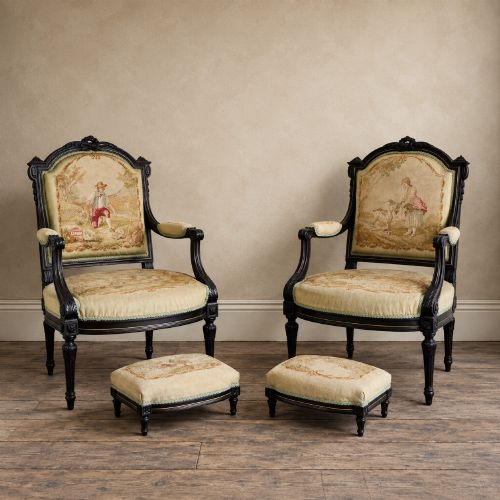
An ebonised frame armchair is a seating piece defined by its darkened, dark-stained or blackened wooden structure, appearing primarily across nineteenth-century styles. These chairs range from French Napoleon III salon pieces and Louis XVI revival designs to English Victorian drawing room seats and Anglo-Indian Regency forms.
The version you are most likely to meet on this page is a nineteenth-century French Napoleon III or Victorian model featuring an ebonised wooden frame. These chairs frequently combine dark woodwork with button upholstery, cane, or brass details, spanning forms from open armchairs to tub chairs and reclining armchairs.
Beyond the standard salon and drawing room types, the evidence includes distinct variations such as X-frame armchairs, country house chairs, and substantial Anglo-Indian ebony dining or armchairs. Each variant demonstrates how nineteenth-century makers adapted dark-finished frames to diverse domestic and colonial settings.
How they were made
Makers constructed these frames using various woods including beech, ebony, and general timber, applying a dark ebonising finish to imitate costly tropical hardwoods. This blackened surface was occasionally paired with gilding highlights, brass mounts, or carved details to create striking contrast against the dark background.
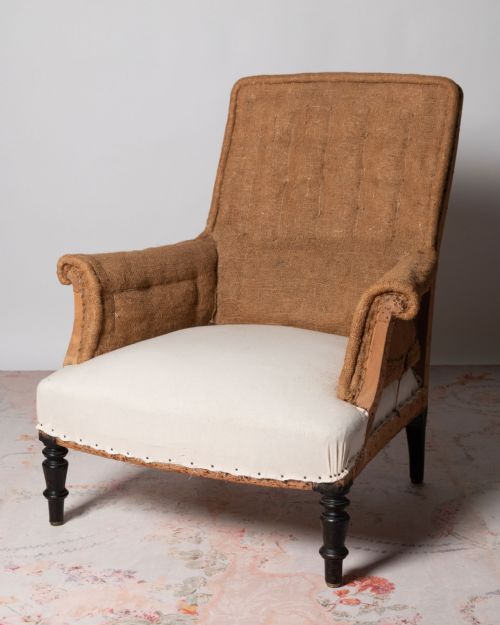
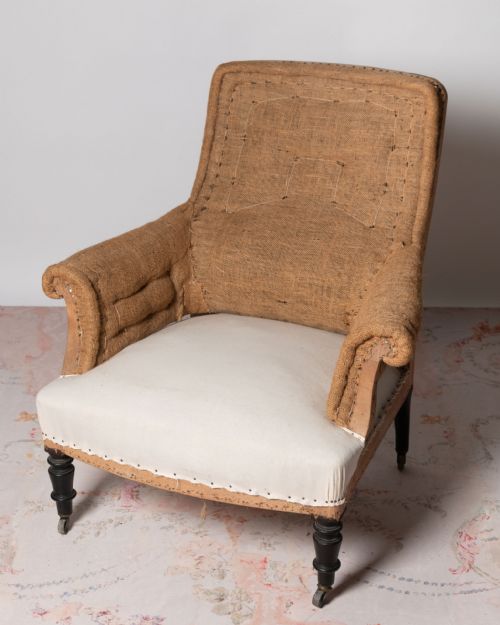
Upholstery methods formed an integral part of the construction, utilising traditional foundation materials like hessian and calico beneath top coverings of fabric. Chairs of this era also incorporated button upholstery techniques to secure stuffing and shape the sprung or padded backs and seats.
Nineteenth-century makers occasionally ebonised ordinary beechwood so convincingly that only a heavy knock reveals the impostor beneath.
What varies in quality
The distinction between standard production and superior examples lies in the refinement of the frame carving and the integrity of the ebonised finish. Finer pieces display crisp hand-carved detailing, harmonious proportions, and resilient structural joinery rather than purely mechanical mass-produced assembly.
Quality also resides in the execution of secondary materials, such as the precision of brass accents, the tightness of cane work where present, and the quality of the underlying upholstery foundations like hessian and calico beneath the visible fabric.
The Ebonised Frame Armchair Glossary
- Ebonised wood
- Timber treated with stain, dye or polish to imitate genuine ebony. This dark finish became particularly fashionable during the nineteenth century for formal and aesthetic period seating.
- Napoleon III
- A nineteenth-century French design period associated with eclectic revivals and ornate comfort. Pieces from this era often feature buttoned upholstery and ebonised frames.
- X-frame
- A structural chair design featuring intersecting supports shaped like the letter X. This classical form reappeared in nineteenth-century aesthetic and Victorian seating.
- Button upholstery
- A traditional technique where deep buttons are pulled through the padding to secure the stuffing and create a tufted pattern. It provides both structural support and decorative texture.
- Cane
- Woven plant material used for seats or backs. It offers lightweight durability and structural flexibility in nineteenth-century chair design.
Ebonised Frame Armchair: Frequently Asked Questions
What is an ebonised frame armchair?
An ebonised frame armchair is a nineteenth-century seating piece with a wooden structure stained or polished black to resemble expensive ebony. These chairs appear in various regional styles, including French Napoleon III and English Victorian designs.
They combine dark wooden skeletons with upholstered components like buttoned backs, fabric, or cane seats, serving as decorative and functional furniture for drawing rooms and salons.
How do I identify a Napoleon III armchair?
Napoleon III armchairs date from nineteenth-century France and typically exhibit ebonised wooden frames paired with plush upholstery. They often feature curved lines, buttoned backs, and occasionally gilt highlights or brass mounts.
Looking closely at the frame construction and upholstery style helps distinguish these French salon pieces from contemporaneous English Victorian seating.
Where were these armchairs used?
These armchairs functioned primarily as indoor seating in nineteenth-century drawing rooms, boudoirs, and formal reception spaces. Their decorative ebonised frames made them suitable for prominent display in domestic interiors.
Certain variants, such as reclining armchairs or country house seating, were designed for relaxed comfort, while Anglo-Indian examples served colonial and domestic residences alike.
What materials are found on these chairs?
The primary material is wood, finished with an ebonised surface to create a dark, polished appearance. Supporting materials include brass details, cane panels, and structural elements like beech and ebony.
Upholstery construction relies on traditional textiles such as hessian, calico, and decorative outer fabrics, frequently secured with buttoning techniques.