



Ebonised Breakfront Cabinet
An ebonised breakfront cabinet brings dramatic dark timber and architectural presence to a room, offering grand display space.
Ebonised Breakfront Cabinet
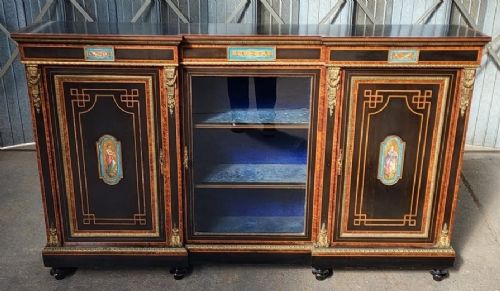
An ebonised breakfront cabinet stands as a commanding piece of nineteenth-century furniture, frequently taking the form of a credenza, display cabinet, or bookcase. The defining architectural feature is the projecting central section, which breaks the plane of the facade and creates depth across the front.
Most examples date from the Victorian era and the Aesthetic Movement, whilst French Napoleon III and Dutch Baroque Revival influences also appear. Makers employed rich contrasting woods like amboyna, burr walnut, and coromandel alongside the characteristic blacked timber finish.
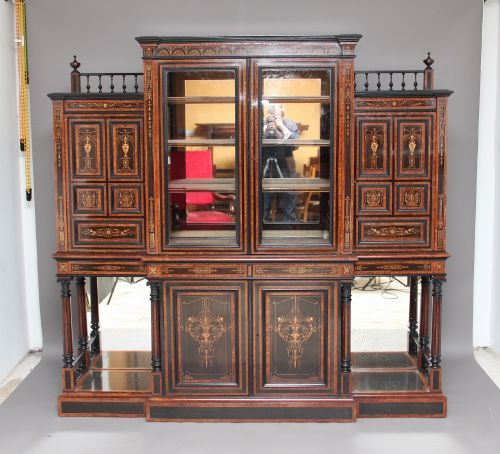
Glazed doors, open shelving, and multi-door configurations dominate the selection, often designed to display porcelain, books, and decorative objects. These cabinets combine utility with high decorative impact, suiting formal reception rooms and libraries alike.
Materials and Construction
Cabinet makers built these pieces using solid and veneered timbers such as walnut, oak, and amboyna, applying an ebonising process to achieve a deep black finish that emulated costly ebony. Surfaces were then polished to a high sheen, providing a dark canvas for decorative inlay.
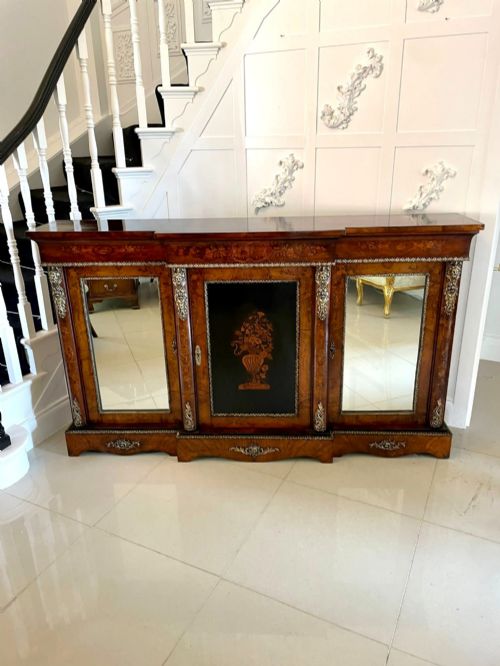
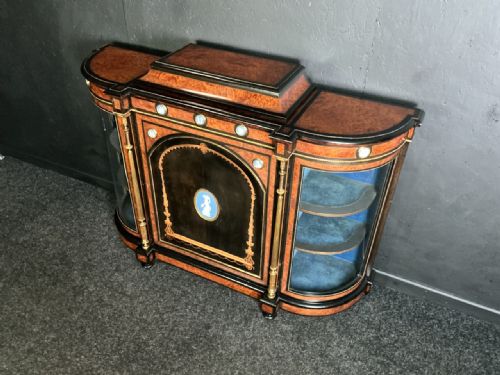
Ornate mounts in ormolu, gilt metal, and brass accent the corners, cornices, and door frames, introducing bright metallic contrast. Marquetry panels in lighter woods and porcelain plaques frequently decorate the central doors and friezes.
Glass panels were individually glazed into timber doors, often shaped with arched or breakfront profiles to catch the light. Marble tops appear on specific French-influenced pieces, adding weight and a cool tactile surface to the dark wooden frame.
Some nineteenth-century makers cleverly ebonised fruitwood to mimic solid ebony, fooling guests until a scratch revealed the lighter wood beneath.
Evaluating Quality
The distinction between standard production and exceptional quality lies in the depth of the timber work and the crispness of the mounts. Finer pieces utilise costly secondary woods and precise, hand-cut marquetry rather than simpler stamped or painted decoration.
Cabinet work by documented firms exhibits superior joinery in the breakfront carcass, ensuring doors hang true and internal shelving remains robust. The weight and chasing of the ormolu or gilt metal mounts also separate workshops of distinction from mass production.
The choice of contrasting veneers dictates the visual hierarchy of the piece, with burr walnut, amboyna, and coromandel commanding attention against the flat black ebonised ground. Preservation of the original glass, polish, and metalwork underpins the integrity of any surviving example.
Lamb of Manchester·Gillow
The Ebonised Breakfront Cabinet Glossary
- Ebonised
- Wood treated with stain or paint to imitate ebony. This dark finish gained immense popularity during the nineteenth century for furniture mimicking luxury imports.
- Breakfront
- A cabinet facade where the central section projects forward from the flanking wings. This architectural arrangement creates dynamic shadow and depth.
- Marquetry
- The art of applying fitted pieces of veneer to a structure to form decorative patterns. Craftsmen utilised contrasting timbers like walnut and boxwood for pictorial effect.
- Ormolu
- Gilt bronze mounts applied to furniture edges and panels. The technique involves mercury gilding over bronze to achieve a lasting golden lustre.
- Vitrine
- A glass-fronted display cabinet designed for porcelain and curiosities. These pieces privilege visibility through large glazed door panels.
Ebonised Breakfront Cabinet: Frequently Asked Questions
How do I date an ebonised cabinet?
Dating relies on observing construction methods, timber choices, and stylistic markers such as Victorian revivalism or Aesthetic Movement restraint. The presence of specific mount styles and secondary woods helps narrow the decade.
Cabinet makers of the nineteenth century utilised distinct joinery techniques that evolved between eighteen-fifty and eighteen-nineties. Comparing the carcass construction to documented pieces provides further chronological context.
Where should I place a breakfront cabinet?
A breakfront cabinet requires a substantial wall space, ideally in a dining room, library, or drawing room where its width and depth can be appreciated. Because of the dark ebonised finish, placing it near a natural light source helps highlight the grain and gilt mounts.
Ensure the room humidity remains stable to protect the delicate veneers and antique glass panels. These pieces anchor a room's decorative scheme, pairing well with both traditional and contemporary interiors.
How do I care for ebonised wood?
Care for ebonised wood involves dusting with a soft, dry cloth and avoiding silicone-based polishes that build up over time. Direct sunlight should be minimised to prevent the black finish and internal veneers from fading.
Maintain consistent indoor temperature and humidity to protect the timber carcass and prevent veneer lifting. Professional wax conservation can be applied sparingly to nourish the polish.