


Ebonised Aesthetic Movement Mirror
An ebonised aesthetic movement mirror brings dark timber, gilt highlights and distinctive Victorian design into a room with striking presence.
Ebonised Aesthetic Movement Mirror
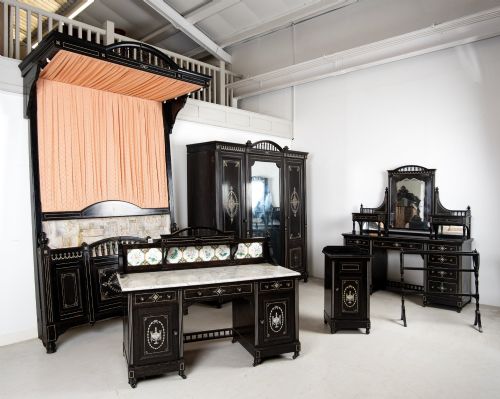
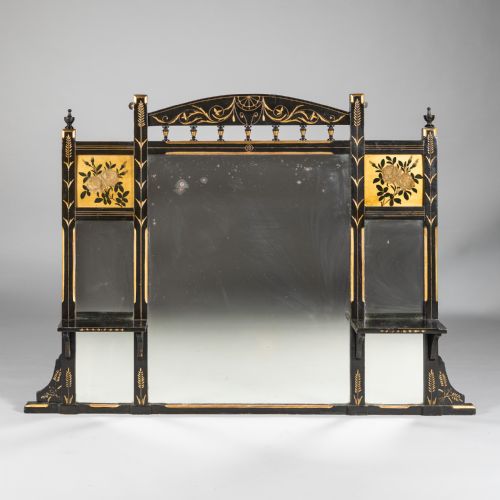
An ebonised aesthetic movement mirror is typically a large overmantel or wall hanging piece from the Victorian period, dating around eighteen eighty to eighteen ninety. These pieces reflect the tastes of the aesthetic movement through ebonised wood, often paired with parcel gilt or painted highlights.
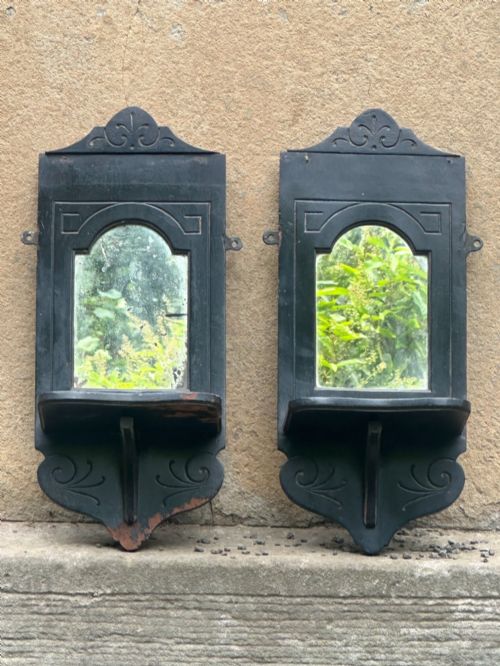
Beyond wall mirrors and overmantels, the broader selections include related cabinet pieces, girandoles, and hall stands sharing the same dark finish and stylistic vocabulary. The most common form on this page is the substantial overmantel mirror designed to anchor a Victorian fireplace.
The aesthetic movement rejected heavy Victorian ornamentation in favour of cleaner lines, japonisme influences, and contrasting finishes. An ebonised aesthetic movement mirror captures this philosophy by combining stark black surfaces with subtle gold leaf or silvered details.
How they were made
Cabinetmakers constructed these frames using timber such as mahogany or walnut, treated to achieve a dense ebonised finish that mimicked costly ebony. Artisans applied gold leaf, paint, or parcel gilding to accentuate carved details, mouldings, and incised linear patterns.
Mirror glass was set into these dark frames, sometimes accompanied by brass fittings or bone inlay depending on the specific piece. The combination of reflective glass and deep ebonised wood created the strong visual contrasts characteristic of the period.
Listings here span the Victorian period around 1880 to 1890, featuring ebonised wood, gold leaf, and mirror glass.
What varies in quality
Quality in these pieces rests upon the crispness of the ebonised finish, the integrity of the underlying timber, and the subtlety of the gilt or painted highlights. Superior examples display careful joinery and well-preserved surface decoration that has survived the Victorian era without heavy intervention.
The scale and ambition of the frame also set finer pieces apart, particularly in large overmantels where proportion and architectural balance dictate the overall visual impact. Original mirror glass with appropriate ageing adds to the character and authenticity of the piece.
Cottier & Co.·Garnett & Sons·Gillows
The Ebonised Aesthetic Movement Mirror Glossary
- Ebonised wood
- Timber stained or painted to resemble ebony, a technique widely utilised in the nineteenth century to achieve a sleek, dark surface.
- Parcel gilt
- A decorative method where only specific portions of an object are gilded with gold leaf, creating contrast against the dark ebonised background.
- Overmantel mirror
- A large mirror specifically designed to hang or rest on the mantelpiece above a fireplace, often forming the visual centrepiece of a Victorian room.
- Girandole
- A branched wall-mounted bracket holding candles or lights, frequently paired with a mirror to reflect and amplify illumination.
- Aesthetic movement
- A late nineteenth-century design ethos prioritising visual beauty and artistic expression over strict moral or narrative utility.
Ebonised Aesthetic Movement Mirror: Frequently Asked Questions
Where should an overmantel mirror hang?
These mirrors were traditionally designed to sit directly upon a mantelpiece or hang securely on the wall just above a fireplace. Their generous proportions allow them to reflect light and anchor the surrounding room.
In a modern interior, they work equally well above a low sideboard or as a focal point in a hallway, provided the wall structure can support the weight.
How do I care for ebonised wood?
Ebonised surfaces require gentle dusting with a soft, dry cloth to prevent the accumulation of grit. Avoid harsh chemical cleaners or excessive moisture, which can damage the dark finish and any underlying gilt.
Applying a suitable microcrystalline wax occasionally will help protect the timber and maintain a soft, natural lustre without clouding the surface.
Are these mirrors original to the nineteenth century?
The pieces recorded here date from the Victorian era, specifically around eighteen eighty to eighteen ninety, capturing the height of the aesthetic movement. Makers utilised traditional joinery and finishing techniques appropriate to that period.
Examining the construction methods, backboards, and the ageing of the glass helps confirm the nineteenth-century origin of each individual frame.
What is parcel gilding?
Parcel gilding involves applying thin leaf gold to selected raised portions, carvings, or incised lines on an otherwise dark object. This technique highlights specific details of the design rather than covering the entire piece in gold.
On these mirrors, the gold catches the light against the dense ebonised wood, creating the characteristic contrast of the aesthetic style.