
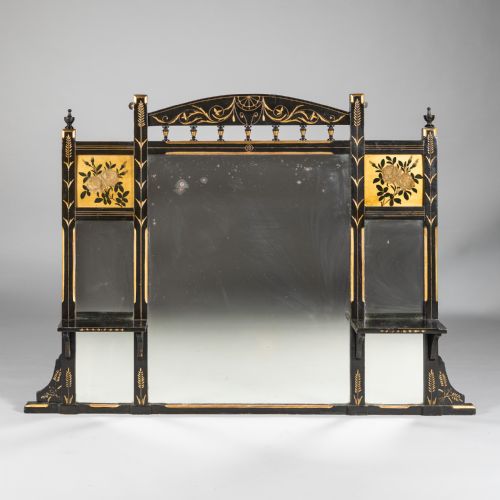


Victorian Black Fireplace Mirror
These heavy, dark overmantel mirrors anchor a room with nineteenth-century proportion and presence.
Victorian Black Fireplace Mirror
A victorian black fireplace mirror is typically a large overmantel glass designed to sit directly above a hearth, reflecting light across the room. You will most frequently meet wide ebonised wood frames finished with parcel-gilt details, originating from the mid to late nineteenth century.
The styles range from the structured geometry of the Aesthetic Movement to early Victorian gesso frames and heavier architectural designs. Most examples function primarily as overmantel mirrors, though occasional wall mirror variants appear among the nineteenth-century stock.
Materials and construction
Makers built these frames using solid wood, applying gesso to create raised mouldings and decorative motifs before finishing the surface with dark paint or ebonising. Gold leaf and parcel-gilt highlights were then added selectively to catch the light against the black ground.
The heavy mirror glass is set within large architectural surrounds, sometimes incorporating cast iron elements or carved wooden details. These substantial pieces relied on robust joinery to support the weight of the wide glass plates over fireplace openings.
One remarkably heavy example includes cast iron construction, proving that Victorian makers built these frames to survive just about anything.
Assessing quality and finish
The distinction between standard production and the finest examples lies in the depth of the gesso carving and the crispness of the parcel-gilt highlights. Superior pieces display harmonious proportions across very large frames, integrating painted surfaces with meticulous gilding.
The treatment of the ebonised finish and the preservation of the original mirror glass significantly influence the character of the piece. Simpler designs rely entirely on clean lines and balanced scale, while ornate versions depend on the precision of their applied decorative ornament.
The Victorian Black Fireplace Mirror Glossary
- Ebonised wood
- Timber treated with a dark stain or finish to imitate expensive ebony. This dark surface forms the primary visual base for nineteenth-century decorative frames.
- Parcel-gilt
- Partially gilded woodwork where gold leaf highlights specific carved details or mouldings against a dark background. It creates a striking contrast across large overmantel frames.
- Gesso
- A plaster-like mixture applied to wood frames and carved into relief ornamentation before gilding or painting. It allows for intricate surface decoration on antique mirrors.
- Overmantel mirror
- A large horizontal looking glass specifically scaled to hang on the wall directly above a fireplace mantel. These pieces dominate the chimney breast in period interiors.
- Aesthetic Movement
- A late nineteenth-century design style emphasising visual beauty and artistic reform over heavy historicism. Frames from this period often feature clean ebonised surfaces with restrained gilt detailing.
Victorian Black Fireplace Mirror: Frequently Asked Questions
Where should I hang an overmantel mirror?
These mirrors were originally designed to sit centrally on the chimney breast directly above a fireplace mantel, where they reflect natural light from windows opposite.
Because of their substantial weight and scale, they require secure fixing directly into solid wall studs or masonry to support the heavy wooden frames safely.
How do I clean an antique mirror glass?
Use a soft, dry cloth to gently remove dust from the glass surface and the delicate ebonised or gilded wooden frame without applying harsh chemical cleaning solutions.
Avoid spraying liquids directly onto the mirror plate, as moisture can seep behind the silvering and cause dark spots or degradation at the edges.
Are all black Victorian mirrors Aesthetic Movement?
While many ebonised examples date from the Aesthetic Movement of the late nineteenth century, earlier Victorian frames also utilised black finishes alongside traditional gesso and gilt work.
Stylistic details such as incised decoration or architectural mouldings help distinguish between the different decades of the nineteenth century.
What is the difference between a wall mirror and an overmantel?
Overmantel mirrors are proportioned specifically to span the width of a fireplace, featuring wide horizontal dimensions designed to anchor the chimney breast.
General wall mirrors from the same period often follow vertical formats or smaller dimensions intended for standard wall placement rather than hearth settings.