




Earthy Oil Artwork
Earthy oil artwork brings the quiet tones of rural landscapes and livestock into a room through rich brushwork.
Earthy Oil Artwork
Earthy oil artwork encompasses traditional oil paintings focused on British and European landscapes, farmyards, and pastoral scenes. These pieces capture quiet rural moments, often depicting sheep, cattle, horses, or rustic buildings set against natural backdrops.
The selections available here span from the nineteenth century through the mid twentieth century, drawing from distinct regional movements. Works range from Scottish Highland views to Yorkshire farmyards and French provincial scenes.
Buyers seeking this phrase typically encounter framed canvases and wood panels populated by subdued natural palettes. The subjects lean heavily toward open fields, woodland streams, and agricultural daily life.
Materials and Construction
These works rely fundamentally on oil paint applied to prepared canvas or wood panel supports. The medium allows for thick impasto texture or thin, blended glazes that build up muted greens, browns, and ochres.
Many pieces retain their original wood panel backing or stretcher frames, occasionally bearing artist inscriptions, studio sale provenance, or period gilt framing.
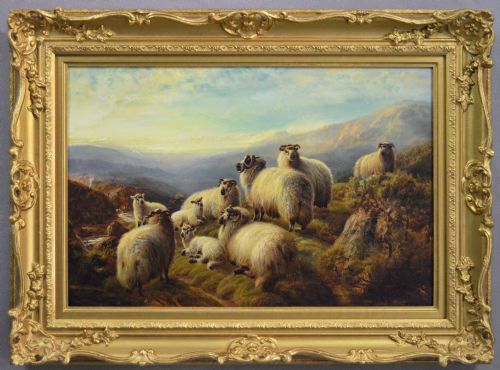
Several canvases faithfully record the stubborn expressions of Highland sheep resting by rivers.
Judging Quality
Quality rests in the handling of light, shadow, and atmosphere within the naturalistic subject matter. Superior examples demonstrate confident, expressive brushwork that gives texture to foliage, water, and animal forms without losing structural clarity.
The strength of the composition and the subtlety of the colour harmony distinguish accomplished regional artists from routine decorative studio output.
William H Myers·Tom Campbell·John Hodgson Lobley·Raimond Louis Lecourt·Herbert Royle·William JB Jenkins·Reginald Grange Brundrit·Vincenzo Irolli·Majorie Hoare·John Frederick Herring·Robert Finley McIntyre·Thomas Creswick·Owen Bowen·William Traies·Ernest Higgins Rigg·J L VAN Leemputten·Frederick William Jackson·Kershaw Schofield·Alois Arnegger·George F Wetherbee·William Greaves·T B Garvie
The Earthy Oil Artwork Glossary
- Canvas
- A heavy woven fabric stretched across a wooden frame to serve as a painting surface. It provides a slightly flexible texture that holds layered oil paint well.
- Wood Panel
- A rigid flat wooden support used instead of canvas for painting. Panels offer a firm surface that preserves fine detail and withstands decades of handling.
- Impasto
- Paint applied thickly to a canvas or panel so that it stands proud of the surface. This technique leaves visible brush or palette knife marks that catch the light.
- Stretcher
- The wooden framework that holds a painted canvas taut. Inscriptions or signatures written directly onto these wooden bars often provide vital provenance.
- Gilt
- A thin layer of gold leaf or metallic gold-coloured paint applied to surface decoration. Frames finished in gilt frequently accompany period oil paintings to complement their tones.
Earthy Oil Artwork: Frequently Asked Questions
What subjects appear in earthy oil artwork?
These paintings focus primarily on rural subjects, including pastoral landscapes, farmyards, and livestock such as sheep, cattle, and working horses. Scenes often incorporate rivers, woodland paths, and country villages.
Settings frequently draw from regional British and French countryside views, capturing agricultural life and natural terrain from past centuries.
How do I care for an antique oil painting?
Keep the canvas or panel away from direct sunlight and fluctuating humidity to prevent the oil paint from cracking or warping. Dust the surface gently with a soft, dry brush without applying pressure.
Avoid using water or chemical cleaners on the paint surface or gilt frame. Professional conservators should handle deeper cleaning or repairs.
How can I tell the period of an oil painting?
Examine the materials, including the type of canvas weave, stretcher construction, and wood panel preparation. Artist signatures, inscriptions on the reverse, and framing styles offer further chronological clues.
Stylistic markers such as brushwork techniques and subject matter conventions align with specific regional schools active across the nineteenth and early twentieth centuries.
Where were these landscape paintings created?
Many pieces originate from regional British art movements, capturing specific locales in Yorkshire, Cumberland, and Scotland. Other examples reflect continental European landscapes from France and beyond.
Artists often painted directly in the countryside, recording local farms, riversides, and rural communities on location.