


Earthenware Mantel Dogs
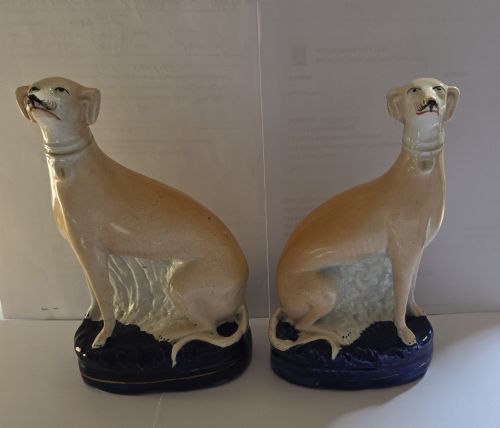
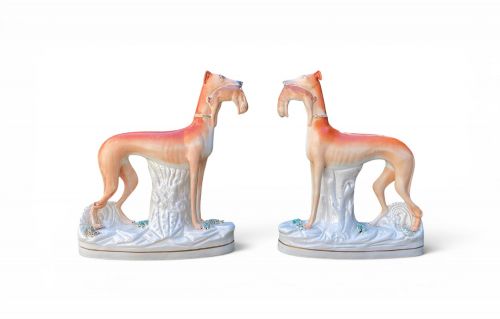
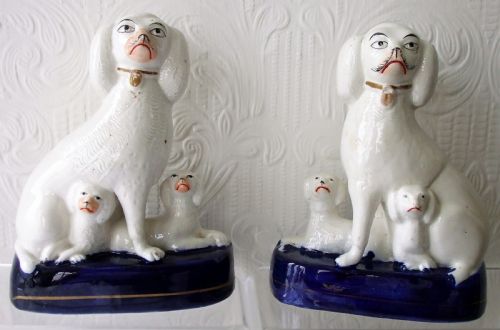
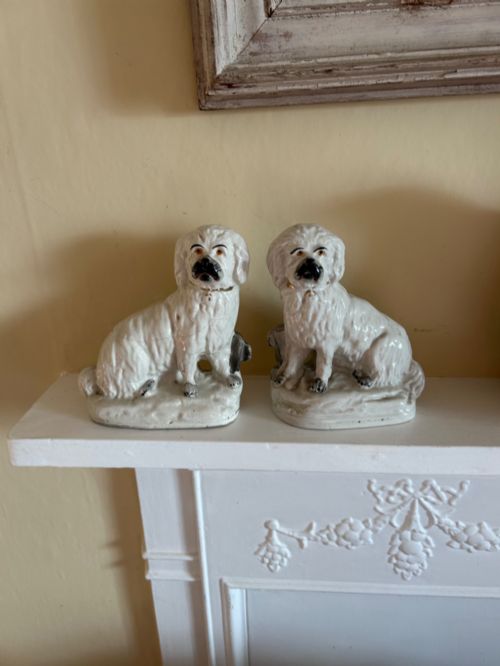
These earthenware mantel dogs are Victorian ceramic figures of spaniels, greyhounds, and poodles made to sit on hearths and mantelpieces.
Earthenware Mantel Dogs
When you search for earthenware mantel dogs, you encounter nineteenth-century ceramic figures modelled as spaniels, greyhounds, poodles, whippets, pugs, and maltese terriers. These pottery figures span periods from the mid-nineteenth century up to nineteen hundred, with Victorian examples dominating the selection.
The objects take various forms including seated pairs, figures with puppies, spill vases, clock groups, and hunting dogs with hares. Most appear as matched pairs intended to sit symmetrically on a mantelpiece or shelf.
Originating largely from English traditional and Victorian country pottery traditions, these ornaments capture the Victorian fondness for domestic animal subjects. Collectors find them in configurations ranging from miniature poodles to grand spaniels.
Judging Quality
The application of glaze and gilding also dictates the standard of a piece. Evenly fired lead glazes and carefully placed gold leaf or gilt highlights indicate superior Staffordshire pottery craftsmanship.
The documented periods span from eighteen fifty through to nineteen hundred, with heavy representation from eighteen sixty and eighteen eighty.
Thomas Parr·Beswick
The Earthenware Mantel Dogs Glossary
- Earthenware
- Porous pottery fired at lower temperatures and glazed to hold liquid and display enamel decoration. This material forms the base of all nineteenth-century mantel dogs.
- Lead glaze
- A glossy coating containing lead oxide applied to ceramic bodies before firing. It provides a smooth, shiny surface characteristic of Victorian figures.
- Spill vase
- A hollow cylindrical holder attached to a ceramic figure designed to hold wooden spills for lighting fires. These functional elements appear alongside the seated animal figures.
- Copper lustre
- A metallic pottery glaze containing copper that produces a reflective, coppery sheen. This finish marks specific variations in Staffordshire dog decoration.
- Staffordshire pottery
- Earthenware produced by potteries in the Staffordshire region of England. The designation covers the vast majority of nineteenth-century animal figures found on mantelpieces.
Earthenware Mantel Dogs: Frequently Asked Questions
What are earthenware mantel dogs?
These pieces are nineteenth-century ceramic figurines modelled as dogs, most commonly spaniels, greyhounds, and poodles. They were produced primarily in Staffordshire as decorative ornaments for the home.
Potters shaped them from earthenware, fired them, and finished them with lead glaze and hand-painted enamel colours or gilt highlights.
How were mantel dogs used?
Victorian households placed these figures in pairs on mantelpieces above fireplaces, often facing inward toward each other. They served purely as decorative ornaments reflecting domestic tastes of the period.
Some specialised variants included hollow backs, spill vases for holding wooden fire lighters, or incorporated clock groups and musician figures.
How do I date an antique dog?
Dating relies on stylistic clues, modelling characteristics, and glaze types seen across mid-to-late nineteenth-century pieces. Examples span from about eighteen fifty through to nineteen hundred.
Earlier pieces often feature simpler modelling and distinct enamel palettes, while later Victorian and turn-of-the-century items show different proportions and manufacturing marks.
Which dog breeds are available?
The selection encompasses a range of canine breeds popular in the Victorian era. Spaniels and greyhounds appear most frequently, alongside poodles, whippets, pugs, and maltese terriers.
These represent both hunting dogs and domestic pets, sometimes modelled alongside puppies, hares, or decorative accessories.