
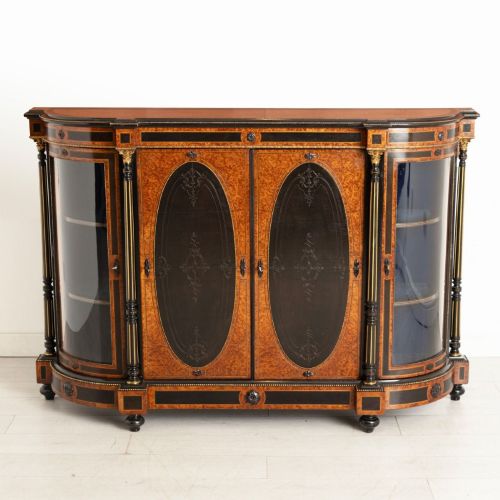
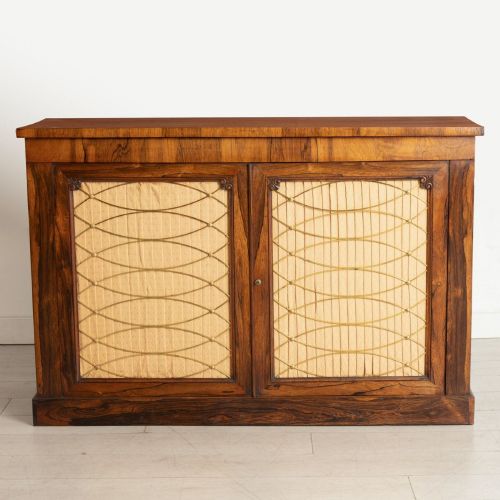
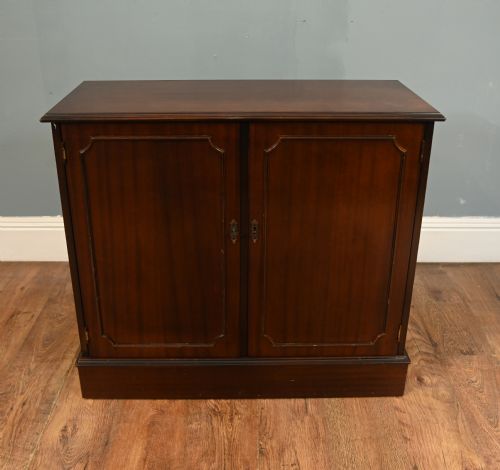


Early Victorian Side Cabinet
An early victorian side cabinet offers refined storage for the home, combining domestic utility with the rich timbers of the mid-nineteenth century.
Early Victorian Side Cabinet
The search phrase early victorian side cabinet covers a practical yet decorative category of nineteenth-century furniture designed for living spaces and bedrooms. Buyers frequently encounter low cupboards, chiffoniers, and compact bedside cabinets originating from this period.
The evidence shows forms ranging from diminutive single-door cupboards and two-door side cabinets to open bookcases and marble-topped rosewood pieces. These items served distinct purposes in period rooms, often holding books, linens, or glassware.
Mahogany and rosewood dominate the surviving pieces, accompanied by occasional examples in burr walnut, gonçalo alves, and amboyna. Most date from around eighteen-forty to eighteen-fifty, bridging late regency tastes and full Victorian design.
How they were made
Cabinet makers utilised dense tropical hardwoods such as mahogany and rosewood, often applying flame veneers to flat surfaces to create striking grain patterns. Finer examples incorporate exotic timbers like amboyna and gonçalo alves for contrasting banding and panels.
Construction techniques relied on solid carcases with well-fitted panelled doors, brass hardware, and occasionally marble tops. Interiors commonly feature simple shelving or drawers, assembled with traditional joinery suited to domestic furniture.
Marble-topped surfaces appear almost exclusively on pieces constructed from rosewood rather than mahogany.
What varies in quality
Quality rests upon the choice of timber and the precision of the cabinet work, particularly in the selection of figured veneers. Superior examples display balanced grain matching across doors and drawers, alongside refined mouldings and original brass mounts.
The presence of secondary timbers, the crispness of carved details, and the integration of specialist materials like white marble or fine inlay distinguish workshops of higher standing from standard utility pieces.
Holland & Sons·Burrey & White
The Early Victorian Side Cabinet Glossary
- Chiffonier
- A low sideboard or cabinet featuring a shelf supported by pillars above the main body. This form frequently includes enclosed storage beneath.
- Gonçalo alves
- A dense exotic hardwood with distinctive figuring, often utilised for decorative banding or feature panels. It provides a rich brown tone with dark contrasting streaks.
- Flame mahogany
- A veneer cut from timber where the grain branches, creating a flickering flame-like pattern. Makers selected this for prominent drawer fronts and door panels.
- Pedestal cupboard
- A single-door upright cabinet designed to stand beside a bed or in a corner. These pieces often feature a panelled door and a plinth base.
Early Victorian Side Cabinet: Frequently Asked Questions
What is an early victorian side cabinet used for?
These cabinets provide compact storage surfaces for living rooms, hallways, and bedrooms. In nineteenth-century interiors, they held books, tableware, or bedside essentials.
Today, they serve equally well as lamp tables, media storage units, or decorative accent pieces in contemporary spaces.
How do I distinguish mahogany from rosewood?
Mahogany generally displays a warm reddish-brown tone with a straight or ribbon-like grain pattern. It forms the basis of most standard domestic cabinets.
Rosewood offers a heavier weight and a deeper, darker brown colour marked by distinctive black grain figuring and natural oily lustre.
Are marble tops original to these cabinets?
Marble tops appear frequently on rosewood side cabinets and chiffoniers from the mid-nineteenth century. They provided a durable, water-resistant surface for serving drinks or displaying ornaments.
When fitted cleanly within the wooden moulding, the marble top forms an authentic part of the piece's original design.
What distinguishes a chiffonier from a standard cabinet?
A chiffonier incorporates a raised superstructure with one or two small shelves mounted on turned pillars above the main enclosed body. Standard side cabinets omit this upper tier entirely, offering a flat top surface instead.
Both forms belong to the broader family of low nineteenth-century storage furniture.