

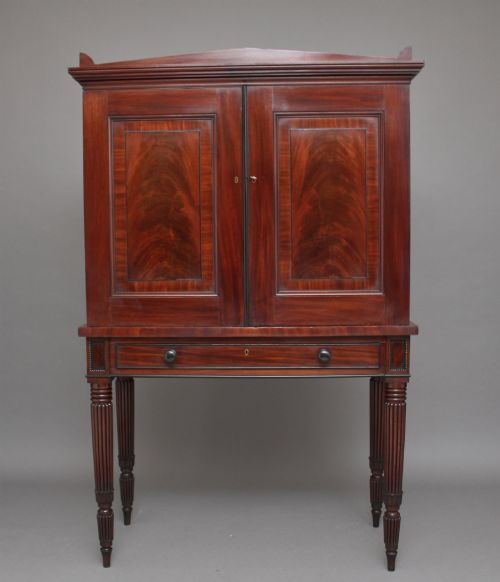

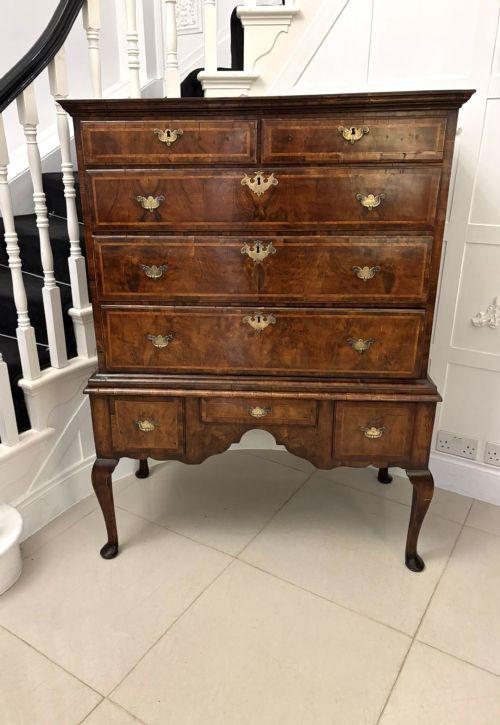
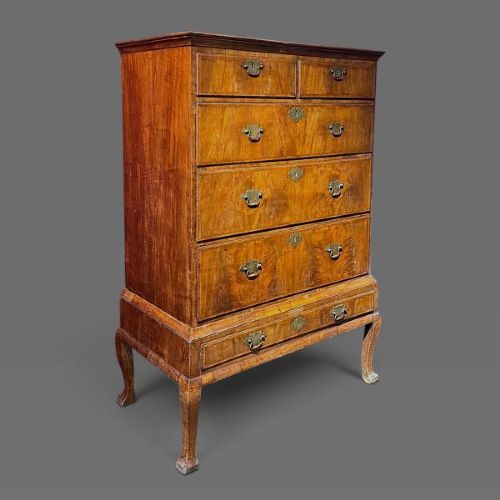
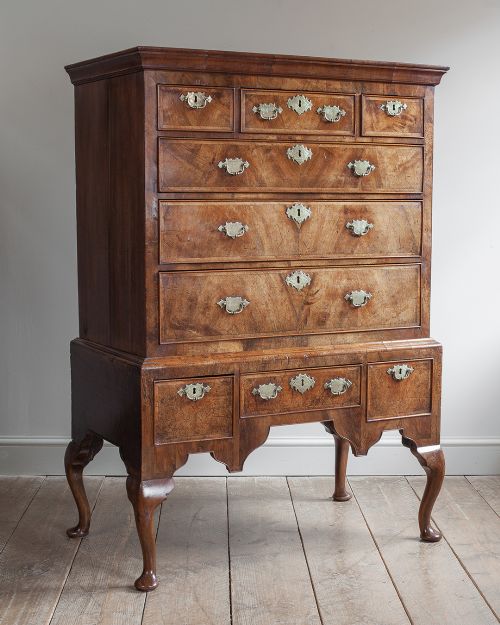
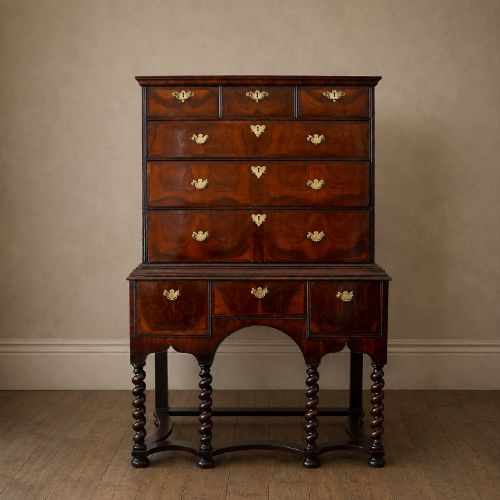




Early Georgian Chest on Stand
An early georgian chest on stand is a raised cabinet piece offering tiered drawer storage atop a supportive frame, prized for interior presence.
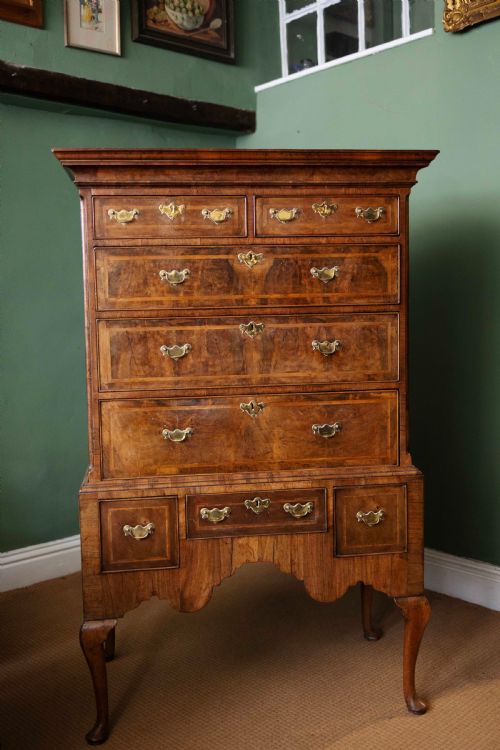
Early Georgian Chest on Stand
The early georgian chest on stand bridges the domestic need for segmented storage and the stylistic shift toward raised furniture forms. Buyers seeking an early georgian chest on stand encounter two distinct functional layers, uniting an upper section of stacked drawers with a lower stand typically fitted with cabriole legs or short supports.
Most examples appearing in trade date from the eighteenth century, spanning the reigns of Queen Anne and George I alongside later revivals. Common iterations employ oak or walnut timbers, often arranged in multi-drawer configurations that elevate the storage compartment well above floor level.
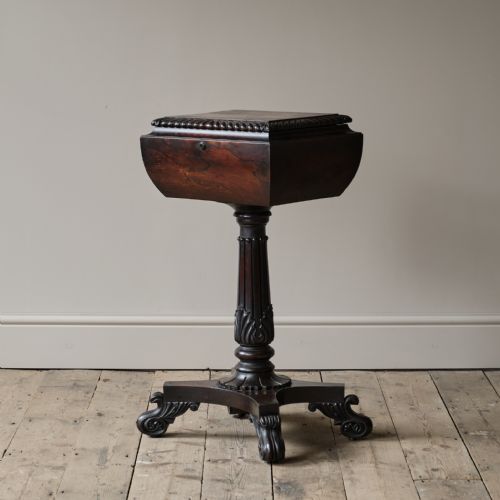
Beyond standard drawer chests, related forms include specialised cabinets, medal cabinets on stands, and teapoys from the nineteenth century. These variations maintain the fundamental architectural principle of a primary container raised upon an independent structural base.
Materials and construction methods
Construction relies heavily on native English hardwoods such as oak and walnut, frequently enhanced by figured burr veneers and intricate banding. Cabinetmakers utilised solid timber frames and panelled drawer linings, applying polished finishes that highlighted the natural grain patterns of the wood.
Decorative surfaces incorporated specialised treatments, including japanned lacquer work and applied gold leaf details on select Chinoiserie pieces. Brass drop handles and escutcheons secured to drawer fronts provided both functional operation and visual contrast against the dark timber ground.
Lower stands utilised sturdy joinery techniques to support the heavy upper chest, employing shaped aprons and cabriole legs terminating in pad or scroll feet. The intersection between upper and lower carcasses demanded precise carpentry to ensure stability without sacrificing the slender profile characteristic of the period.
Early Georgian Chest on Stand Retail Price Guide 2026
Typical asking prices for early georgian chest on stand among the pieces listed under this phrase on Sellingantiques today, from the lower quarter to the upper quarter. They describe what is for sale here now, not the wider market.
Some miniature cabinets on stands were originally built as master furniture makers' intricate scale models to demonstrate trade skills to prospective patrons.
Distinctions in quality and execution
Quality manifests in the selection of primary timbers and the precision of veneer matching across drawer fronts. Superior examples display carefully chosen burr walnut or banded oak grains that flow continuously across the facade, whereas lesser pieces utilise random planking with minimal grain alignment.
The sophistication of the lower stand significantly dictates the overall calibre of the piece. Stands featuring crisply carved cabriole legs and well-proportioned arches demonstrate a higher standard of craftsmanship than plain, unadorned structural frames.
Hardware integrity and interior joinery further separate ordinary items from exceptional survivors. Original brass furniture, clean dovetail construction, and undisturbed secondary softwood linings indicate careful maintenance and high-grade original workshop production.
The Early Georgian Chest on Stand Glossary
- Chest on stand
- A two-part furniture form comprising an upper drawer section resting upon an open-frame support base. This configuration lifts the primary storage compartment for easier access.
- Cabriole leg
- A furniture support that curves outward at the knee and tapers inward toward the foot. The profile imitates the natural bend of an animal's leg.
- Japanned
- A European imitation of East Asian lacquerwork produced by applying successive layers of varnish and metallic powder. Artisans often decorated these surfaces with raised Chinoiserie motifs.
- Burr walnut
- Timber harvested from walnut tree growths, featuring swirling, mottled grain patterns. Cabinetmakers sliced this wood into thin veneers for decorative drawer fronts.
- Teapoy
- A small storage box mounted on a central pillar or stand, originally designed to hold tea leaves. Nineteenth-century variants often incorporate sarcophagus shapes.
Early Georgian Chest on Stand: Frequently Asked Questions
What is an early georgian chest on stand?
An early georgian chest on stand is a dual-component storage item featuring a drawer cabinet raised on a separate supportive base. These pieces combine domestic utility with formal eighteenth-century design.
They typically stand on cabriole legs and serve as prominent focal points within traditional interior schemes.
How were these cabinets used?
These furnishings functioned primarily for storing valuable textiles, documents, or personal items within upper drawers while elevating the contents above damp floor levels. The elevated height also facilitated easier standing access.
Specialised variants accommodated small collections, tea caddies, or medals rather than general clothing.
How do I identify a George I period piece?
George I examples generally feature walnut or oak construction, often displaying figured veneers, cross-banding, and polished brass hardware. The presence of cabriole legs and shaped aprons points directly to early eighteenth-century styling.
Construction methods such as hand-cut dovetails and native timber secondary woods help confirm the era of manufacture.
Where should I place a chest on stand at home?
These pieces suit entrance halls, living rooms, or bedrooms where their vertical proportions and decorative stands remain fully visible. Positioning them away from direct sunlight and heat sources protects fragile walnut and lacquer surfaces.
Their compact footprints allow them to occupy wall spaces that cannot accommodate wider chest designs.