


Dutch Winter Scene Painting
A dutch winter scene painting brings cold canals, frozen rivers and snow-covered villages into a room with remarkable atmosphere.
Dutch Winter Scene Painting
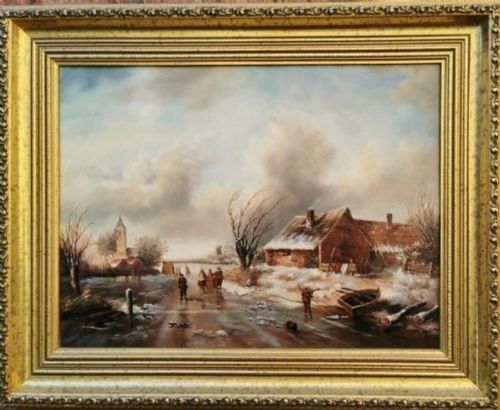
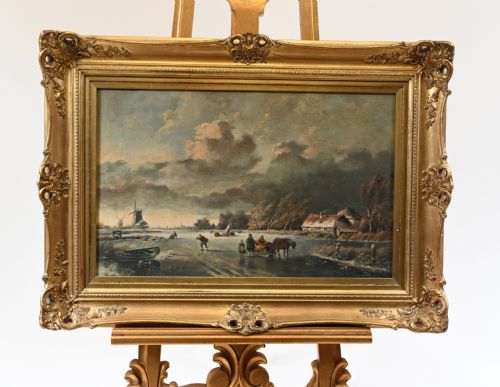
A dutch winter scene painting captures the chill of frozen waterways, frosted cottages and figures skating beneath pale skies. These works range from intimate nineteenth century views to mid twentieth century interpretations.
The composition frequently centres on a frozen river or canal, where skaters, villagers collecting firewood and distant townscapes establish a narrative of daily life in colder months. Such works bring a quiet, atmospheric stillness to an interior.
Examples on this page span the nineteenth century and the twentieth century, employing traditional landscape conventions that echo the Dutch Golden Age style as well as nineteenth century romanticism and the Hague school.
Materials and methods
Artists built these scenes using oil paint applied to canvas or wood panels, sometimes employing gouache on paper for specific luminous qualities. The medium allowed rich layering to depict thick snow and reflective ice.
Frames of gilt or giltwood frequently enclose the canvas, adding warmth and definition to the cool palette of whites, greys and muted blues characteristic of winter landscapes.
Distinguishing quality
Quality rests in the handling of light across snow and ice, where subtle tonal shifts create depth rather than flat white expanses. A stronger painting reveals confident brushwork that defines figures and architecture with economy and precision.
The inclusion of named artists or signed works introduces greater documentary interest, while the atmospheric control over pale winter sunlight marks the difference between standard decorative works and finer examples.
T Bergman·Pieter Cornelis Steenhouwer·Ludwig Hermann·Louis Smets·Anthonij Anton Mauve·Kuypers
The Dutch Winter Scene Painting Glossary
- Dutch School
- A term describing artists working in the manner or tradition of the Netherlands, known for observational landscape and genre painting. It encompasses various centuries of regional artistic development.
- Hague School
- A group of artists working in The Hague during the second half of the nineteenth century who painted in a realistic, often tonal style. They drew inspiration from the natural landscape and everyday rural life.
- Giltwood
- Wood carved and coated with gold leaf or a gold-coloured metallic finish to frame a painting. This traditional framing technique enhances the visual weight and period character of the artwork.
- Panel
- A solid support of wood used instead of canvas for painting. Panels offer a rigid surface that influenced how artists applied fine details in earlier and traditional works.
Dutch Winter Scene Painting: Frequently Asked Questions
What periods do these paintings come from?
The works span from the nineteenth century through to the mid twentieth century, including pieces dated around eighteen seventy, nineteen hundred, and nineteen fifty.
They reflect evolving traditions such as nineteenth century romanticism and the Hague school alongside retrospective Dutch Golden Age styles.
What surfaces were used for these paintings?
Artists painted primarily on canvas and wood panels, with occasional examples executed in gouache on paper.
These traditional supports were chosen for their stability and texture, which suited the application of oil paint.
How should I display a winter landscape?
These paintings suit rooms with traditional or neutral decor where the cool tones of snow and ice can provide a striking focal point.
Matching the work with an appropriate gilt frame helps integrate the piece into wall spaces alongside other historic artworks.
What subjects typically appear in these scenes?
Common subjects include frozen rivers with figures skating, snowy village quays, cottages with figures collecting firewood, and distant castles.
These narrative elements depict historic rural life during harsh European winters.