
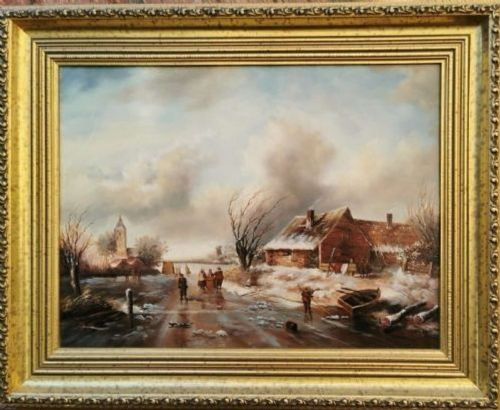


Dutch Canal Landscape Painting
A dutch canal landscape painting brings the stillness of frozen waterways and historic cities straight into your room.
Dutch Canal Landscape Painting
When you search for a dutch canal landscape painting, you encounter works that capture European waterways, windmills, and freezing winter scenes. These pieces frequently emerge from the nineteenth century, the Victorian era, and mid-century movements, drawing on traditions like the Dutch School and Impressionism.
The most common examples on this page are oil paintings on canvas and wood panel, alongside occasional watercolours. Subjects range from imaginary waterways in the Dutch Manner to specific locations such as Rotterdam and Venice.
Makers and artists represented include figures like William Raymond Dommersen and William Dommersen, alongside pieces attributed to the Flemish School and the nineteenth-century Dutch School. Works span from unsigned studies to named impressions from the nineteen-fifties.
How they were made
Painters built these works using oil paint applied to canvas or wood panels, sometimes mounting them with gesso and giltwood frames. The technique relies on layered brushwork to capture the reflective quality of water and the flat expanse of skies.
Frames often feature gilt ornamentation that complements the warm tones of the oils, while board supports appear in specific impressionist examples from the early twentieth century.
Keep an eye out for hidden barges drifting down frozen canals when you inspect the winter scenes.
What varies in quality
Quality separates through the sureness of the brushwork and the handling of light across the canal surface. Stronger examples demonstrate confident spatial depth in the rendering of buildings, barges, and frozen banks.
Attribution also plays a role, moving from unsigned student copies and generic school pieces up to signed works by known nineteenth-century painters.
William Raymond Dommersen·William Dommersen·Jan van Couver
The Dutch Canal Landscape Painting Glossary
- Dutch School
- A stylistic classification reflecting the artistic traditions and subject matter originating in the Netherlands. It often emphasises naturalistic lighting and atmospheric landscapes.
- Giltwood
- Wood that has been coated with a thin layer of gold leaf or gilt. This material is frequently found on the decorative frames housing these paintings.
- Impressionism
- A nineteenth-century movement characterised by relatively small, thin, yet visible brush strokes and an emphasis on accurate depiction of light. Mid-century variants continue this approach.
- Oudehoofpoort
- A specific geographic landmark in Rotterdam, often appearing as a named subject in nineteenth-century topographical works.
Dutch Canal Landscape Painting: Frequently Asked Questions
What periods do these paintings come from?
The available selection spans from the nineteenth century through the Victorian period and into mid-century twentieth-century works.
Dates range from specific years like eighteen-eighty up to nineteen-sixty, encompassing both traditional realism and impressionist interpretations.
Are all the paintings on canvas?
While canvas is common, works also appear on wood panels and board.
Support materials vary according to the date and style of the piece, with some mid-century examples utilising board.
How do I identify a winter landscape?
Winter scenes typically depict frozen canals, snow-covered banks, and skaters under muted grey skies.
These compositions often align with the Dutch Manner style associated with cold-weather European waterways.
Who painted these works?
Makers include named nineteenth-century artists such as William Dommersen and Jan van Couver.
Other pieces are attributed more broadly to the Dutch School, Flemish School, or remain unsigned.