
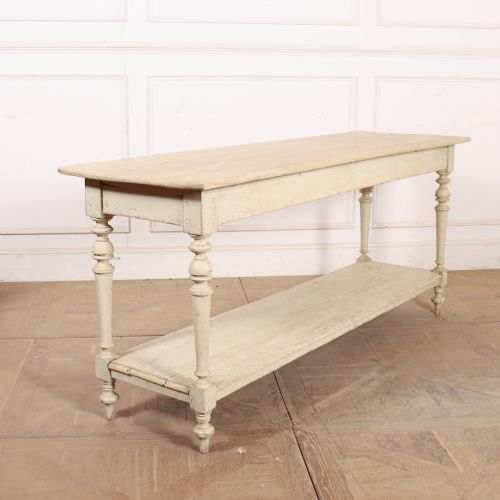
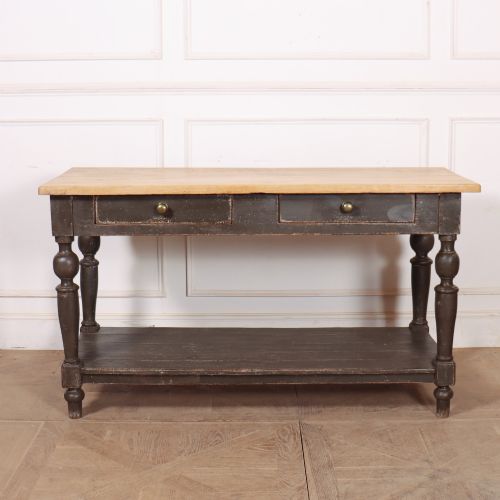


Drapers Shop Counter
These drapers shop counter pieces are utilitarian fixtures of nineteenth and early twentieth century commerce that now serve as generous statement islands in modern homes.
Drapers Shop Counter
When you search for a drapers shop counter, you are looking at substantial commercial furniture designed for displaying and selling textiles in nineteenth and early twentieth century mercantile spaces. The selection ranges from monumental French oak and pine drapers tables to compact English mahogany counters, haberdashery cabinets, and multi-drawer storage units.
How They Were Made
These fixtures rely on robust timbers such as oak, mahogany, and pine to withstand heavy daily use in busy retail environments. Workshops utilised solid planks for expansive table tops, often paired with banks of dovetailed drawers and brass or cast iron hardware.
Surfaces frequently show layers of historical paint, French polishing, or later bleaching to lighten the dense woods. Structural additions like adjustable feet appear on later Victorian variants to accommodate uneven shop floors.
Several counters retain adjustable iron feet designed to level furniture on nineteenth century timber shop floors that had slowly sagged over decades.
What Varies in Quality
The distinction between standard commercial joinery and superior items lies in the choice of timber and the complexity of the storage configuration. Pieces featuring extensive banks of working drawers with original brass pulls command greater attention than simple open tables.
Proportion and scale dictate desirability, moving from standard domestic dimensions to monumental lengths exceeding four metres. The integrity of the original timber surface, whether authentic painted softwood or patinated bleached oak, defines the character of each individual counter.
The Drapers Shop Counter Glossary
- Haberdashery cabinet
- A specialised storage unit containing numerous shallow drawers designed to organise small sewing notions, ribbons, and fastenings. These cabinets often incorporate glass panels to display wares to prospective customers.
- Bleached oak
- Timber that has been chemically or physically treated to remove its dark original finish, resulting in a pale, dry surface. This finish is particularly common on French commercial furniture originating from the nineteenth century.
- Console table
- A long, narrow table style frequently associated with drapers tables adapted for domestic hallways or living spaces. They provide significant surface area while occupying minimal floor depth.
- Cast iron
- A strong, rigid metal alloy utilised for the structural framework or decorative brackets of display stands and counter supports. It provides industrial stability beneath heavy wooden tops.
Drapers Shop Counter: Frequently Asked Questions
How were drapers counters used?
Merchants utilised these long tables and drawer banks to measure, cut, and wrap fabrics for customers in nineteenth century shops.
The large top surfaces provided ample workspace for folding textiles, while the numerous small drawers kept ribbons, threads, and lace sorted and accessible.
What rooms suit a shop counter?
These substantial pieces function exceptionally well as kitchen islands, providing both expansive preparation space and deep storage drawers.
Alternatively, longer tables serve effectively as console surfaces in wide hallways or as statement desks within home studies.
How do I identify a French drapers table?
French examples typically feature lighter timbers such as pine or oak, often finished with a bleached or painted treatment rather than dark polish.
They frequently display simpler, more rustic lines influenced by provincial craftsmanship compared to formal English equivalents.
What is a haberdashery drawer unit?
These units consist of multiple stacked, shallow drawers engineered specifically to hold small dry goods and sewing accessories.
The numerous small handles and standardised drawer heights create a distinct modular aesthetic characteristic of Edwardian and interwar retail fittings.