



Doulton Lambeth Relief Ceramics
Doulton Lambeth relief ceramics are robust salt-glazed stoneware vessels that bring tactile Victorian craft and botanical ornament straight into a modern interior.
Doulton Lambeth Relief Ceramics
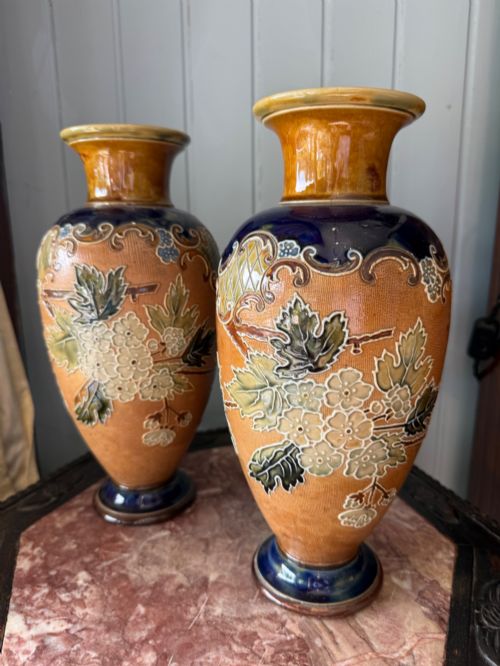
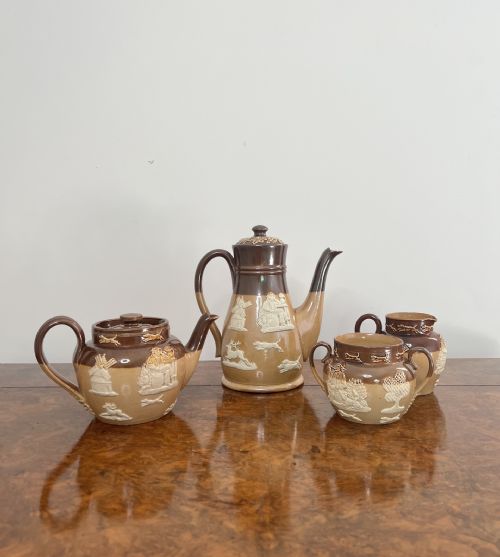
Doulton Lambeth relief ceramics comprise jugs, vases, candlesticks, and complete tea sets created during the Victorian era. The selection centres heavily on utilitarian and decorative vessels fashioned from durable stoneware bodies.
Most pieces date from the latter decades of the nineteenth century, spanning the 1870s through to the 1890s. Buyers will frequently encounter harvest jugs alongside floral or sporting motifs aligned with Arts and Crafts tastes.
Forms range from intimate single candlesticks and pitchers up to larger multi-piece tea sets and paired vases. These domestic and decorative items reflect the thriving studio pottery output of the London pottery.
Materials and methods of production
Production relies on dense clay bodies fired into robust stoneware capable of holding liquids or supporting heavy applied ornament. Artisans applied salt during the kiln firing to produce a distinctive pitted, lustrous glaze across the ceramic surface.
Relief decoration forms through moulded or sprigged details applied directly to the wet clay body before glazing. Certain vessels also incorporate functional metal additions such as silver rims fitted to the stoneware necks.
Sporting scenes on nineteenth-century jugs prove that Victorian potters enjoyed a proper cricket match just as much as a harvest festival.
Judging quality in stoneware
Quality rests upon the crispness of the moulded relief work and the depth of the salt glaze finish. Stronger examples display sharp definition in floral patterns or figural scenes without blurring across the ceramic contours.
Scale and complexity also dictate standing, with matched pairs, complete tea sets, and named decorator pieces commanding greater attention. The inclusion of hallmarked silver mounts adds another layer of refinement to domestic jugs.
Emma Shutes·Royal Doulton
The Doulton Lambeth Relief Ceramics Glossary
- Salt glaze
- A vitreous coating created by throwing common salt into the kiln during high-temperature firing, leaving an orange-peel texture on the stoneware.
- Stoneware
- A heavy, impermeable ceramic fired at high temperatures until the clay body vitrifies, making it distinct from porous earthenware.
- Sprigging
- A technique where separately moulded clay ornaments are applied in relief to the surface of an unfired vessel using slip as an adhesive.
- Harvest jug
- A traditional bulbous drinking vessel often decorated with rural scenes, hunting motifs, or festive inscriptions relating to agrarian life.
Doulton Lambeth Relief Ceramics: Frequently Asked Questions
How do I date Doulton Lambeth pieces?
Dating relies on stylistic clues like Art Nouveau motifs or Jubilee commemorations, alongside impressed factory stamps found on the stoneware base.
Most surviving examples date from the Victorian period between 1870 and 1890, matching the peak years of the Lambeth art pottery studios.
Are these ceramic jugs waterproof?
Yes, the dense stoneware body and vitrified salt glaze render these vessels entirely non-porous and suitable for holding liquids.
Original harvest jugs and pitchers were designed for functional domestic use as well as decorative display.
How should I clean salt-glazed stoneware?
Warm water and a soft cloth suffice for removing dust from the textured relief surface without risking the historic ceramic glaze.
Avoid harsh chemical detergents that might penetrate unglazed areas or tarnish any fitted silver rims.