
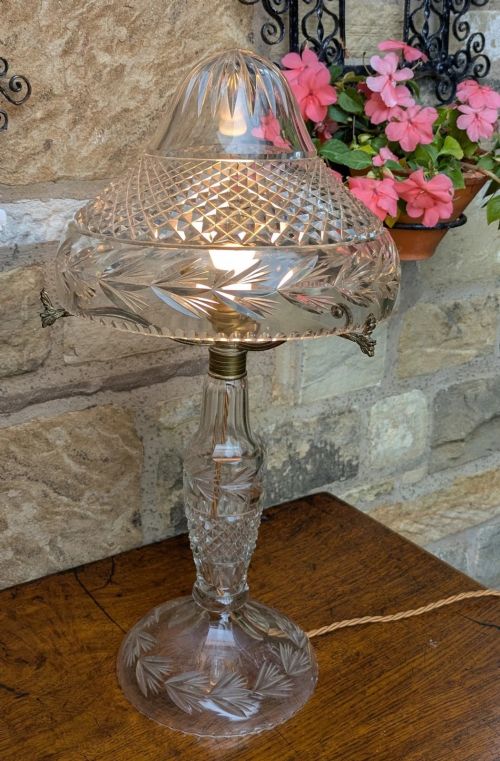


Dome Shade Table Light
These dome shade table light examples bring period character and focused illumination to a room, spanning Edwardian elegance to Art Deco geometry.
Dome Shade Table Light
When you search for a dome shade table light, you are looking at domestic illumination spanning the late nineteenth century through to the interwar decades. The selection here leans heavily towards early twentieth century production, embracing Edwardian refinement alongside later modernist experiments.
The dominant forms combine heavy bases in brass, bronze or cut glass with characteristic rounded shades that direct the illumination downward. You will encounter table lamps alongside versatile hybrid fixtures that bridge the gap between ceiling pendants and desk lighting.
Geographical origins range widely across British, European and North American workshops. Makers experimented freely with historical revivals alongside emerging industrial aesthetics during the 1920s and 1930s.
Materials and construction
Construction relies upon metals such as brass, bronze and chrome to form sturdy, weighted bases and structural framing. These metallic components are frequently cast, chased or mounted to provide a secure housing for electrical fittings.
Shades utilise cut glass, lead crystal, etched crystal, fabric or sheet metal to diffuse the light source. Glass elements demonstrate deep pressing or hand-cutting techniques that refract the bulb's glow across the room.
Materials across these listings include brass, fabric, glass, chrome, cut glass, bronze, lead crystal and metal.
What separates the finest examples
Quality rests upon the purity of the materials and the crispness of execution in the metalwork and glass. Heavy lead crystal and finely cast bronze denote a higher tier of manufacturing ambition than standard commercial alternatives.
Design integrity also dictates worth, as pieces aligned with specific movements like Jugendstil, Bauhaus or deliberate Neoclassical Revival display a more rigorous adherence to period style than generic contemporary copies.
Stuart Crystal
The Dome Shade Table Light Glossary
- Art Deco
- A design style characterised by sleek geometric shapes, streamlined forms and modern industrial materials popular during the 1920s and 1930s. It represents a sharp break from heavy Victorian ornamentation.
- Bauhaus
- A German school of design emphasising functionalism, clean lines and the union of art and industrial technology. Pieces from this influence prioritize unadorned utility.
- Jugendstil
- The continental European manifestation of Art Nouveau, featuring organic motifs and flowing vegetal lines. It predates the rigid geometry of later Deco designs.
- Lead crystal
- Glass containing metal oxide to increase weight, brilliance and refractive index. This material allows for deep, sharp hand-cutting.
- Neoclassical Revival
- A style drawing inspiration from classical Greek and Roman architecture and ornament. It frequently employs symmetrical bronze mounts and restrained classical motifs.
Dome Shade Table Light: Frequently Asked Questions
What periods do these lamps cover?
The pieces span from the late nineteenth century through the Edwardian era and into the 1920s and 1930s.
You will find everything from late Victorian gilt bronze to streamlined Art Deco metal and glass designs.
Were all these originally electric?
Not necessarily, as many period items started life as oil lamps, candlesticks or decorative statuary before later conversion.
Bronze figures and classical statuettes were frequently adapted to house electrical components during the twentieth century.
What materials make up the shades?
Shades are constructed from cut glass, lead crystal, etched glass, fabric or sheet metal.
Heavy crystal and etched glass provide strong downward task illumination while diffusing the bulb's glare.