


Derby Porcelain Candlesticks
Derby porcelain candlesticks combine delicate modelling with functional illumination, offering collectors exquisite examples of Georgian ceramic art.
Derby Porcelain Candlesticks
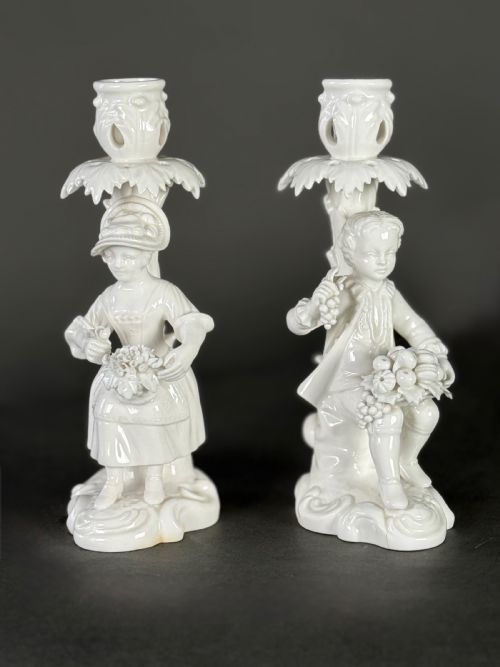
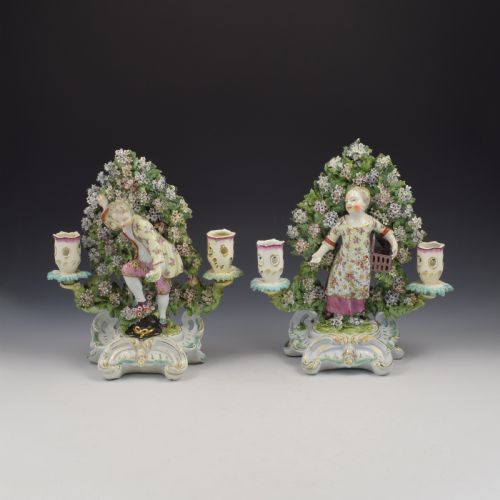
Derby porcelain candlesticks represent a sophisticated intersection of 18th-century sculpture and domestic lighting, often taking the form of figural groups or bocage settings. These pieces showcase detailed modelled subjects such as musicians, children, and dancers framed by foliage.
The versions most frequently encountered on this page span the Georgian period, including 18th-century patch-mark examples and 19th-century interpretations. Buyers will find pairs featuring pastoral motifs, allegorical figures like Liberty and Matrimony, and Rococo revival influences.
Originating from the renowned Derby factory, these candlesticks display the distinct sculptural ambitions of their makers. Surviving pieces demonstrate the evolution from early soft-paste compositions to later hard-paste bodies across the Georgian era.
Materials and Technique
Makers utilised both soft-paste and hard-paste porcelain, shaping the clay through intricate moulding and hand-modelling techniques. This allowed artisans to achieve the elaborate forms seen in figural compositions and applied bocage work.
Listings feature Georgian and 18th-century pieces alongside 19th-century examples, showcasing porcelain, enamel, and gold leaf materials.
Assessing Quality
Quality in these pieces rests primarily upon the crispness of the modelling and the delicacy of the hand-painted enamel decoration. Superior examples retain the fine details of facial expressions and the intricate dimensionality of the foliage without blurring.
The preservation of applied bocage and fragile porcelain appendages significantly influences the character of a piece. Finer specimens exhibit careful firing processes that avoid warping, maintaining structural integrity alongside vibrant, well-preserved gilding.
The Derby Porcelain Candlesticks Glossary
- Bocage
- An applied background of leaves and flowers modelled in relief around figural porcelain. This decorative leafy arbour is characteristic of mid-18th-century Rococo design.
- Soft-paste porcelain
- An artificial ceramic paste fired at lower temperatures than hard-paste porcelain. It possesses a warm, creamy translucency typical of early Derby production.
- Patch-mark period
- A phase in Derby manufacturing identified by small unglazed marks on the base left by the pot supports in the kiln. It helps date pieces to the mid-18th century.
- Gilding
- The application of gold leaf or gold gilt onto the porcelain surface. This technique accentuates moulded details and adds decorative splendour to the candlesticks.
- Hard-paste porcelain
- A true porcelain composed of kaolin and petuntse fired at high temperatures. It provides a durable, brilliantly white body utilised in later wares.
Derby Porcelain Candlesticks: Frequently Asked Questions
How were they used historically?
In Georgian homes, these candlesticks were placed on mantelpieces, side tables, or dining surfaces to provide ambient candlelight. The reflective glazed porcelain and gold gilding enhanced the flickering glow of the candles.
While functional, their elaborate figural designs meant they served primarily as conversation pieces. They displayed the owner's refined taste and appreciation for fine art ceramics.
How do I live with antique candlesticks?
Displaying these pieces requires stable surfaces away from high traffic areas to protect fragile porcelain elements like bocage and fingers. Gentle placement on mantelpieces or within secure cabinets ensures they remain safe from accidental knocks.
Lighting them should be approached with caution to avoid smoke damage to the delicate enamel and gilding. Most modern collectors prefer to exhibit them unlit as pure sculptures.
How do I tell periods apart?
Distinguishing between periods involves examining the paste composition, glaze characteristics, and underlying manufacturing marks. Early pieces often utilise soft-paste porcelain and feature patch-marks on the unglazed base.
Stylistic shifts also indicate date, moving from mid-18th-century Rococo asymmetry to later 19th-century interpretations. Comparing the crispness of the modelling helps establish the chronological context of each piece.