


Polychrome Porcelain Candlestick Holders
Polychrome porcelain candlestick holders are decorative objects of soft-paste and hard-paste porcelain, painted in vibrant enamel colours to brighten any room.
Polychrome Porcelain Candlestick Holders
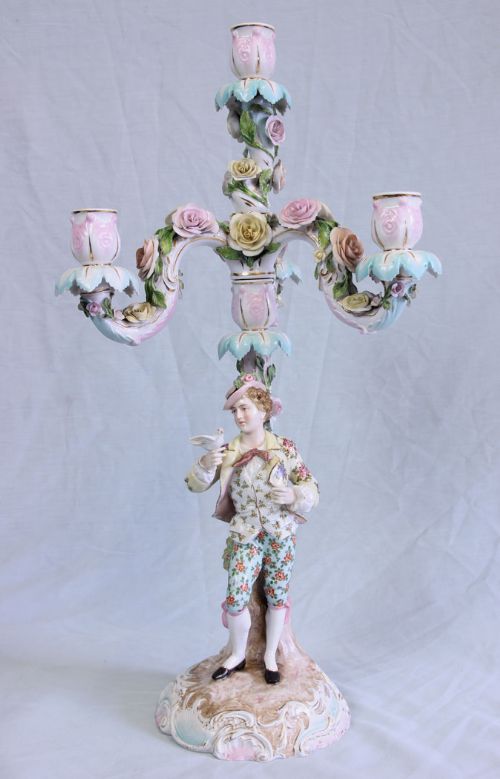
Polychrome porcelain candlestick holders encompass figural groups, musicians, dancers, and allegorical figures created by notable factories during the eighteenth and nineteenth centuries. The pieces on this page span the Georgian era, Rococo Revival, and late nineteenth-century German production, bringing sculptural form together with functional lighting.
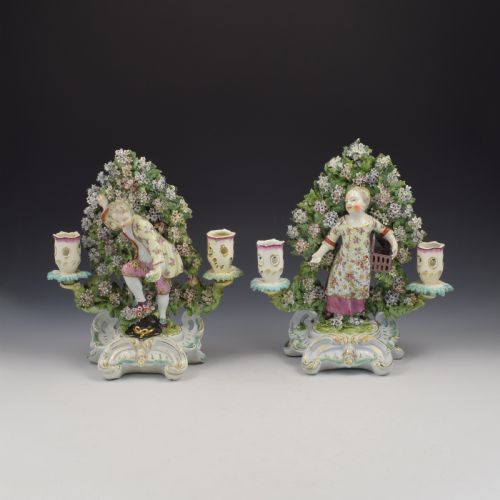
Buyers will most frequently encounter pairs of figural sticks adorned with bocage foliage backgrounds, musicians, shepherdesses, and children. These range from eighteenth-century Derby and Bow examples to nineteenth-century German pieces from Sitzendorf, Dresden, and Meissen.
The primary forms serve both as lighting devices and mantel ornaments, often featuring sconces supported by figures or botanical branches. Their surfaces display detailed enamel painting, sometimes accented with gold leaf or gilding.
What varies in quality
The standard of modelling in the figures and the delicacy of the applied bocage leaves set the finest polychrome porcelain candlestick holders apart from simpler productions. Crisp facial expressions and naturalistic postures indicate superior craftsmanship in the mould-making and finishing stages.
The precision and vibrancy of the hand-painted enamel work and the generous application of gold leaf dictate visual impact. Earlier eighteenth-century examples often demonstrate finer detail in the hand-sculpted foliage compared to later nineteenth-century factory output.
Ranelagh dancers and children dressed as Liberty and Matrimony light up the room.
Derby Porcelain·Sitzendorf·Dresden·Bow Porcelain·Minton·Meissen·Saxony Porcelain
The Polychrome Porcelain Candlestick Holders Glossary
- Bocage
- A background of applied porcelain leaves and flowers that frames figural porcelain groups. This decorative feature is especially characteristic of eighteenth-century English factories like Derby and Bow.
- Enamel
- Coloured glass powder fused to the porcelain surface during firing to create bright, durable ornamentation. It allows for the rich palette seen on polychrome pieces.
- Hard-paste porcelain
- A true porcelain composed of kaolin and petuntse, fired at very high temperatures to create a dense, vitrified body. It was widely adopted by continental European factories.
- Soft-paste porcelain
- An artificial porcelain body containing glass frit and white clay, fired at lower temperatures than hard-paste. It has a warm, slightly translucent appearance typical of early English wares.
- Sconce
- The socket at the top of a candlestick designed to hold a wax candle securely in place. On these pieces, they are often integrated into floral or architectural motifs.
Polychrome Porcelain Candlestick Holders: Frequently Asked Questions
How do I date these candlesticks?
Dating relies on identifying factory marks, paste composition, and stylistic periods such as the Georgian era or Rococo Revival. Eighteenth-century examples often feature patch marks or distinct porcelain bodies, whereas nineteenth-century pieces display different factory stamps.
Examining the hand-painting techniques and the intricacy of the bocage work also helps narrow down the decade of production.
Were these used for daily lighting?
While technically designed to hold candles, many of these elaborate figural pieces served primarily as decorative garnitures for mantelpieces and tables. Their delicate bocage and painted surfaces made them valuable display items for prosperous households.
Using them for actual lighting required caution to avoid damaging the painted enamel and porcelain flowers.
What is bocage?
Bocage is the stylized foliage background made of applied porcelain leaves and blossoms that surrounds the figures. It mimics natural arbours and wooded scenes popular in eighteenth-century pastoral design.
This feature required immense skill to model and attach before firing without collapsing in the kiln.
How do English and German pieces differ?
English factories like Derby and Bow frequently utilised soft-paste porcelain during the eighteenth century, resulting in distinctive translucency and softer glaze textures. German makers such as Meissen, Sitzendorf, and Dresden often worked in hard-paste porcelain and produced elaborate nineteenth-century revivals.
The sculpting styles and colour palettes also reflect the distinct aesthetic traditions of their respective manufacturing regions.