

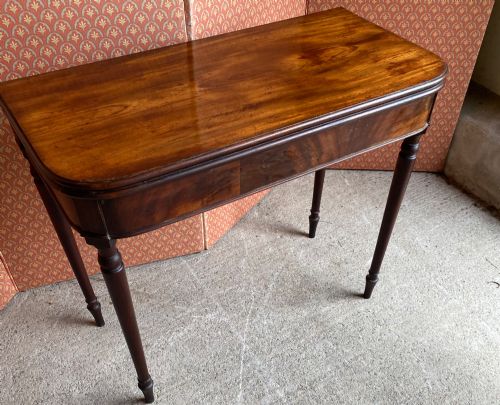
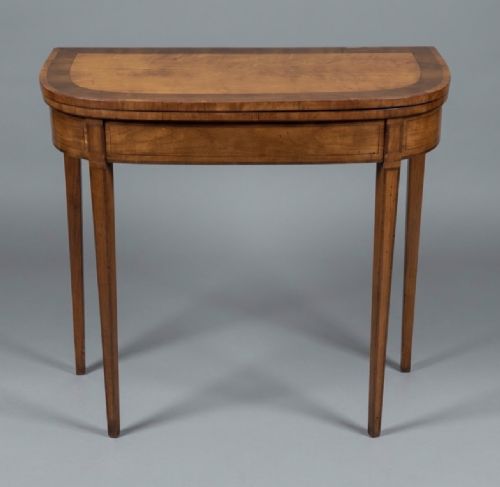
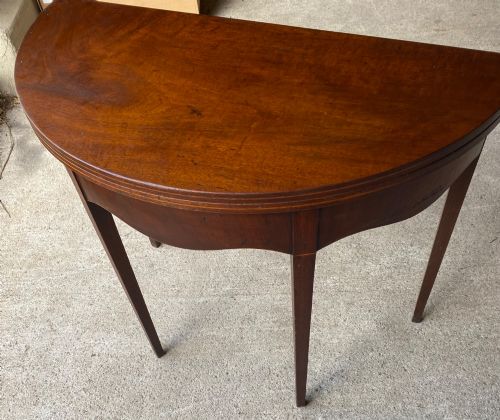
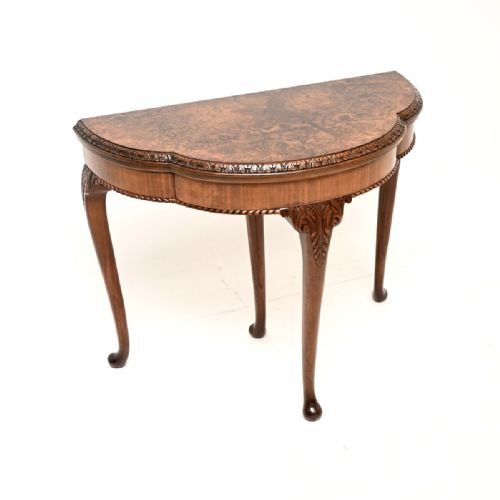
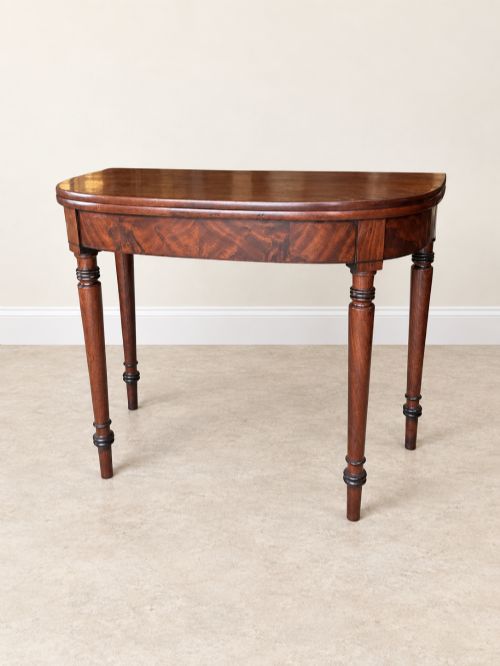
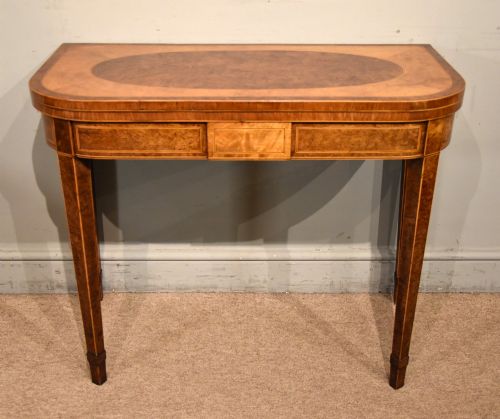
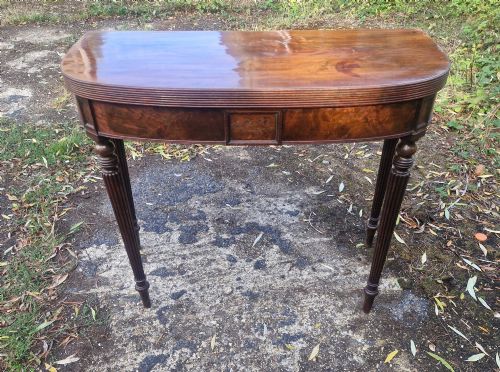
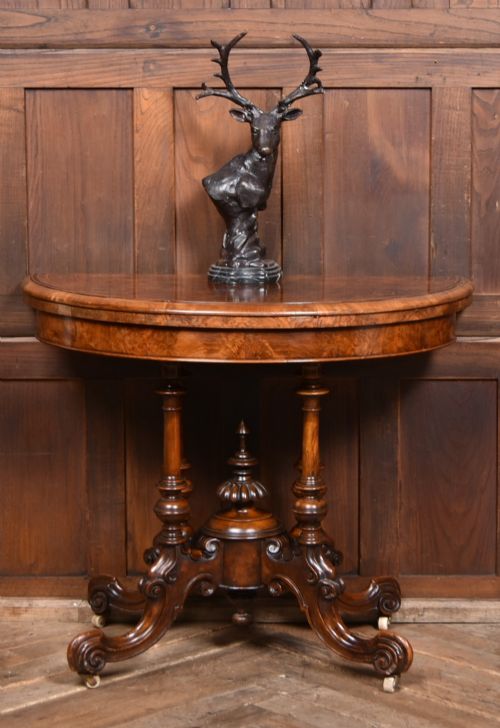
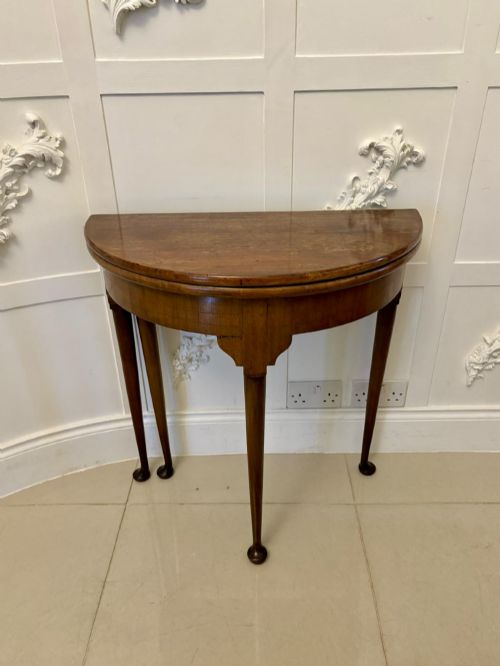
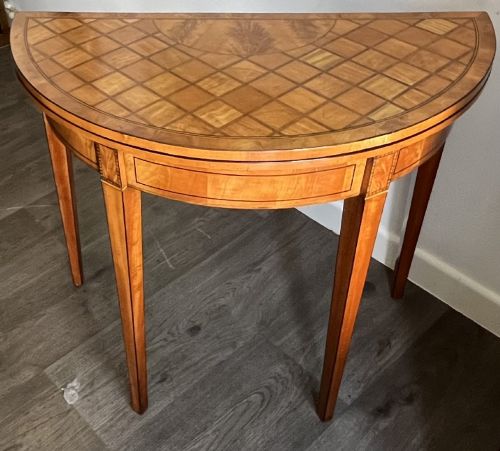
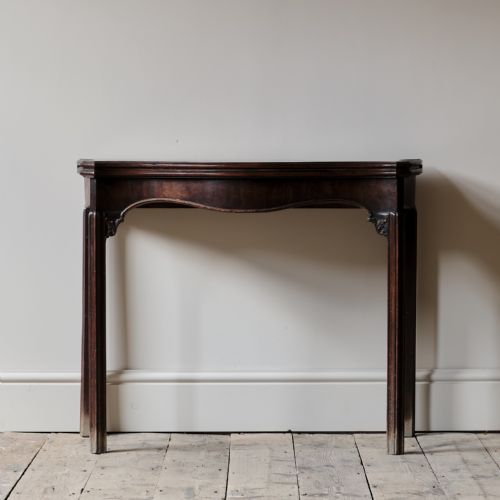
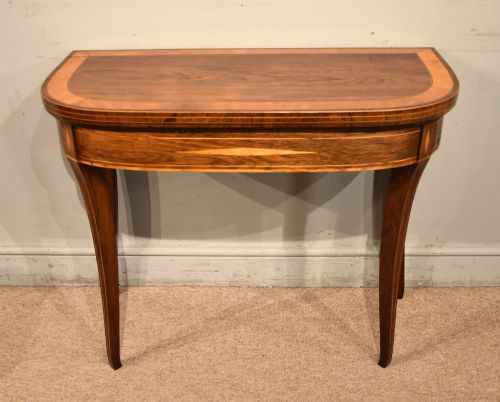
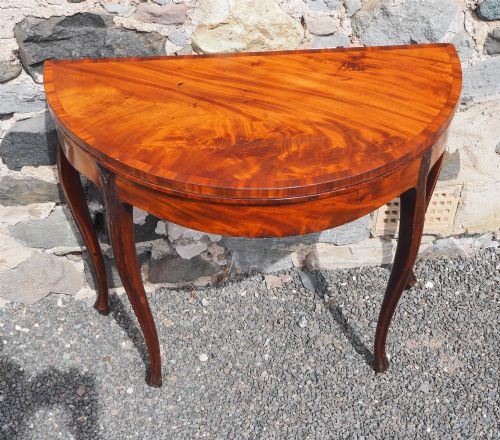
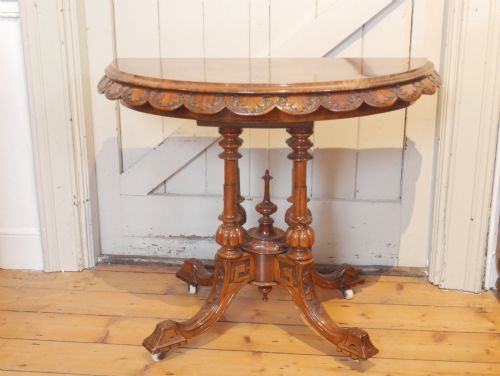
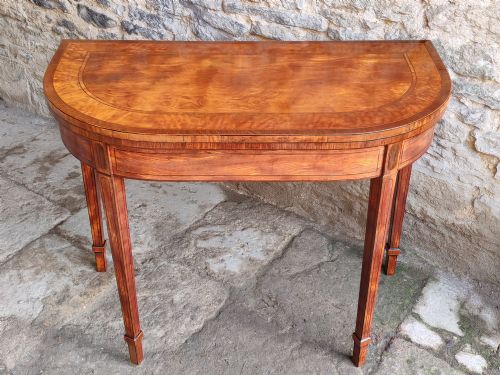
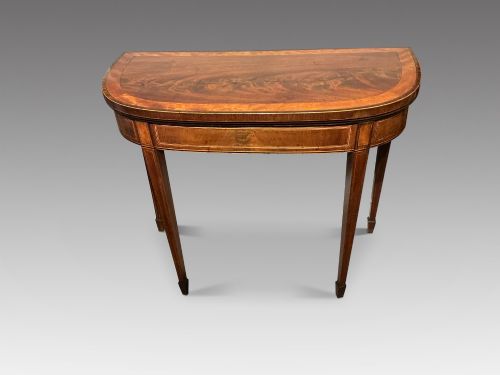
Demilune Gaming Table
A demilune gaming table is a semicircular folding piece that expands for play, offering versatile elegance for a hallway or drawing room.
Demilune Gaming Table
When you search for a demilune gaming table, you encounter half-round folding items designed for card play and tea. These pieces typically date from the Georgian, Regency, and Victorian periods, often taking the form of card tables, tea tables, or console tables.
The semicircular or D-shaped top opens on a pivoted or swinging rear leg to reveal a baize-lined playing surface. Many examples from the late eighteenth century utilise satinwood, mahogany, or rosewood, sometimes supplied in matched pairs.
Construction and materials
Cabinet makers constructed these tables using solid timber frames faced with figured veneers such as mahogany, burr walnut, and satinwood. Crossbanding in contrasting woods like boxwood defines the curved edges of the semicircular top.
Inlaid stringing and marquetry decorate many eighteenth-century surfaces, whilst later nineteenth-century examples rely on rich natural grain patterns. Hinges and pivoting mechanisms allow the folding leaf to rest securely when open.
Demilune Gaming Table Retail Price Guide 2026
Typical asking prices for demilune gaming table among the pieces listed under this phrase on Sellingantiques today, from the lower quarter to the upper quarter. They describe what is for sale here now, not the wider market.
Some clever eighteenth-century card tables include hidden corner wells designed specifically to keep stray gaming chips from rolling onto the floor.
Gradations in quality
Quality rests primarily in the choice of timber figure and the precision of the veneer work on the folding top. Superior pieces display book-matched mahogany or intricate satinwood and boxwood inlay that aligns seamlessly when closed.
Structural stability in the pivoting rear leg and the crispness of carved or tapered legs further distinguish fine workshops from standard production.
The Demilune Gaming Table Glossary
- Demilune
- A half-moon or semicircular shape used for furniture designed to stand flat against a wall.
- Crossbanding
- A strip of veneer applied around the border of a table top with the grain running perpendicular to the centre.
- Baize
- A coarse woollen fabric, traditionally green, used to line the playing surface of card tables.
- Turnover top
- A hinged tabletop that folds out to double its surface area for games or dining.
- Marquetry
- Decorative patterns formed by fitting together small pieces of coloured wood veneer into a larger design.
Demilune Gaming Table: Frequently Asked Questions
How do you use a demilune gaming table?
These tables sit flat against a wall as a console when closed, serving as a surface for decorative objects or lamps. Opening the hinged top reveals a baize surface traditionally used for card games.
Many examples also function as tea tables, accommodating a tea service when folded out or kept against the wall.
How do I identify a Georgian gaming table?
Georgian pieces often feature solid mahogany or satinwood veneer with subtle boxwood stringing and straight tapered legs. Construction methods from this era rely on hand-cut joints and distinct pivoting gate legs to support the open leaf.
Stylistic cues include neoclassical motifs or Sheraton influence, distinguishing them from heavier Victorian walnut versions.
What is the difference between a card table and a tea table?
Card tables generally feature an interior lined with baize or felt for playing cards, sometimes with small corner depressions for chips or coins. Tea tables usually have plain polished wood interiors intended for porcelain and silverware.
In practice, makers often produced versatile folding designs used interchangeably for both purposes.
Where should I place a half round table?
The flat straight edge sits flush against a wall, making these tables ideal for narrow hallways, entrance spaces, or the perimeter of a drawing room. Placing one beneath a mirror creates a traditional focal point in a reception area.
When positioned in open space, the table requires pulling away from the wall to allow the top to unfold.