

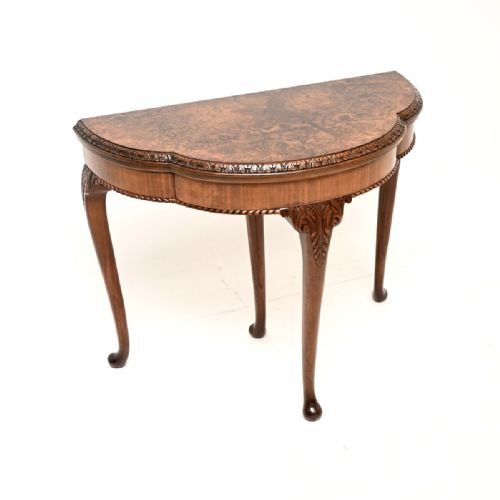
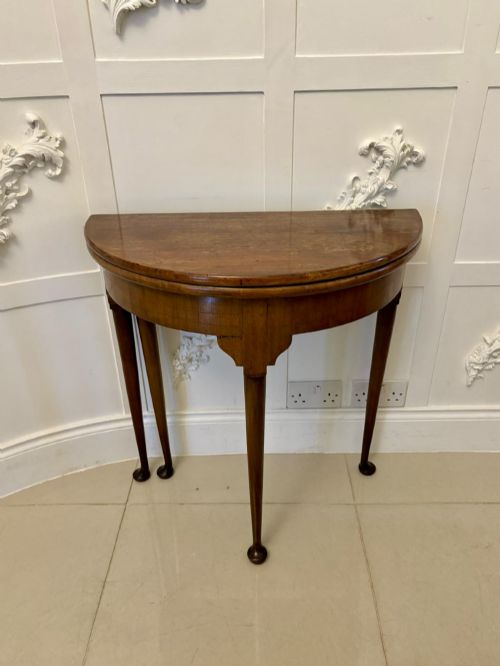
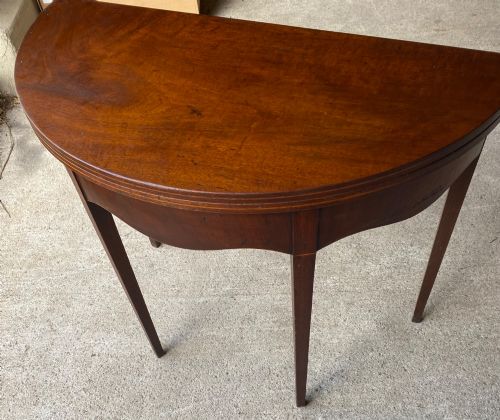
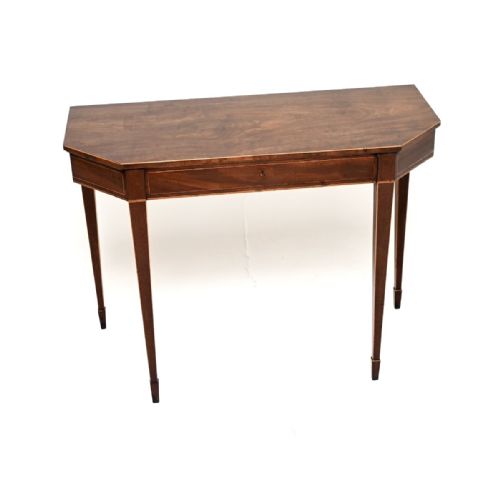
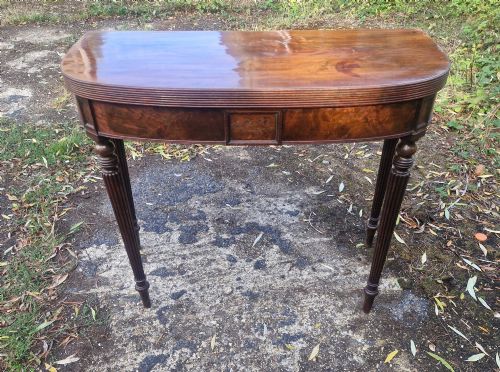
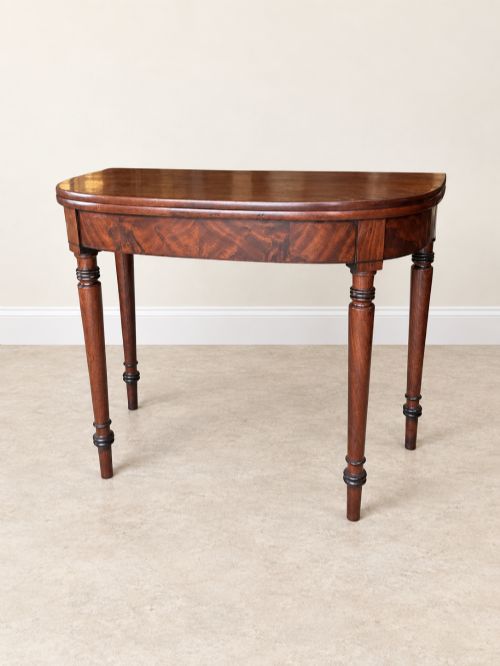
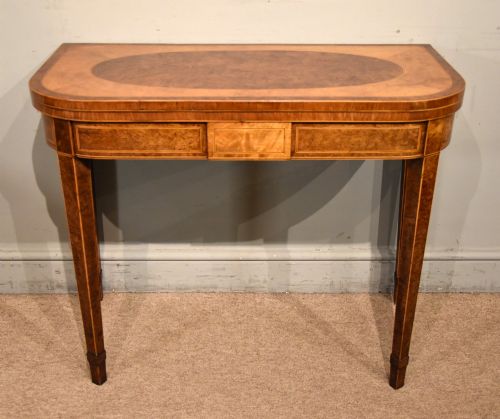
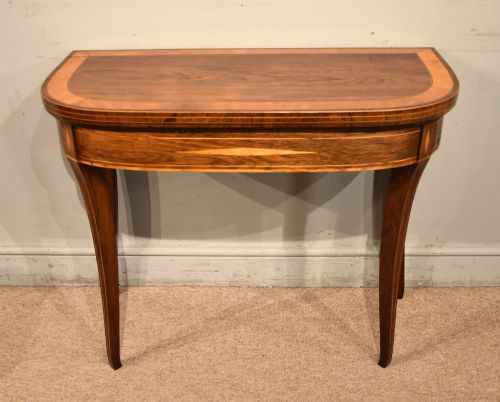

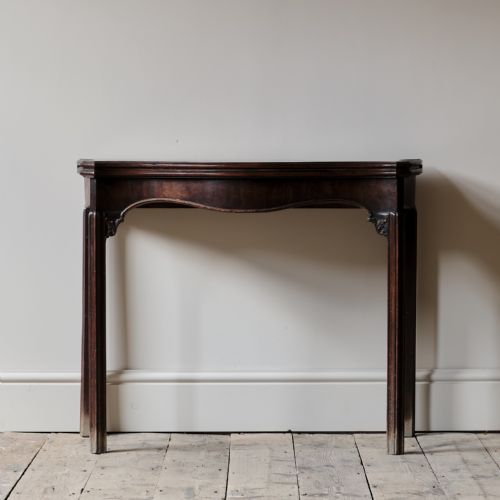
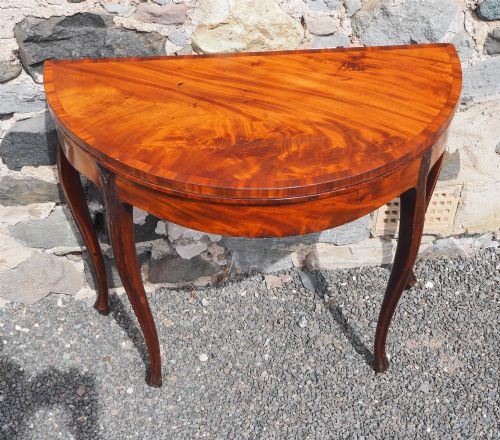
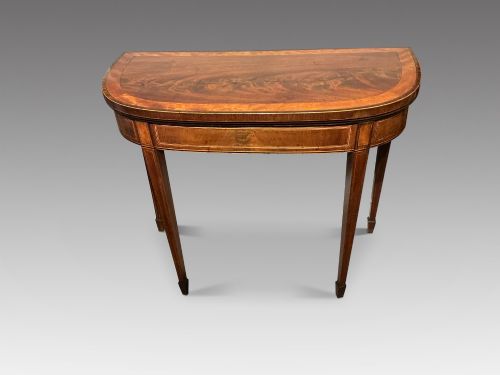
Demilune Folding Table
A demilune folding table offers a curved profile against a wall that expands smoothly for cards or tea.
Demilune Folding Table
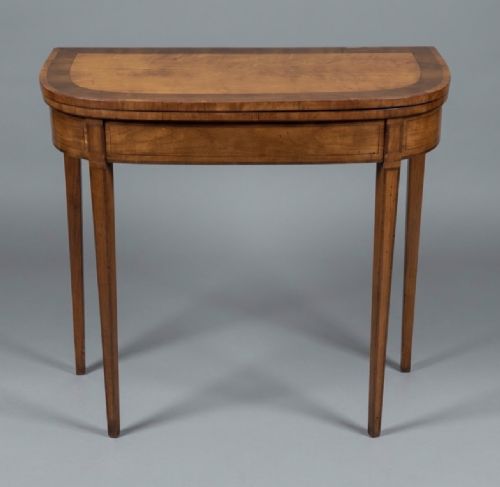
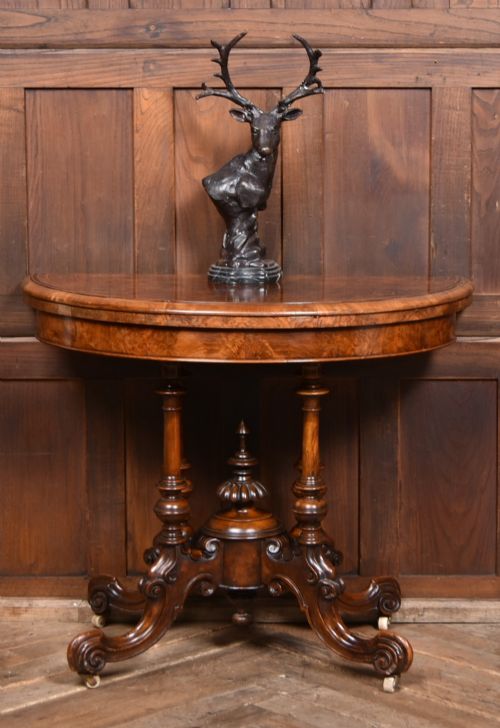
A demilune folding table provides a semicircular top that sits flat against a wall until opened on hinges to reveal a larger surface for cards, tea, or games. These pieces emerge primarily from the eighteenth and nineteenth centuries, spanning Georgian, Regency, and Victorian periods.
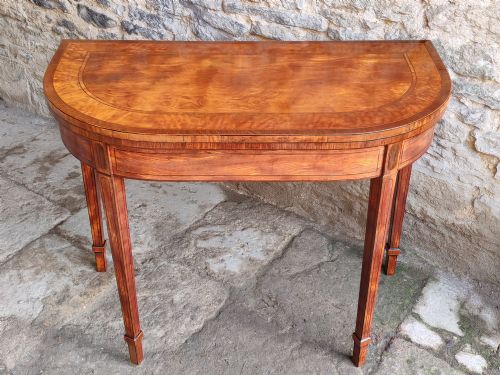
The versions met most frequently on this page are constructed from mahogany or satinwood, often taking the form of card tables, tea tables, or console tables that double their surface area when the hinged leaf is turned over or swung round.
Design influences across the inventory reflect prevailing cabinet-making modes such as Sheraton, Hepplewhite, and general classical revivals, linking domestic utility with disciplined proportion.
Distinctions in Quality and Execution
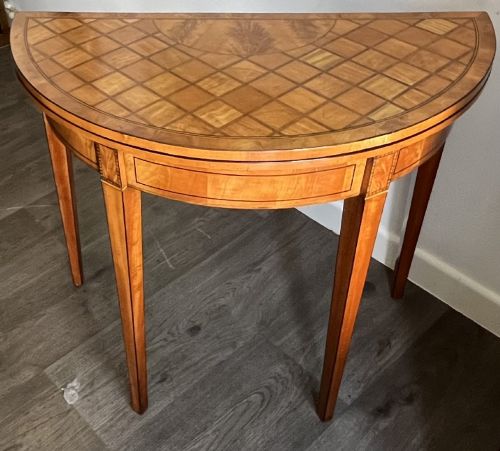
Quality rests upon the selection of timber figures, such as highly grained Honduras mahogany or meticulously matched satinwood veneers, alongside the crispness of inlaid stringing and crossbanding. Finer examples display harmonious grain patterns that continue uninterrupted across the fold when the table is opened.
Structural integrity of the hinge mechanism and the stability of the leg frame separate standard workshop production from superior cabinet work, ensuring the pivoted leaf bears weight evenly without sagging.
Demilune Folding Table Retail Price Guide 2026
Typical asking prices for demilune folding table among the pieces listed under this phrase on Sellingantiques today, from the lower quarter to the upper quarter. They describe what is for sale here now, not the wider market.
Some hidden compartments tucked beneath folding leaves still hold faint traces of eighteenth-century candle wax.
Gillows
The Demilune Folding Table Glossary
- Demilune
- A half-moon shape, describing furniture with a straight back edge for placement against a wall and a semicircular front.
- Crossbanding
- A strip of veneer applied to the border of a tabletop with the wood grain running perpendicular to the central panel.
- Fold-over
- A table construction where the top surface is hinged to double in area when unfolded.
- Stringing
- Thin inlay lines of contrasting timber used to outline borders and geometric panels on cabinet furniture.
- Rule joint
- A moulded knuckle joint connecting a fixed table top to a hinged flap, leaving no gap when open.
Demilune Folding Table: Frequently Asked Questions
How do I use a demilune folding table daily?
These tables function as compact console tables against a hallway or living room wall when closed, keeping floor space clear while holding decorative objects.
Opening the top reveals a generous baize-lined or polished timber surface suitable for card games, writing, or serving tea when guests visit.
What is the difference between a card table and a tea table?
Card tables typically feature internal recesses for counters or candle stands and often retain original green baize linings tailored for gaming.
Tea tables focus on polished wood presentation surfaces designed to hold porcelain without gaming compartments underneath.
How do I identify a Georgian demilune table?
Georgian pieces display restrained classical proportions, often utilising solid mahogany, delicate satinwood veneers, and tapered legs influenced by Sheraton or Hepplewhite designs.
Construction details include hand-cut dovetails in the drawer linings and traditional timber fixings rather than modern screws.
Can these tables support weight when opened?
The hinged leaf relies on a swing leg or a gateleg action that pivots outward from the frame to support the extended half of the top.
While sturdy enough for normal dining, writing, or card playing, heavy downward pressure should be avoided near the unsupported outer corners.