


Deep Buttoned Leather Ottoman
These deep buttoned leather ottoman pieces bring substantial proportions and tactile hide to a room, offering both seating and surface utility.

Deep Buttoned Leather Ottoman
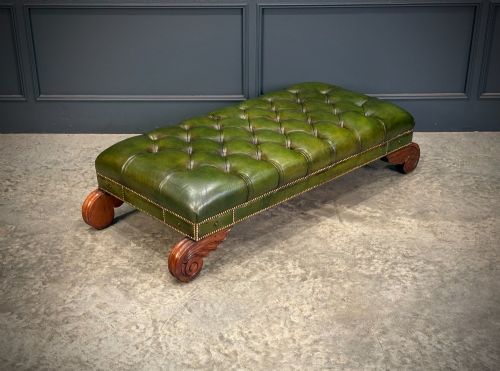
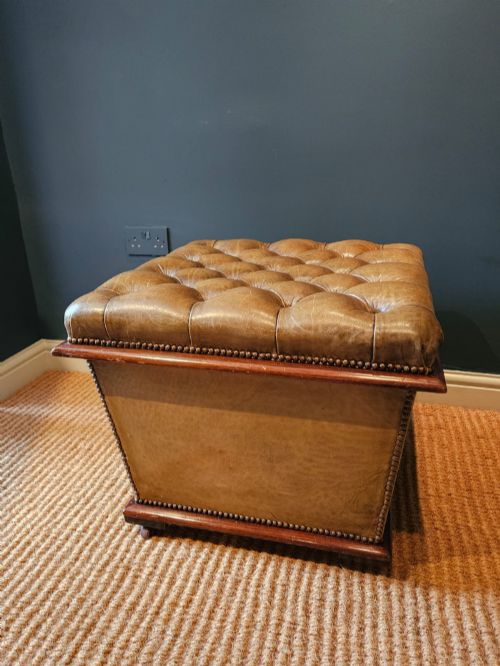
A deep buttoned leather ottoman typically presents as a substantial footstool, long stool, or centre stool designed for traditional interiors. These items span Victorian, Regency, and Georgian style periods, often taking the form of large footstools and window seats.
Most examples found on this page date from the nineteenth century, including Victorian and Regency eras. Makers constructed them using robust timbers such as mahogany, walnut, and oak to support the heavy upholstery.
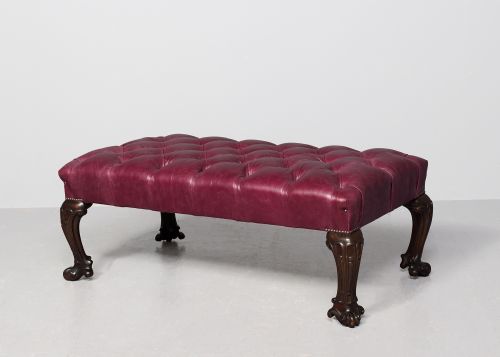
Buyers encounter forms ranging from cabriole-legged walnut stools to grand country house centre stools. The unifying feature remains the combination of supportive hide upholstery and sunken buttoning.
How they were made
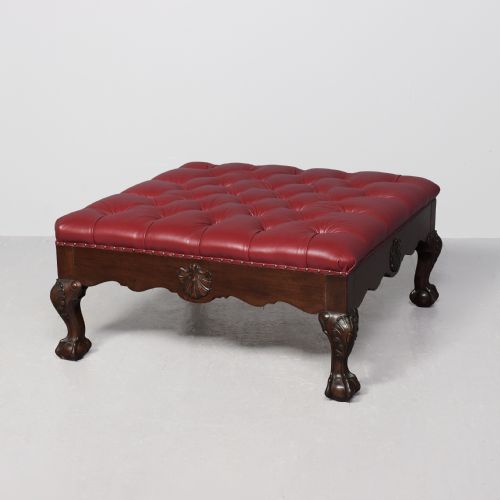
Frames rely on hardwoods like mahogany, walnut, and oak, often shaped into cabriole legs or rectilinear rails in the Georgian and Regency styles. Artisans secured these structures to bear the weight of heavy daily use in libraries and drawing rooms.
Upholstery involves stretching leather over dense padding, secured with deep tufting and frequently finished with brass-studded details. The hide is often hand-dyed to achieve deep burgundy, green, or traditional red colourations.
Many long stools incorporate rows of brass studs, originally driven by hand to secure hide upholstery against sturdy nineteenth-century timber frames.
What varies in quality
Scale and timber selection dictate the standing of a piece, with exceptionally large proportions and finely figured mahogany or walnut commanding greater presence. The depth and regularity of the buttoning also reflect the maker's hand.
The choice of leather, from standard hide to richly hand-dyed variants, alters the tactile finish and visual depth. Frame details such as carved cabriole legs or precise brass-studded borders separate standard workshop output from exceptional examples.
James Shoolbred
The Deep Buttoned Leather Ottoman Glossary
- Deep buttoned
- Upholstery technique where buttons are pulled tight through the padding to create a diamond pattern. This method secures the internal filling and provides a firm, textured surface.
- Cabriole leg
- Furniture leg featuring a double curve, typically swelling outward at the knee and tapering inward at the foot. This design appears frequently on Victorian walnut and mahogany stools.
- Centre stool
- Large freestanding seating item placed in the middle of a room rather than against a wall. These pieces often serve as informal tables or expansive footrests.
- Hide
- The natural pelt of cattle used for heavy upholstery. It is durable and develops a distinct patina over time.
- Brass-studded
- Decorative finishing where individual brass tacks secure the leather edges to the wooden frame. This detail provides a bright metallic contrast to the dark timber and leather.
Deep Buttoned Leather Ottoman: Frequently Asked Questions
What is a deep buttoned leather ottoman?
A deep buttoned leather ottoman is a padded footstool or centre stool upholstered in hide with sunken tufted buttons. They serve as versatile seats, footrests, or informal room surfaces.
Originating largely in the nineteenth century, these pieces feature timber frames of mahogany, walnut, or oak. Their sturdy construction suits traditional library and drawing room settings.
Where were these ottomans used?
These items traditionally sat in grand country house libraries, drawing rooms, and large reception spaces. Long stools and window seats were positioned beneath windows or in front of club fenders.
Their robust timber frames and durable leather upholstery allowed them to function as both seating and temporary display surfaces for books or trays.
How do I tell Victorian pieces apart?
Victorian examples often feature dark hardwoods like walnut or light oak, sometimes incorporating cabriole legs. Regency and Georgian style pieces lean toward mahogany frames and rigorous classical proportions.
Examining the timber grain and the style of the legs helps distinguish mid-nineteenth-century items from later revivals. Brass-studded detailing and hand-dyed hides appear across multiple periods.
Can I use an ottoman as a coffee table?
These firm, flat-topped stools accommodate trays easily, making them practical for holding drinks or books. The deep buttoned surface provides a stable base when paired with a flat tray.
Their substantial size ensures they anchor a seating arrangement while offering the dual benefit of extra casual seating.