
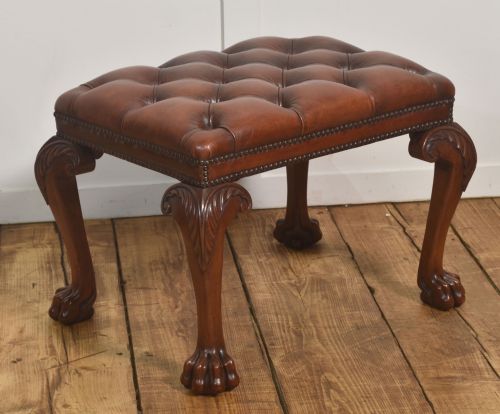


Brass Studded Leather Footstool
A brass studded leather footstool combines sturdy timber frames with rich hides and metal tacking, offering a practical seat that anchors a traditional room.

Brass Studded Leather Footstool
A brass studded leather footstool is a low seating piece typically framed in hardwood and topped with hide secured by metal tacks. These forms range from small dressing seats to large ottomans built for domestic comfort.
The versions most commonly met on this page date from the nineteenth century, including Regency and Victorian periods, alongside Edwardian examples and later pieces from nineteen-twenty. They appear in styles from Chippendale-inspired designs to Carolean revivals.
Buyers look for these furnishings to add texture and functional seating to studies, libraries, and drawing rooms. Their sturdy construction and aged upholstery suit traditional interiors where tactile materials matter.
Materials and construction
Makers built the frames of a brass studded leather footstool using dense timbers such as mahogany, rosewood, walnut, oak, and yew wood. These hardwoods provided the structural integrity required to support daily use and heavy upholstery.
Upholsters stretched leather over padding and fastened the edges using individual brass studs driven directly into the wood frame. This metal tacking served both a structural purpose in securing the hide and a decorative function along the borders.
Country house occupants occasionally rested weary boots on stools designed with hidden storage for slippers.
Distinguishing quality in these stools
Quality in a brass studded leather footstool often rests on the choice of timber and the precision of the frame joinery. Dense woods like rosewood and mahogany indicate a higher grade of manufacture than basic hardwoods.
The treatment of the leather and the regularity of the brass stud work also separate standard pieces from finer examples. Hand-dyed hides, buttoned upholstery, and carefully spaced tacks show greater attention to detail by the original maker.
The Brass Studded Leather Footstool Glossary
- Ottoman
- A low upholstered seat or footstool without a back or arms, often built with internal storage space. These large forms served as central room pieces in nineteenth-century houses.
- Cabriole leg
- A furniture leg that curves out and then in, resembling an animal's leg in shape. This form appears frequently on Victorian and revival seating.
- Box ottoman
- A footstool designed with a hinged top that opens to reveal a storage compartment. These pieces combine seating with practical containment for household items.
- Buttoned leather
- Upholstery pulled deep with tufts or buttons arranged in a geometric diamond pattern. This technique secures the padding and creates a textured surface.
Brass Studded Leather Footstool: Frequently Asked Questions
Where should I place a footstool?
These pieces sit comfortably in libraries, living rooms, and dressing areas, functioning as extra seats or footrests.
Their substantial timber frames and dark leather surfaces pair well with traditional armchairs and heavy wooden tables.
How do I care for antique leather?
Keep the leather conditioned with appropriate balms to prevent the hide from drying out over time.
Avoid placing the stool in direct sunlight or near heat sources that might crack the aged material and loosen the brass tacks.
How do I identify a Victorian stool?
Victorian examples often employ heavy mahogany frames, deep buttoned leather, and robust cabriole or turned legs.
Makers of this era favoured substantial proportions and dark, rich timbers suited to formal domestic interiors.