




Decorative Stone Urns
Decorative stone urns bring classical form and substantial weight to an interior, shaped from solid minerals to echo antiquity.
Decorative Stone Urns
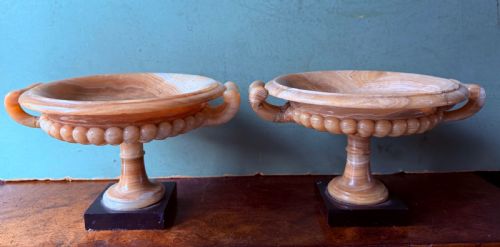
Decorative stone urns encompass carved vessels, tazze, and centrepieces rooted in classical design, often created as souvenirs or formal display pieces. When exploring decorative stone urns, the selection draws heavily from nineteenth-century Neoclassical and Grand Tour traditions, ranging in scale from smaller mantel tazze to substantial pedestals.
The forms frequently mirror antique archaeological discoveries, rendered in shapes such as classical tazze, handled vases, and pedestal-mounted vessels. Pieces originate from workshops in Italy, France, and India, reflecting nineteenth-century and Victorian tastes for mineral specimens and architectural ornament.
How they were made
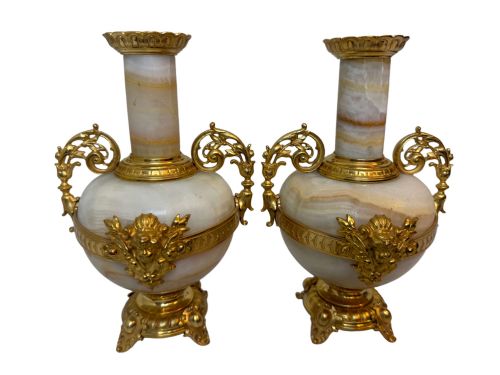
Carvers shaped these objects from blocks of alabaster, white and serpentine marble, and green onyx, frequently employing precise lathe work and hand chiselling. Surfaces were polished to highlight natural veining and figures within the stone, occasionally complemented by applied gilt bronze mountings and champlevé enamel detailing.
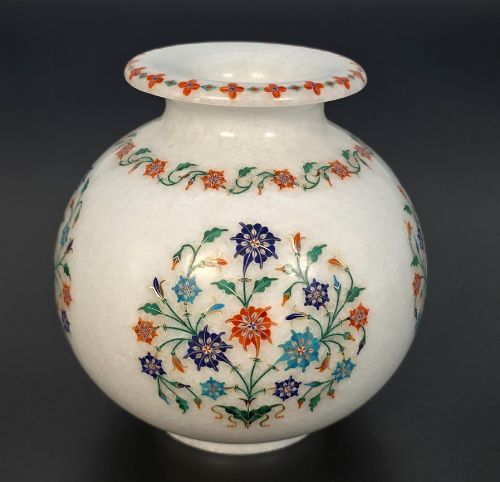
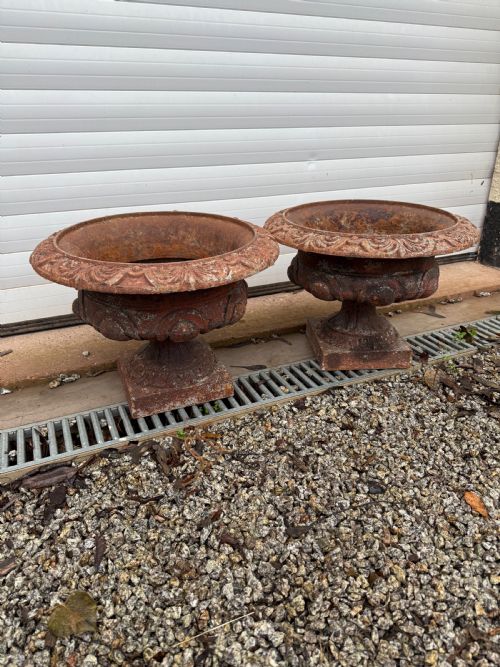
Certain varieties incorporate semi-precious stone inlay, adhering to intricate Pietra Dura techniques where cut mineral segments form floral or geometric patterns. Cast iron alternatives appear among garden forms, offering a robust structural material suited to exterior display.
Nineteenth-century travellers packed heavy alabaster tazze across Europe in horse-drawn carriages, trusting fragile stone to survive the Grand Tour.
What varies in quality
Quality rests upon the selection of the raw mineral and the crispness of the carving, where sharply defined acanthus leaves and smooth, symmetrical contours distinguish finer examples. The internal figuring of the alabaster, marble, or onyx dictates visual depth, with highly figured stones commanding greater optical presence.
The integration of secondary materials such as gilt bronze mounts and champlevé enamel alters the character of a piece, requiring precise metalwork that complements rather than overpowers the stone body. Bases and pedestals fashioned from contrasting black marble or matching stone provide structural stability while anchoring the composition.
The Decorative Stone Urns Glossary
- Tazza
- A shallow bowl or vase raised on a stem and foot, commonly carved from marble or alabaster in nineteenth-century Italian workshops.
- Grand Tour
- A cultural journey undertaken by nineteenth-century travellers who acquired souvenirs such as alabaster and serpentine marble urns.
- Pietra Dura
- An artistic technique involving the inlay of cut and fitted semi-precious stones into a marble matrix.
- Champlevé Enamel
- A method where enamel is fused into depressions or troughs carved into a metal surface, seen on gilt bronze vase mounts.
- Serpentine
- A dark green, mottled mineral resembling snake skin, utilised for carved nineteenth-century vases.
Decorative Stone Urns: Frequently Asked Questions
What are decorative stone urns made of?
These vessels are carved from natural minerals including alabaster, white and green marble, and onyx. Some examples incorporate cast iron or feature gilt bronze mounts and semi-precious stone inlay.
The variety of stone used often indicates the geographic origin and period of the workshop, from Italian Grand Tour alabaster to Indian Pietra Dura work.
Where were these urns originally made?
The pieces originate primarily from nineteenth-century European and Asian workshops, with significant production centred in Italy for Grand Tour souvenirs. French makers also produced mounted onyx vessels, while Indian craftsmen created inlaid marble pieces during the Raj period.
Each region applied local geological materials and distinct decorative techniques to classical vessel forms.
How do I style a stone urn at home?
Smaller tazze and vases suit tabletops, sideboards, and mantelpieces where the natural veining of the stone catches ambient light. Larger pedestals and garden urns function as focal points in hallways or outdoor settings.
Pairing them with contrasting wooden surfaces or placing them on dedicated marble columns enhances their architectural silhouette.
How do I distinguish nineteenth-century pieces?
Nineteenth-century examples display hand-carved details, characteristic mineral selections such as alabastro egiziano, and period mounting techniques like gilt bronze and champlevé enamel. Examining the underside and the nature of the stone wear reveals the age of the carving.
Stylistic cues such as Neoclassical proportions and Grand Tour souvenir formats further anchor pieces to this era.