




Decorative Bisque Porcelain Ornaments
These decorative bisque porcelain ornaments bring soft texture and fine nineteenth-century moulding into a room.
Decorative Bisque Porcelain Ornaments
You are most likely to meet figures of ladies, gentlemen, children, and fisher folk, alongside animal studies and vases. These unglazed items rely on the matte surface of biscuit porcelain to reveal delicate modelling rather than glossy glaze.
Makers such as Royal Dux, Copeland, Chantilly, and Vion et Baury appear within these periods, spanning Victorian production up to nineteen-ten.
How they were made
These pieces are formed from bisque porcelain, also known as biscuit porcelain or Parian ware, which is fired without a glaze to leave a matte, stone-like exterior. This unglazed ceramic body allows fine facial expressions, drapery folds, and hair details to remain crisp and unclouded.
Many examples are enhanced with enamel paint, gold leaf, or gilt highlights applied over the fired white body. These touches of colour and metal draw attention to costume details, borders, and sculptural relief.
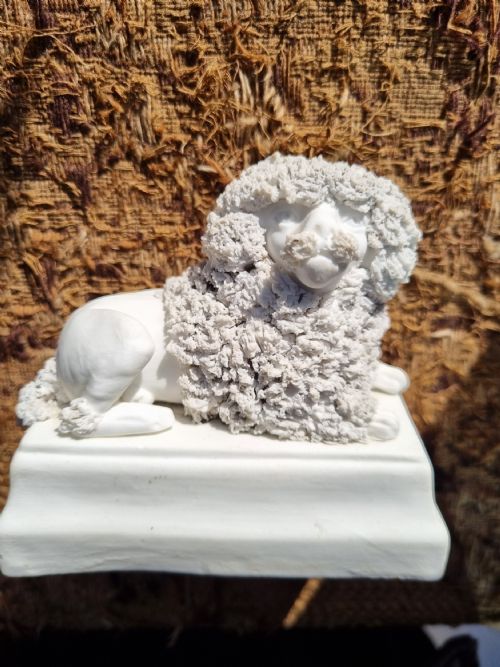
A white bisque pottery poodle stands ready to guard the mantelpiece without ever shedding a hair.
What varies in quality
The use of enamel and gold leaf varies from restrained touches to heavier embellishment. Finer pieces integrate colour and gilt to accentuate the form without masking the matte texture of the bisque body.
Royal Dux·Copeland·Chantilly·Vion et Baury
The Decorative Bisque Porcelain Ornaments Glossary
- Bisque porcelain
- Unglazed ceramic fired once to create a matte, porous finish that resembles marble. This material is also referred to as biscuit porcelain.
- Parian ware
- A fine-grained type of biscuit porcelain developed in the nineteenth century to imitate white marble. It was frequently used for Victorian portrait busts and sculptural figures.
- Rococo Revival
- A nineteenth-century design style drawing on eighteenth-century French motifs with asymmetrical scrolls, naturalistic foliage, and flowing curves. It appears often in Victorian and French decorative objects.
- Figurine
- A small carved or moulded statuette representing a human or animal figure. These items were widely produced as mantelpiece ornaments during the Victorian and Edwardian eras.
Decorative Bisque Porcelain Ornaments: Frequently Asked Questions
What are piano babies?
Piano babies are small bisque porcelain figures of resting infants or toddlers popular during the late nineteenth and early twentieth centuries. They were often placed on the decorative wooden casing of upright pianos.
These figures showcase unglazed matte surfaces and delicate hand-painted details, capturing playful poses from the period.
How do I clean bisque porcelain?
Because bisque porcelain is unglazed and porous, it absorbs dust and oils easily. Cleaning requires a soft, dry brush rather than water or chemical cleaners.
Gentle brushing prevents dirt from settling into the fine grooves of the unglazed matte surface.
What is the difference between bisque and Parian ware?
Bisque is a general term for any unglazed ceramic fired once to a matte state. Parian ware is a specific, highly vitrified biscuit porcelain developed in the nineteenth century to look like white marble.
Parian ware generally has a smoother, denser body than standard nineteenth-century bisque.
How can I date these ornaments?
Dating relies on stylistic clues such as Victorian costume, Rococo Revival scrolls, or Art Nouveau curves, alongside factory marks. Nineteenth-century pieces often display impressed numbers or painted factory stamps on the base.
Comparing the modelling style to known Victorian and Edwardian production helps narrow the decade of manufacture.