

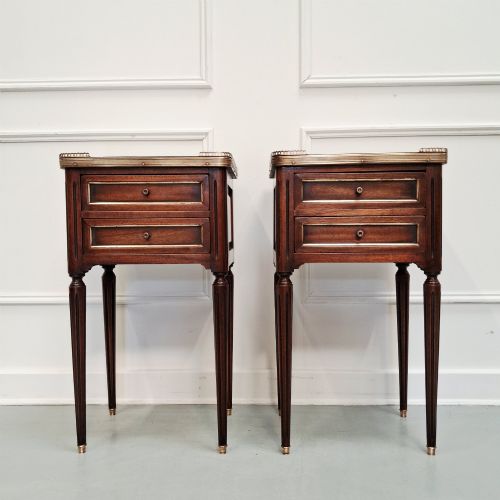
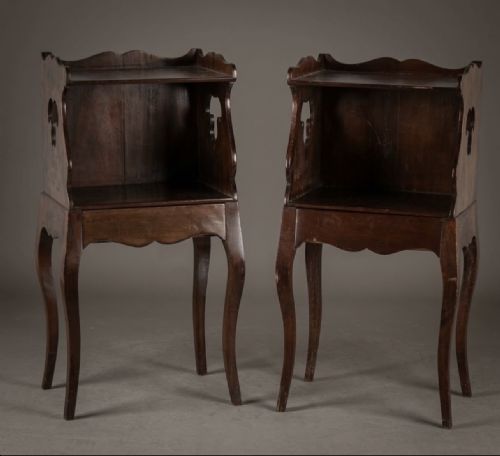


Dark Wood French Nightstand
A dark wood French nightstand brings rich continental character beside the bed, combining deep timber tones with classic bedside utility.
Dark Wood French Nightstand
A dark wood French nightstand provides compact bedside storage and display, appearing across periods from the nineteenth century to the early twentieth century. These pieces take the form of bedside tables, bedside cabinets, and small side cupboards designed for continental interiors.
Most examples found here channel traditional French styles, including French Provincial, French Empire, Louis XV Revival, and French Neoclassical. Makers adapted these forms into practical bedside furniture featuring single doors, open compartments, or multiple drawers.
The selection ranges from simple provincial bedside tables to highly decorative cabinets finished with parquetry veneer or marble tops. Buyers encounter single items as well as matched pairs suitable for placing on both sides of a bed.
How they were made
Cabinetmakers constructed these nightstands using substantial timber frameworks of walnut, mahogany, rosewood, and oak, often applying fine walnut or rosewood veneers to flat surfaces. Parquetry techniques created geometric patterns on top surfaces and doors, demonstrating precise woodworking skill.
Many of these tables incorporate heavy marble tops, which provide a durable and cool surface resistant to spills and heat. Brass mounts, handles, and gallery rails frequently accent the dark timber, adding metallic contrast to the French designs.
Dark Wood French Nightstand Retail Price Guide 2026
Typical asking prices for dark wood french nightstand among the pieces listed under this phrase on Sellingantiques today, from the lower quarter to the upper quarter. They describe what is for sale here now, not the wider market.
Listings feature pieces spanning the nineteenth century through the 1920s, constructed in walnut, rosewood, oak, and mahogany.
What varies in quality
The calibre of timber preparation and veneer selection separates standard utility pieces from exceptional examples. Dense walnut, figured rosewood, and quartered veneers display superior grain movement and depth compared to plain timber surfaces.
Execution of carving and joinery dictates the refinement of each cabinet. Hand-carved details, smoothly operating tambour doors, tight dovetail joints, and substantial marble slabs indicate higher workshop standards.
Melissa White
The Dark Wood French Nightstand Glossary
- Parquetry veneer
- Thin slices of decorative wood arranged in geometric mosaic patterns across furniture surfaces. This technique creates visually striking geometric designs on table tops and cabinet doors.
- Tambour
- A flexible shutter made of narrow vertical strips of wood glued to a canvas backing. This construction allows doors to slide smoothly around curved cabinet corners.
- Marble top
- A polished stone slab fitted to the upper surface of a bedside table. It offers a smooth, water-resistant top designed to handle heavy daily use.
- Canterbury cupboard
- A low bedside cabinet or stand featuring enclosed storage paired with upright partitions. It provides specialised organisation alongside the bed.
- French Empire
- A classical revival style characterised by heavy proportions, dark timber, and restrained classical brass mounts. It draws inspiration from ancient Roman and Greek design.
Dark Wood French Nightstand: Frequently Asked Questions
How do I date a nightstand?
Dating a nightstand involves examining the timber species, construction methods, and stylistic details present in the piece. Nineteenth-century models often display hand-cut dovetails and solid timber carcasses, while later 1900s pieces may utilise machine-cut elements or specific revival styles.
Comparing the hardware, veneer work, and overall proportions against known period styles helps narrow down the decade of production.
Are these tables sold in pairs?
Listings include both single bedside cabinets and matched pairs suited for framing a bed. Pairs offer symmetrical balance in a bedroom layout, while single tables work well in compact spaces or eclectic room schemes.
Checking individual descriptions clarifies whether an item is offered as a single piece or a matched set.
How do I care for a marble top?
Marble top surfaces require gentle cleaning with mild, pH-neutral soap and water to preserve the stone's polished finish. Avoiding acidic cleaners prevents etching and staining on the natural mineral surface.
Using coasters and mats protects the stone from liquid rings and physical impacts during daily use.