
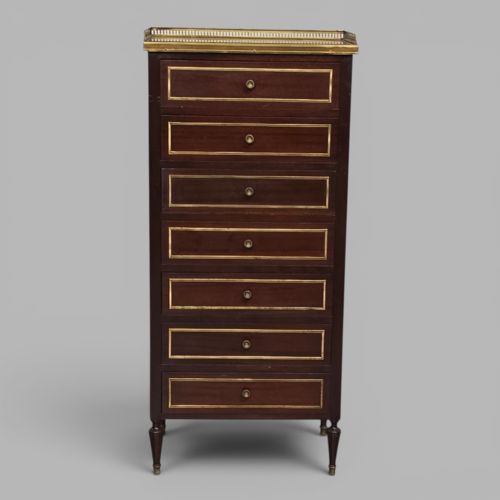


Dark Wood Bank Drawers
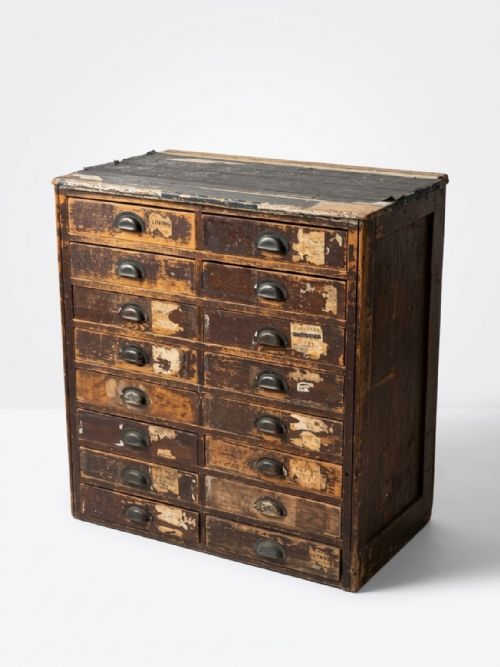
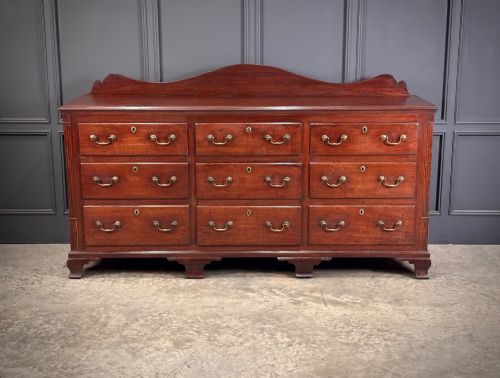
These dark wood bank drawers are sturdy multi-drawer units built for trade, storage or filing, prized for their deep colour and practical grid of small compartments.
Dark Wood Bank Drawers
Dark wood bank drawers comprise multi-drawer cabinets, apothecary chests, and workshop fittings designed for commercial or domestic sorting. When searching for dark wood bank drawers, a buyer encounters configurations ranging from compact Georgian small chests to large 18th-century mahogany pieces and tall Victorian chemist shop fittings.
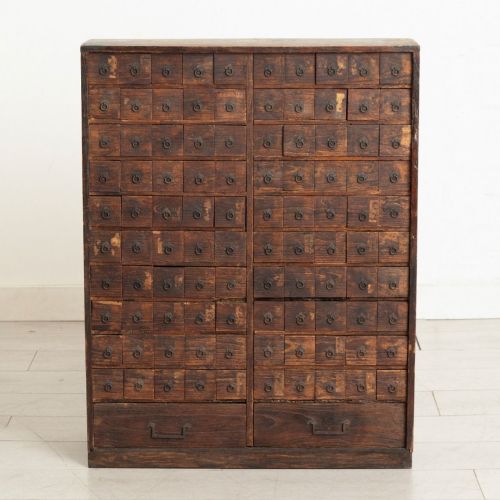
The selections span distinct historical periods including Georgian, Victorian, Edwardian, and the Meiji Period, alongside 1920s industrial workshop units. Forms vary from chemist shop fittings and apothecary cabinets to heavy banker's drawers, ironmongers' drawers, and letter file cabinets.
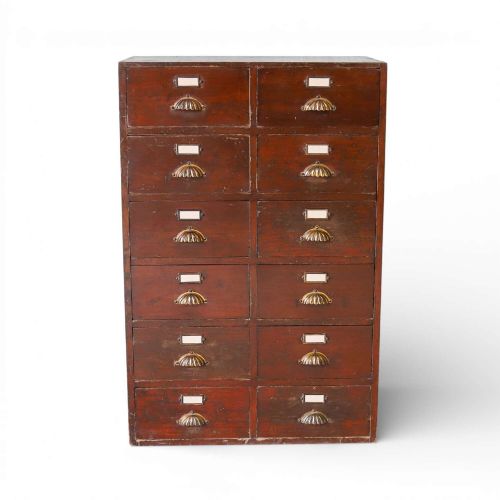
Most examples utilise rich timbers such as mahogany and walnut, paired with functional hardware like brass drop handles, shell pulls, and label holders. These multi-drawer assemblies serve modern interiors as striking storage solutions that retain their original utilitarian character.
How they were made
Construction relies heavily on dense timbers including mahogany, walnut, pine, cedar, and iron, selected for durability in commercial environments. Workshops shaped these materials into robust frames housing numerous small compartments, often incorporating integrated locking mechanisms or safe cupboards.
Hardware details such as brass drop handles, scalloped brass handles, and iron pulls are fastened securely to each drawer front. Label holders made from brass assist with the original filing and categorisation purposes inherent to chemist shops and ironmongers.
Amberg’s patent letter file cabinet offers a glimpse into turn-of-the-century office organisation systems.
What varies in quality
The distinction between tiers rests upon the choice of primary timber, such as figured mahogany or polished walnut versus simpler pine or cedar carcases. Finer pieces demonstrate superior cabinet-making through tight joinery, graduated drawer proportions, and original hardware.
Retaining authentic components like original shell pulls, label holders, and operational locking systems elevates an example above units missing their period fittings or bearing replacement elements.
The Dark Wood Bank Drawers Glossary
- Bank of drawers
- A multi-tiered cabinetry unit containing numerous small drawers, originally built for commercial, retail, or apothecary use. These units maximise storage within a compact footprint.
- Chemist shop fitting
- Custom cabinetry designed specifically for pharmacy interiors to house medicines and dry goods in labelled compartments. They often feature extensive banks of small drawers.
- Shell pull
- A semi-circular drawer handle shaped like a scallop shell, common on late 19th-century and Edwardian cabinetry. It provides a comfortable grip for frequently opened small drawers.
- Graduated drawers
- A vertical sequence of drawers that decrease in depth from bottom to top, improving visual balance and storage utility. This arrangement appears frequently in shop chests.
- Label holder
- A small metal frame fixed to a drawer front to retain a paper card describing the contents. They are characteristic of commercial, filing, and apothecary furniture.
Dark Wood Bank Drawers: Frequently Asked Questions
What were bank drawers originally used for?
These units served commercial and trade purposes in chemists, apothecary shops, ironmongers, and workshops to organise small stock items, powders, or hardware.
Later adaptations included office filing and domestic sorting, turning utilitarian storage into functional furniture for homes.
How do I identify a Georgian bank drawers unit?
Georgian pieces typically feature dense mahogany timbers, hand-cut dovetail joints, and restrained proportions characteristic of the 18th century.
They often incorporate traditional brass hardware and fine craftsmanship intended for wealthy domestic or professional settings.
Are these drawers suitable for modern home use?
Their numerous small compartments make them exceptionally practical for organising stationery, jewellery, collections, or kitchen accessories in contemporary rooms.
Placing them in studies, hallways, or living spaces adds architectural character while offering dense, concealed storage.
What timbers are most common?
Mahogany and walnut appear frequently in finer shop fittings and domestic pieces, offering deep colour and durable grain patterns.
Other examples utilise pine or cedar carcases, sometimes combined with iron fittings for industrial workshop environments.