
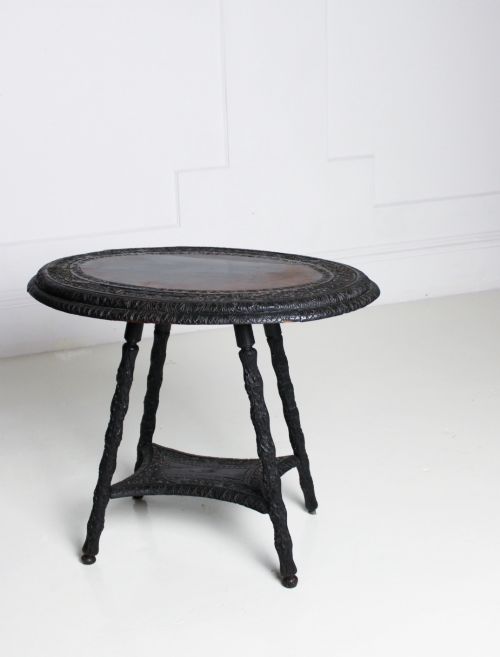
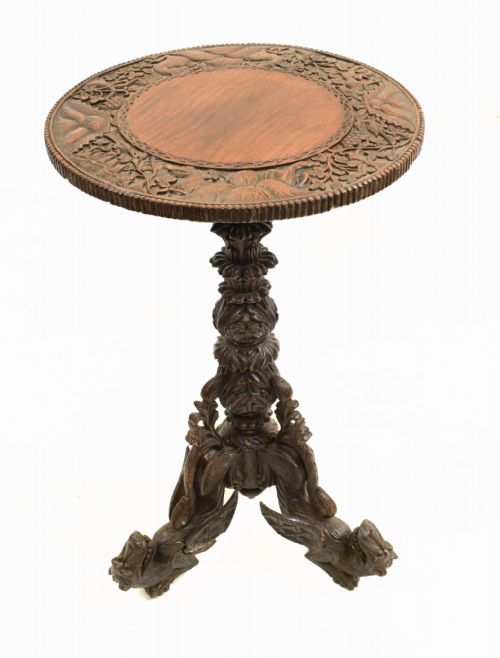


Dark Teak Occasional Table
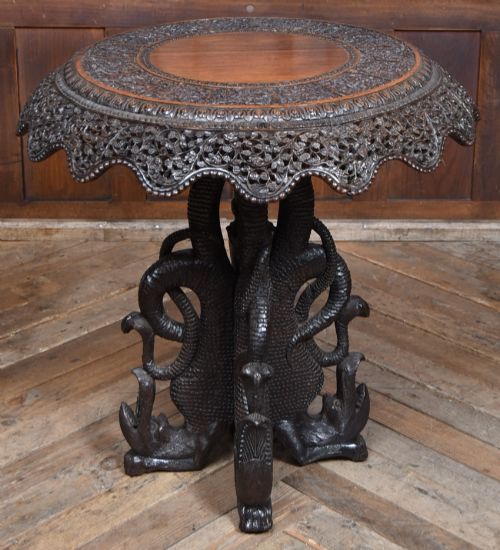
A dark teak occasional table brings dense grain and deep colonial carving into a room, serving as a striking centrepiece for lamps or tea.
Dark Teak Occasional Table
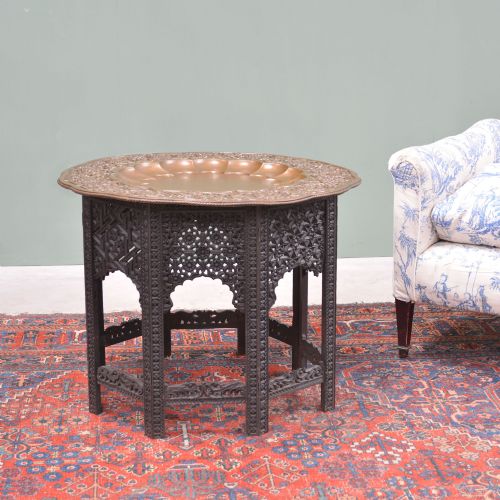
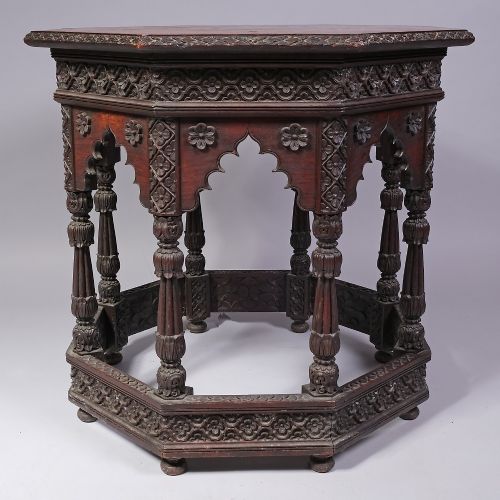
A dark teak occasional table is typically encountered as a compact piece originating from nineteenth-century British colonial workshops, often categorised under Anglo-Indian, Anglo-Burmese, or Chinese Export styles. These items manifest in various practical forms, including side tables, nests of tables, tray top tables, and folding or tilt-top designs suitable for flexible placement.
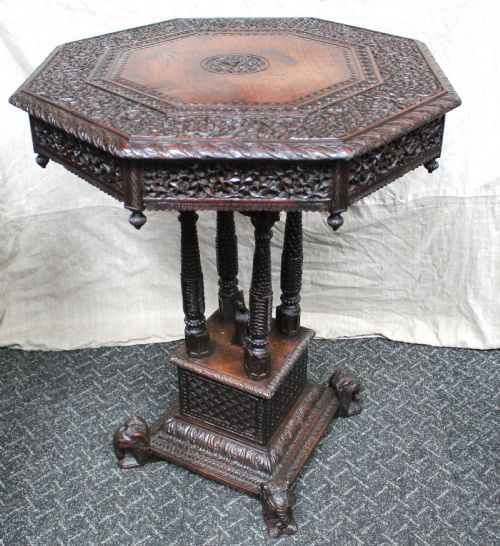
The regional origins span distinct stylistic centres such as Hoshiarpur and the Bombay Presidency, yielding characteristic shapes like octagonal surfaces, circular tops, and shield-shaped coffee tables. Many examples incorporate figural supports, most notably elephant or camel legs carved directly from the timber.
The periods represented stretch across the Victorian era into the early twentieth century, encompassing items dated through the eighteen-forties up to nineteen-thirty. Buyers frequently encounter small folding versions designed for campaign use or stationary pedestal and two-tier side tables.
Materials and construction methods
Makers utilised dense timbers such as solid teak, padouk, and rosewood, providing a heavy, durable structural foundation capable of supporting intricate surface decoration. Artisans then worked these hardwoods using deep relief carving techniques to create elaborate floral, geometric, and animal motifs across the tops and apron rails.
Surface ornamentation frequently incorporates contrasting materials, utilising inlaid brass wire, sheet brass, and bone or bone inlay to highlight the dark grain of the timber. Folding frameworks and removable tray tops relied on precise joinery and collapsible hinges to ensure portability without sacrificing stability.
Listings incorporate materials including teak, rosewood, padouk, brass, and bone inlay across periods spanning the Victorian era into the early twentieth century.
Distinguishing quality in colonial tables
Quality rests primarily in the crispness and depth of the hand-carved detail, where superior examples exhibit sharp relief without splintering the dense hardwood. The integration of contrasting inlays, such as precise brass wire or fitted bone segments, separates standard utility pieces from finer exhibition-grade items.
Structural integrity of folding mechanisms and the alignment of complex geometric or figural supports dictate the standard of execution. The choice of primary timber also influences the piece, with dense, unblemished teak and rich rosewood commanding greater visual depth than lesser mixed hardwoods.
The Dark Teak Occasional Table Glossary
- Anglo-Indian
- Describing decorative arts produced in the Indian subcontinent during the British colonial period, combining traditional local craftsmanship with British furniture forms. These pieces often feature dense carving and exotic hardwoods.
- Hoshiarpur
- A North Indian town renowned for its specialised woodwork, particularly tables featuring intricate bone and brass inlay work set into dark timber. Artisans there mastered dense geometric patterns.
- Tray top
- A furniture surface designed with a raised moulded edge or a removable upper tray, allowing the top to function independently for serving. This form is common in collapsible campaign furniture.
- Tilt-top
- A table construction featuring a mechanism that allows the circular or shaped surface to pivot into a vertical position when not in use. This saved space in nineteenth-century domestic interiors.
- Padouk
- A heavy, durable tropical hardwood displaying a rich reddish-brown colour that darkens gracefully with age. It provided an alternative to teak for fine colonial furniture.
Dark Teak Occasional Table: Frequently Asked Questions
What is an elephant table?
An elephant table is a small occasional piece featuring carved wooden elephant figures supporting the main surface, typically originating from the Bombay Presidency during the late nineteenth century.
These pieces were produced for the colonial export market and use dense hardwoods like teak or rosewood to render the detailed animal legs and trunks.
How do I care for dark teak?
Dark teak and tropical hardwoods require minimal maintenance, benefiting simply from occasional dusting with a dry cloth and protection from direct heat sources.
Avoid heavy liquid polishes that can build up within the deep recesses of hand-carved panels and instead let the natural oils in the timber maintain the lustre.
Were these tables made to fold?
Many Anglo-Indian and campaign tables were constructed with collapsible bases or removable trays to allow for easy transport and storage.
These folding mechanisms rely on clever interlocking wooden hinges or removable pins rather than modern metal hardware.
What defines Hoshiarpur furniture?
Hoshiarpur furniture is distinguished by dense, all-over surface decoration created using intricate micro-mosaic inlay of bone and contrasting dark wood.
Local craftsmen covered entire table surfaces in floral vines and geometric lattices, creating a highly textured and luminous appearance.