




Dark Mahogany Wall Unit
A dark mahogany wall unit solves floor space issues while providing storage, bringing timber warmth and period proportion to a room.
Dark Mahogany Wall Unit
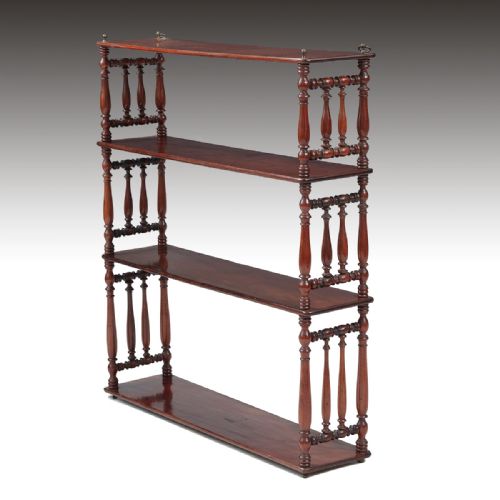
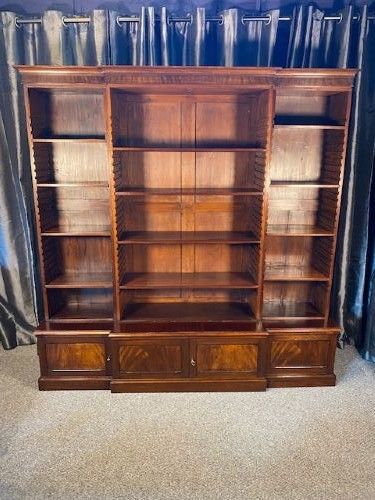
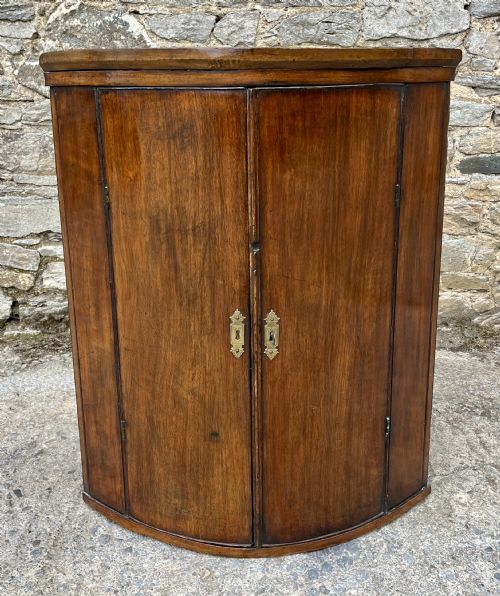
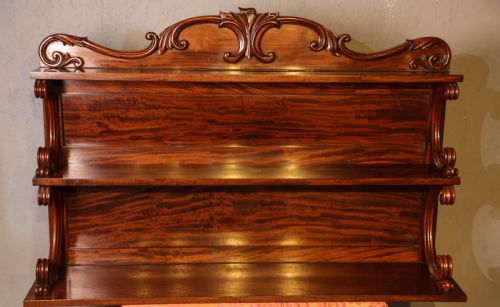
A dark mahogany wall unit encompasses corner cabinets, hanging shelves, and wall-mounted bookcases spanning the Georgian, Victorian, and Regency periods. These pieces are designed to utilise vertical space efficiently, offering enclosed storage or open display without encroaching on the room's floor plan.
The version most commonly encountered on this page is the Georgian or 19th Century hanging corner cupboard, frequently constructed with a bow front. Alongside these, buyers will frequently find sets of hanging shelves and wall cabinets originating from the 18th century onwards.
Materials and construction methods
The primary material is mahogany, occasionally accented with flame mahogany veneer, rosewood, oak, or boxwood inlay. Metal fixtures such as brass frequently appear on hinges, escutcheons, and hanging hardware.
Joinery techniques reflect traditional cabinet making, utilising solid timber alongside veneered surfaces to create bowed fronts, tambour doors, and architectural cornices like broken arch pediments.
Listings span multiple eras, featuring Georgian, Regency, Victorian, and Edwardian periods alongside materials like oak, rosewood, and glass.
Distinctions in quality
Construction integrity also separates standard items from finer works, visible in the choice of secondary timbers, dovetail joint execution, and the original condition of brass hardware and glass panes.
The Dark Mahogany Wall Unit Glossary
- Bow front
- A convex curved cabinet front that projects outward from the corners. This shape softens the angular appearance of a room and requires advanced woodworking skill to build.
- Tambour
- A door constructed from narrow vertical strips of wood glued to a canvas backing, allowing it to slide smoothly around a curved track.
- Pediment
- The decorative triangular or broken architectural crown situated at the top of a cabinet. It draws the eye upward and signals formal period design.
- Crossbanding
- A decorative border of veneer laid around the perimeter of a panel so the grain runs perpendicular to the central field. It frames the wood grain effectively.
- Escutcheon
- A protective plate surrounding a keyhole, frequently fashioned from brass. It prevents the surrounding timber from wearing down through repeated use.
Dark Mahogany Wall Unit: Frequently Asked Questions
How do I hang a heavy wall unit?
These pieces require secure fixing directly into wall studs or masonry using appropriate brackets suited to the weight of the timber. Professional installation ensures the cabinet remains stable when loaded with books or display items.
Older units often feature original hanging brackets or reinforced internal structures designed for wall mounting. Inspect these anchor points carefully before installation.
What is the difference between a corner cabinet and a wall shelf?
Corner cabinets feature enclosed doors, often with shelving inside, to keep dust away from contents while utilising unused room angles. Wall shelves remain open for displaying books or decorative objects.
Both forms maximise vertical space, but enclosed cupboards offer privacy and security for stored items.
How do I identify a Georgian piece?
Georgian pieces typically display proportion, restrained classical ornament, and dense mahogany timbers that have darkened deeply over centuries. Look for hand-cut dovetails and traditional joinery methods.
Details like brass H-hinges and boxwood stringing further point toward 18th-century workshop origins.
Can these cabinets hold heavy books?
Wall-mounted bookcases and portable bookshelves accommodate standard volumes, though fixed shelves distribute weight reliably. Check the thickness of the shelf boards and the strength of their internal supports.
Heavier loads require solid timber construction rather than delicate veneer.
How should I care for mahogany surfaces?
Dust regularly with a soft, dry cloth and apply occasional high-grade beeswax to nourish the timber grain. Avoid placing units in direct sunlight or near heat sources to prevent the wood from drying out.
Gentle maintenance preserves the rich patina developed over generations of use.