




Dark Mahogany Treen
Dark mahogany treen brings together dense tropical timber and domestic utility, offering small functional objects shaped by the lathe or carving knife.
Dark Mahogany Treen
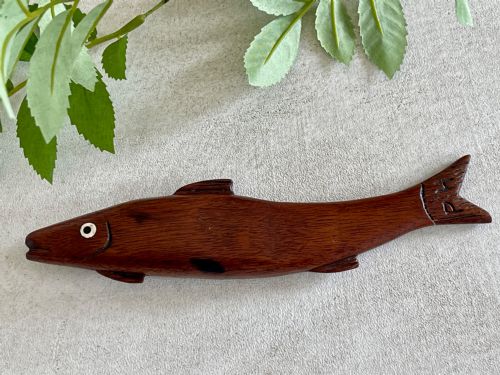
Dark mahogany treen comprises small wooden domestic items, games, and personal accessories shaped from rich, heavy timber. When you search for dark mahogany treen, you encounter functional objects ranging from spill holders and egg cup stands to tobacco boxes and knitting sheaths.
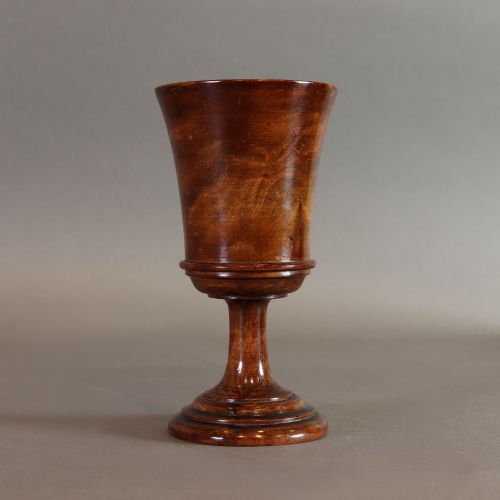
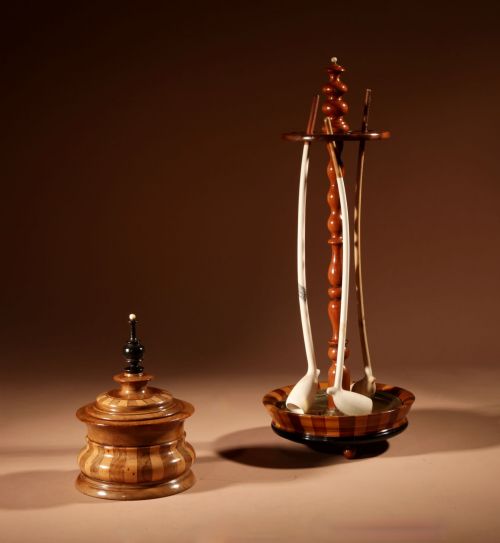
The pieces on this page span the eighteenth and nineteenth centuries, taking in Georgian and Victorian forms alongside folk art interpretations. You find turned circular boxes, pedestal goblets, and decanter stands fashioned for everyday use in wealthy and modest households alike.
Makers often utilised imported mahogany alongside native hardwoods, creating deep brown surfaces that have darkened further through handling and age. These items survive as tactile records of past domestic habits, valued for their utility and the warmth of the polished grain.
Materials and construction
Craftsmen shaped these objects using woodturning lathes and hand-carving tools, working with dense mahogany and related hardwoods. Items like pedestal goblets, spill holders, and ball and cup games rely on precise lathe work to achieve balanced, symmetrical forms.
Larger storage containers and pipe stands utilise coopered construction, assembling curved mahogany staves held together by wooden or metal bands. Secondary materials occasionally appear in small details, such as bone or brass fittings integrated into games and instruments.
One past collection provenance links a revolving egg cup stand directly to the private estate of Mrs Henry Ford the second.
Assessing quality and craftsmanship
Quality in dark mahogany treen rests upon the crispness of the turning and the proportional balance of the object. Superior pieces display clean, sharp mouldings and well-judged wall thicknesses that reveal the turner's precise control over the dense timber.
The condition of the surface and the depth of the natural patina significantly influence the character of each piece. Objects that retain their original rich colour and soft sheen from centuries of handling stand apart from those with stripped or overly polished finishes.
The Dark Mahogany Treen Glossary
- Treen
- Small handmade wooden objects for domestic or personal use. The word derives from an old term meaning made of tree.
- Knitting sheath
- A small carved or turned device tucked into a belt or apron to hold a knitting needle steady. They often show distinct regional carving styles.
- Spill holder
- A small container designed to hold thin tapers of paper or wood used for lighting candles and fires. They sat on mantelpieces and tables across Georgian and Victorian interiors.
- Coopered
- Constructed from curved wooden staves joined edge to edge, similar to the method used for barrels. This technique suited cylindrical containers like tobacco boxes and pipe stands.
- Bilboquet
- A traditional cup and ball game requiring dexterity to catch the ball on a spike or in the cup. Examples are carved from solid hardwood.
- Cheese coaster
- A small trolley or stand fitted with small rollers, designed to glide smoothly along a dining table. They kept heavy mahogany cheese sledges moving easily among guests.
Dark Mahogany Treen: Frequently Asked Questions
How were these objects used?
These items served practical domestic functions, from holding tobacco and pipes to storing fruit, nuts, or eggs. Others, such as knitting sheaths and cup and ball games, provided utility and pastime.
Every piece was designed for a specific task in the household or for personal entertainment.
How do I care for mahogany treen?
Keep wooden treen out of direct sunlight and away from sudden temperature shifts to prevent the timber from splitting. A light application of natural wax helps maintain the surface sheen.
Avoid using water or harsh modern cleaning products on antique wood surfaces.
How can I tell the period?
Dating relies on observing the turning style, construction methods, and tool marks left on the timber. Georgian pieces often display different proportions and mouldings compared to later Victorian examples.
Wear patterns and the depth of the patina also offer clues to the age of the piece.