



Dark Brown Loo Table
A dark brown loo table brings deep wood tones and a tilting top to a room, serving as both a dining piece and an impressive centre table.
Dark Brown Loo Table
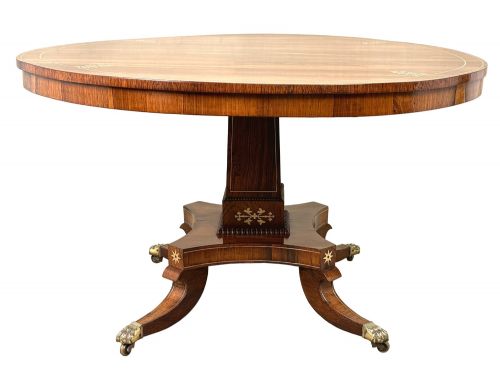
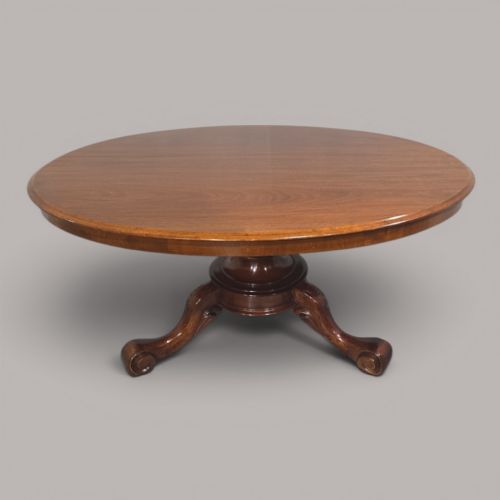
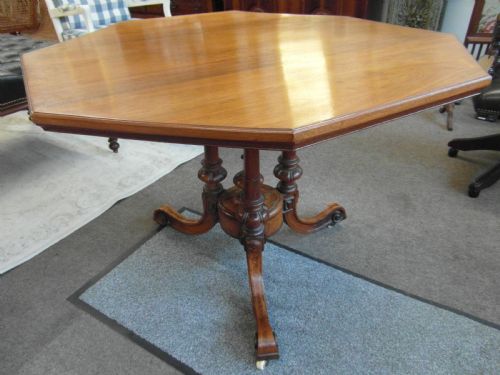
A dark brown loo table is a large, freestanding piece designed to sit in the middle of a room, often featuring a tilt mechanism that allows the top to stand vertically when not in use. The examples seen here belong mainly to the 19th century, spanning the Regency, William IV, and Victorian periods.
Most pieces encountered on this page are circular, oval, or violin-shaped tables, constructed from rich timbers like rosewood, mahogany, and walnut. They serve versatile functions, appearing across the inventory as centre tables, dining tables, and coffee tables.
Buyers seeking this phrase will find a strong representation of Victorian and Regency craftsmanship, where dark timber surfaces demonstrate the traditional forms used for evening card games and social gatherings.
How they were made
Cabinet makers utilised dense hardwoods such as mahogany, rosewood, and walnut to build these robust tables, often selecting burr walnut for its distinctive patterned grain. Timber veneers were carefully applied over solid secondary woods to create smooth, expansive surfaces for circular and oval tops.
Many pieces incorporate intricate wood inlay, marquetry, and brass inlay set directly into the dark wood surfaces, alongside turned pedestals and heavy supporting bases. The tilt-top mechanisms were engineered with sturdy pivots and brass catches to allow the heavy tops to move securely between horizontal and vertical positions.
Listings span the nineteenth century, including Regency, William IV, and Victorian periods, constructed primarily in rosewood, mahogany, and walnut.
What varies in quality
The distinction between standard examples and the finest pieces lies in the choice of timber and the sophistication of the decorative work. Rich burr walnut, elaborate marquetry, and precise brass inlay elevate a table far above plain mahogany or simpler fruitwood constructions.
Constructional refinement also dictates value, seen in the weight and stability of the central pedestal, the crispness of the carved details, and the seamless operation of the tilt mechanism. Tables bearing documented maker signatures or attributed designs show a higher level of workshop execution.
James Winter of Wardour Street·George Smith
The Dark Brown Loo Table Glossary
- Loo table
- A large nineteenth-century table designed for the card game loo, featuring a tilt-top mechanism for convenient storage against a wall.
- Tilt top
- A hinged table top that rotates from a horizontal surface to a vertical position, secured by a brass latch or catch.
- Marquetry
- Decorative patterns formed by the insertion of different coloured wood veneers into a solid wood matrix.
- Centre table
- A freestanding table finished on all sides, intended to occupy the middle of a room rather than sit against a wall.
Dark Brown Loo Table: Frequently Asked Questions
What is a loo table used for?
These tables were originally created for the nineteenth-century card game called loo, requiring a spacious surface that could accommodate players gathered around the centre of a room.
Today, buyers use them as grand dining tables, large coffee tables, or prominent entrance hall pieces that double as sculptural furniture when tilted upright.
How do I tilt the top?
The mechanism relies on a pivoting block beneath the surface held in place by a brass catch or sliding bolt. Releasing this catch allows the heavy wooden top to swing smoothly into a vertical position for storage.
Support the weight of the top with both hands while operating the catch to prevent any sudden movement or strain on the pivot.
Are these tables solid wood?
Most examples combine solid timber frames and pedestals with finely figured wood veneers applied to the broad surfaces of the top. This technique allowed cabinet makers to display striking grain patterns like burr walnut without risking the warping common in large solid planks.
The base structures and turned columns are typically carved from heavy native or exotic hardwoods to provide adequate stability.
How do I tell Regency from Victorian?
Regency pieces often display restrained classical lines, geometric brass inlay, and rosewood surfaces reflecting early nineteenth-century neoclassical tastes. Victorian examples tend towards heavier proportions, elaborate marquetry, and rich burr walnut finishes with ornate carved pedestals.
Examining the construction methods, secondary timbers, and decorative motifs helps clarify the specific period of manufacture.