



Curved Wood Accent Table
These curved wood accent table pieces bring fluid lines to domestic rooms, combining bentwood or inlaid timber with practical small surfaces.
Curved Wood Accent Table
When searching for a curved wood accent table, a buyer encounters a diverse group of occasional, side, and console furniture spanning the nineteenth and twentieth centuries. These pieces serve functional roles beside seating or against hallway walls while introducing organic forms to an interior.
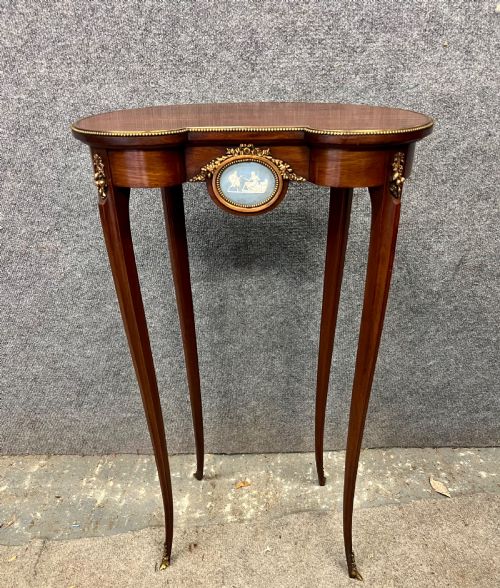
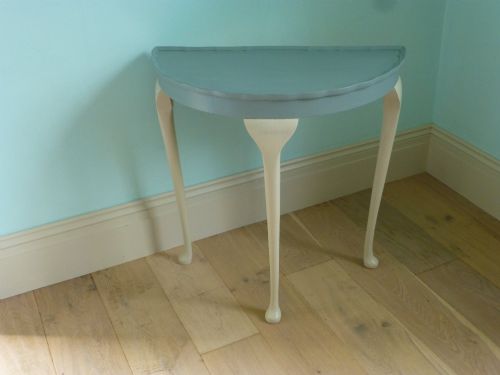
The versions met most frequently on this page include Edwardian mahogany occasional tables, Art Deco coffee tables, and satinwood examples executed in Sheraton Revival or Art Nouveau idioms. Forms range from kidney-shaped lamp tables and demi-lune consoles to Viennese bentwood side pieces.
Origins vary across British and continental workshops, reflecting shifts from nineteenth-century revivalism toward modernist minimalism in the interwar decades. Each item demonstrates how makers manipulated timber to soften room corners through arcs and rounded perimeters.
Materials and construction
Construction relies heavily on mahogany, satinwood, and walnut, often enhanced with burr walnut or birds eye maple veneers that accentuate natural grain patterns. Cabinetmakers utilised timber bending techniques alongside traditional joinery to achieve structural curves without compromising stability.
Brass elements appear as mounts or sabots, while painted wood surfaces offer alternative decorative finishes on demi-lune console tables. In bentwood production, solid timber is subjected to steam to enable extreme radial shaping, characteristic of Viennese workshop output.
Curved Wood Accent Table Retail Price Guide 2026
Typical asking prices for curved wood accent table among the pieces listed under this phrase on Sellingantiques today, from the lower quarter to the upper quarter. They describe what is for sale here now, not the wider market.
Object types recorded across the inventory include side tables, occasional tables, console tables, coffee tables, pembroke tables, and centre tables.
Qualities that distinguish the range
The hierarchy of quality rests on the precision of the timber bending and the finesse of surface decoration, such as intricate marquetry inlay or matched veneer selection. Superior examples display seamless curved joints and harmonious proportions that integrate the organic silhouette with functional utility.
Lesser pieces rely on simpler surface treatments and heavier framing that obscure the fluid grace intrinsic to the form. The distinction lies in whether the timber manipulation serves an aesthetic vision or merely functions as basic carpentry.
Gilbert Rohde·Fischel·Thonet
The Curved Wood Accent Table Glossary
- Bentwood
- Wood that has been shaped by heating it with steam and then bending it into curved forms. This technique creates lightweight yet robust frames seen in continental tables.
- Demi-lune
- A half-moon shape used for console and hall tables designed to stand flat against a wall. The curved front softens the transition of furniture in narrow spaces.
- Marquetry
- Decorative patterns created by fitting small pieces of veneer into a wooden support. This technique decorates tabletop surfaces with floral or geometric motifs.
- Occasional table
- A small, movable table designed for specific, intermittent use within a room. Examples include lamp tables and small tea pieces.
Curved Wood Accent Table: Frequently Asked Questions
What defines a curved wood accent table?
A curved wood accent table is a small surface piece featuring rounded perimeters, kidney shapes, or bentwood frames. These items range from Edwardian occasional tables to Art Deco coffee tables.
They introduce organic silhouettes into domestic interiors while providing practical placement for lamps and small objects.
How do I identify an Art Deco table?
Art Deco tables typically date from the early decades of the twentieth century and showcase geometric symmetry combined with smooth curves. They frequently utilise exotic veneers like birds eye maple or ebonised details.
Unlike earlier revival styles, they lean towards streamlined modernity without ornate carving.
Where should I place a console table?
Console tables with curved fronts, such as demi-lune hall pieces, work best positioned flat against a wall in entryways or corridors. Their shallow depth allows them to occupy narrow pathways without obstructing movement.
They provide an immediate surface for keys or decorative objects upon entering a room.
What is satinwood furniture?
Satinwood furniture utilises a dense, yellowish timber known for its natural sheen and smooth texture. It became popular during revival periods for light, elegant occasional tables.
Makers often paired it with inlaid contrasting woods to create delicate tabletop patterns.
How do bentwood tables differ?
Bentwood tables rely on steam-heated timber manipulated into continuous curves rather than cut and joined segments. This technique produces lightweight frames associated with Viennese manufacturing.
They offer structural resilience combined with an airy visual presence.