
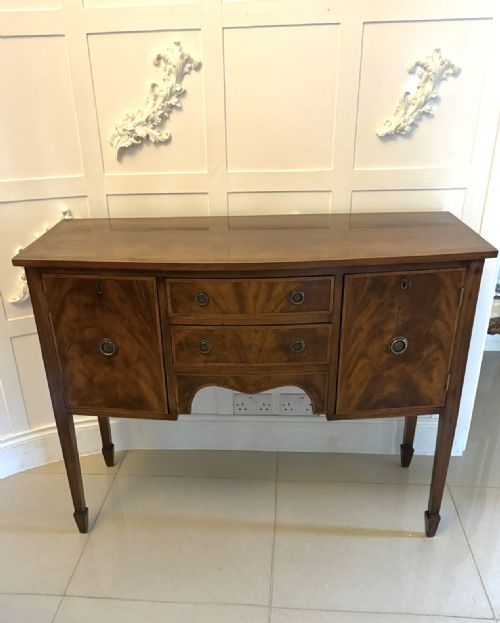


Curved Mahogany Buffet
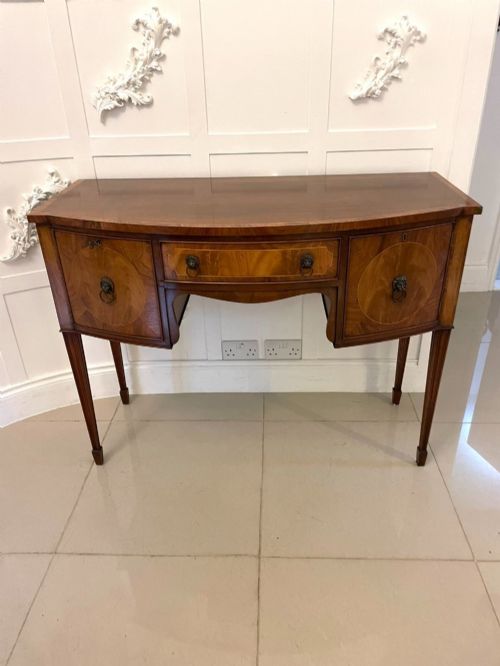
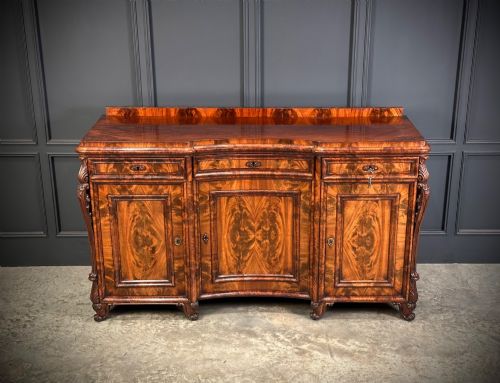
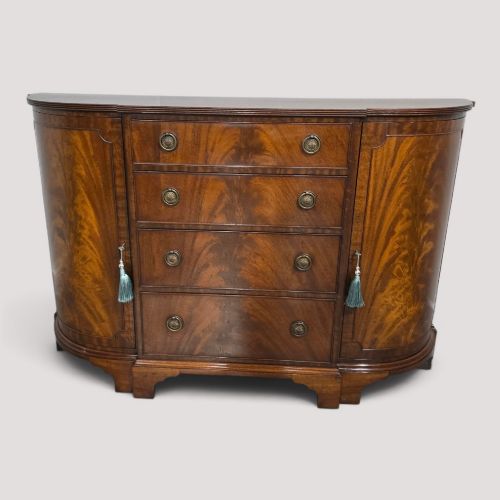
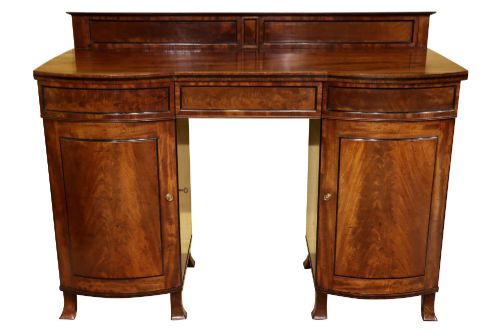
These curved mahogany buffet pieces bring sweeping lines and rich timber into a dining room with genuine presence.
Curved Mahogany Buffet
A curved mahogany buffet represents a refined form of dining furniture designed for serving and storage, appearing predominantly across Georgian, Regency, and nineteenth century periods. These items feature characteristic bowed, serpentine, or demi-lune fronts that soften the rigidity of a traditional dining room layout.
The versions most frequently met on this page include Georgian and Regency examples, alongside later nineteenth century and Edwardian interpretations. Makers constructed these pieces as sideboards, serving tables, and side cabinets, utilising the natural grain of mahogany to create striking visual focal points.
How they were made
Cabinet makers relied primarily upon solid mahogany and flame mahogany veneer, chosen for deep figuring and rich warmth. They laid these veneers carefully over secondary timbers to achieve sweeping curves along the front elevation.
Detailing often involved delicate boxwood and satinwood inlay, alongside brass fittings such as handles and rails. Construction demanded precise joinery to maintain the structural integrity of bowed and serpentine shapes over centuries of use.
The listings span from the eighteenth century through to the Art Deco period, showcasing mahogany, satinwood, and boxwood.
What varies in quality
Quality rests significantly in the selection and bookmatching of the mahogany veneer, where superior examples display symmetrical flame patterns across the curved drawers and doors. The crispness of inlaid stringing and the depth of the timber's natural patina further distinguish finer pieces from simpler workshop productions.
Structural harmony also separates the work, seen in how gracefully the bowed frame meets the legs and how smoothly the drawers operate within their curved housings. Well-proportioned pedestal ends and original brass hardware elevate an item beyond standard utilitarian furniture.
Bowman Brothers
The Curved Mahogany Buffet Glossary
- Bow front
- A convex curved cabinet front that projects outward in a smooth arc. This shape defined many Georgian and Regency sideboards.
- Serpentine
- A front contour characterised by a convex centre flanked by concave ends, or vice versa. It requires high skill in woodworking to execute properly.
- Demi-lune
- A half-moon shape used for console tables and sideboards. These pieces fit flat against a wall while offering a curved profile.
- Flame mahogany
- A veneer cut from the branch junction of a mahogany tree, showing a flamy, mottled grain pattern. It provided high visual drama for elite cabinetwork.
- Inlay
- Contrasting woods such as boxwood and satinwood set into the surface of the mahogany. This technique created geometric borders and decorative motifs.
Curved Mahogany Buffet: Frequently Asked Questions
How were these buffets used historically?
Dining rooms utilised these cabinets for holding silverware, linens, and serving dishes during large meals. Servants placed dishes upon the top surface before bringing them to the dining table.
Their curved designs allowed easier movement around the furniture in crowded townhouses and country estates.
How do I date a mahogany sideboard?
Dating relies upon examining the secondary woods, construction methods, and stylistic details like leg shapes and handle designs. Georgian pieces tend to show hand-cut dovetails and understated bracket feet.
Later nineteenth and twentieth century interpretations often incorporate machine-cut elements and bolder Revival styling influenced by French or Edwardian tastes.
How do I care for mahogany furniture?
Mahogany thrives in stable indoor environments away from direct sunlight and sudden temperature shifts. Regular dusting with a soft, dry cloth preserves the polished surface.
Applying traditional wax occasionally nourishes the timber and maintains the deep lustre of the original polish without sealing the wood.