

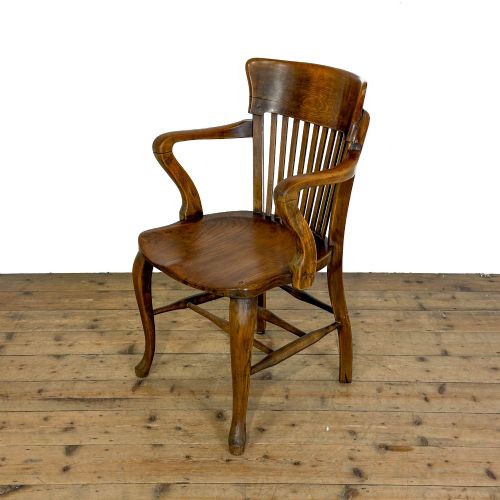


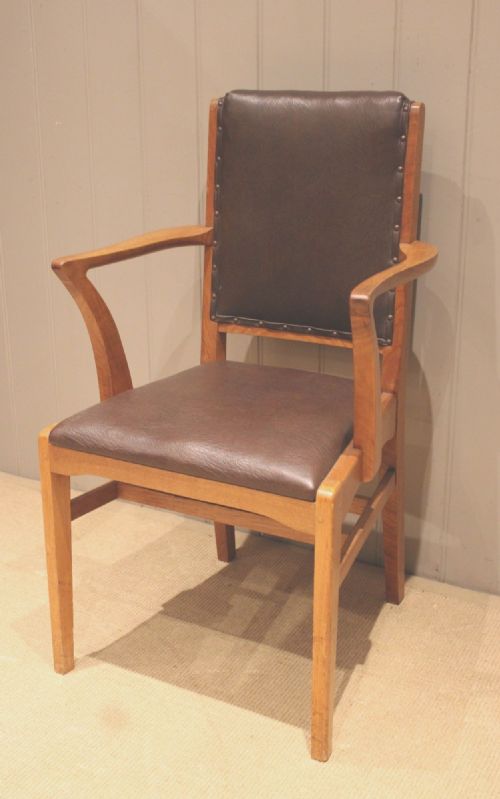


Curved Arm Office Chair
A curved arm office chair gives daily seating both character and support, spanning Edwardian oak designs and Regency mahogany forms.
Curved Arm Office Chair
A curved arm office chair brings together desk chairs and armchairs intended for working spaces, drawing on a span of periods from the nineteenth century into the nineteen-thirties. You meet styles ranging from Queen Anne style and Sheraton revival to Art Deco and Regency, reflecting shifts in taste across decades of commercial and domestic furnishing.
The most common versions on this page are constructed in mahogany and oak, often taking the form of desk armchairs or tub armchairs. Pieces trace origins through the Edwardian era, Victorian period, and early twentieth century, showing how workspace seating evolved to support the user while maintaining traditional cabinet-making forms.
Materials and construction
Timbers such as mahogany, oak, and walnut form the structural framework of these chairs, frequently complemented by secondary woods and solid construction methods. Workshops utilised bentwood techniques in specific instances, shaping timber under steam to create flowing lines.
Upholstery materials including leather and fabric provide seat and back padding, while brass and iron elements appear in mounts, inlays, and structural supports. Inlaid details in lighter woods decorate mahogany surfaces on specific revival pieces.
Curved Arm Office Chair Retail Price Guide 2026
Typical asking prices for curved arm office chair among the pieces listed under this phrase on Sellingantiques today, from the lower quarter to the upper quarter. They describe what is for sale here now, not the wider market.
One listed bentwood armchair carries a direct link to a natural history agency, showing utility beyond the standard office.
Judging quality in office seating
The standard of timber selection distinguishes finer examples, particularly where figured mahogany, burr walnut, or quarter-sawn oak displays natural grain patterns. Execution of traditional joinery and carved or inlaid details marks the difference between standard commercial output and workshop production.
Integration of materials such as supple leather upholstery and patinated brass hardware influences the overall finish. Proportions and the careful shaping of curved armrests determine how successfully comfort meets structural design.
Thonet·Watkins & Doncaster
The Curved Arm Office Chair Glossary
- Sheraton revival
- A late nineteenth or early twentieth century style drawing inspiration from the lighter neoclassical furniture designs of Thomas Sheraton. It frequently employs mahogany with delicate inlay work.
- Bentwood
- Wood shaped by heating and bending it into curved forms, a technique used by makers like Thonet to create strong, light chair frames. This method reduced joints and allowed for continuous fluid lines.
- Tub armchair
- An upholstered chair with a continuous curved back and arms that form a rounded enclosure. This form provides enclosing side support for the seated person.
- Sabre leg
- A concave tapering furniture leg that curves outward towards the back, reminiscent of a cavalry sabre. This form appears frequently on Regency furniture designs.
- Queen Anne style
- A revival style referencing early eighteenth-century English furniture, characterised by cabriole legs and curved structural lines. It emphasises domestic comfort through restrained ornamentation.
Curved Arm Office Chair: Frequently Asked Questions
What periods do these chairs cover?
The selection spans from the nineteenth century through the Edwardian era and into the nineteen-thirties. Pieces represent various historical revivals alongside pieces made during the Regency, Victorian, and Art Deco periods.
Chronological placement relies on stylistic traits, construction methods, and documented dates within individual listings. Each era brought distinct preferences for timber and decorative detailing.
How were these chairs used originally?
They served primarily at writing desks, tables, and in offices where ergonomic support and mobility were required for administrative tasks. The addition of curved arms provided comfort during long periods of writing or reading.
Many designs bridged domestic libraries and commercial offices, reflecting the changing nature of professional workspaces during the nineteenth and early twentieth centuries.
Which woods appear most frequently?
Mahogany and oak dominate the selection, appearing in both solid forms and veneered surfaces. Walnut and burr walnut are also used to achieve decorative grain patterns on specific desk chairs.
Secondary materials include brass for inlay and mounts, alongside iron framework on industrial or specialised seating forms.
How do I identify a revival style?
Revival pieces borrow decorative vocabulary and structural forms from earlier centuries, such as Sheraton or Queen Anne designs, but are manufactured at a later date. They combine historical aesthetics with the woodworking techniques of their actual period of production.
Examining internal construction, timber preparation, and secondary woods helps distinguish a nineteenth or twentieth-century interpretation from original period work.