
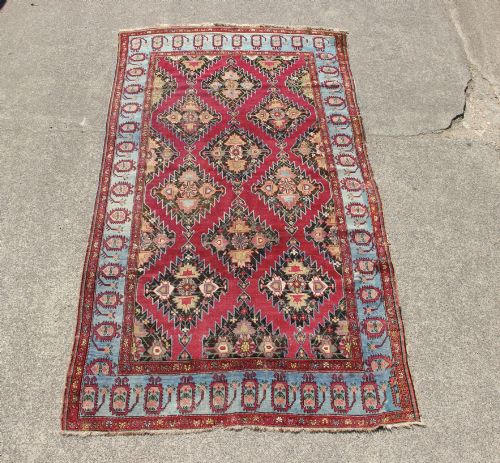
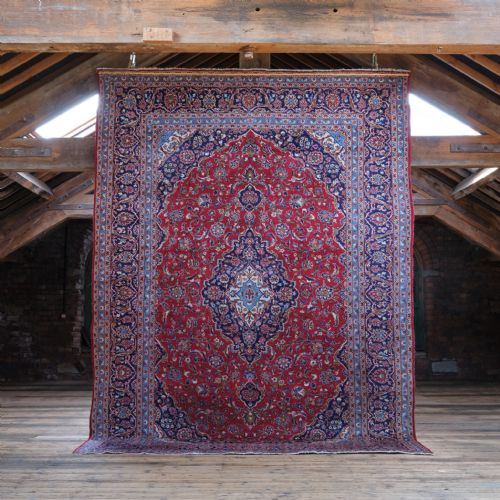

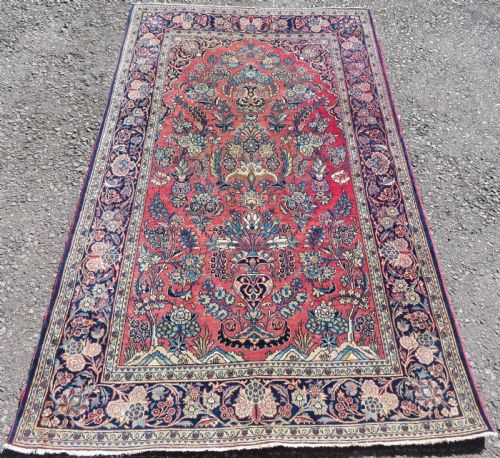


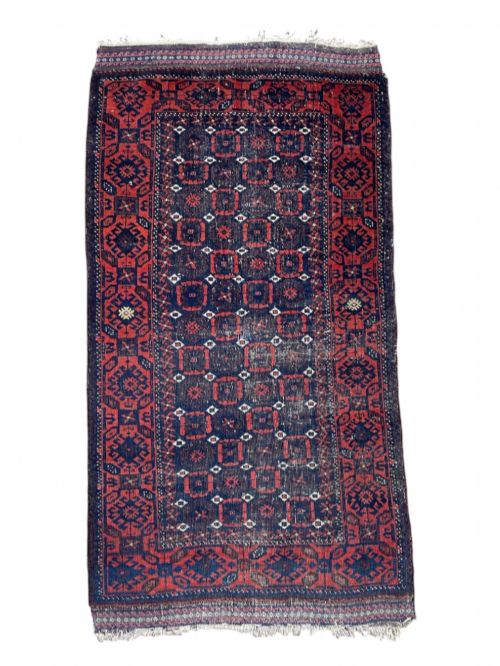


Crimson and Blue Rug
These crimson and blue rug options bring deep madder reds and indigo dyes into a room, offering centuries of regional weaving traditions.
Crimson and Blue Rug
A crimson and blue rug gathers floor coverings from Persian, Caucasian, Turkish, and Indian origins, spanning the nineteenth and twentieth centuries. These pieces encompass large carpets, area rugs, runners, and kilims.
The selections available here lean heavily towards Persian city and village workshops, alongside Turkish and Caucasian tribal output, featuring wool constructions from periods ranging from eighteen-eighty to nineteen-forty.
How they were made
Weavers constructed these textiles using wool piles tied onto cotton foundation warps and wefts, employing hand-knotted techniques to build dense surfaces.
Dyers utilised natural materials to achieve deep crimson and blue tones, creating stable palettes that hold their character across decades of use.
The listings feature pieces dated from the nineteenth century up to nineteen-forty, utilising wool and cotton across Persian, Turkish, and Indian styles.
What varies in quality
Knot density and precision of drawing separate standard village output from finer city workshop productions, influencing how sharply the motifs resolve.
The depth and saturation of the red and blue dyes dictate the visual strength of the piece, alongside the overall integrity of the wool pile and foundation.
The Crimson and Blue Rug Glossary
- Madder
- A natural dye plant root yielding red hues. It provides the foundational crimson tones seen in many antique Oriental carpets.
- Indigo
- A vegetal dye source producing deep blues. This pigment forms the contrasting dark blue grounds and borders in traditional rugs.
- Warp
- The vertical threads stretched on a loom. Cotton warps provide the stable structural grid supporting the knotted wool pile.
- Weft
- The horizontal threads passed between warp rows. They bind the knots tightly in place across the width of the carpet.
- Kilim
- A flat-woven carpet lacking a pile. These pieces rely on interlocking weft techniques rather than knotted tufts.
Crimson and Blue Rug: Frequently Asked Questions
How do I clean a wool rug?
Vacuum gently without a rotating brush roll to protect the pile and foundation threads from undue stress.
Professional specialist washing remains essential for deep cleaning to prevent dye bleed between the crimson and blue sections.
Can I place these in a hallway?
Runner formats and smaller rugs fit narrow corridors and transitional spaces effectively. Ensure you place a quality underlay beneath the piece to prevent slipping and reduce friction on the cotton foundation.
Foot traffic distributes wear across the wool surface, though high-traffic areas require rotation to maintain even distribution.
How do I date an antique rug?
Examine the palette, wool quality, and structural characteristics such as selvedges and end finishes. Natural dyes and hand-spun wool typically point to nineteenth or early twentieth-century origins.
Stylistic motifs and regional weaving structures help narrow the decade of production when compared against known examples.
Why do colours vary in different lights?
Natural dyes interact dynamically with shifting daylight and artificial illumination. Madder red and indigo blue can appear deeper or softer depending on the angle of the light.
Hand-spun wool absorbs dye unevenly across the fleece, creating subtle tonal shifts known as abrash across the field.