


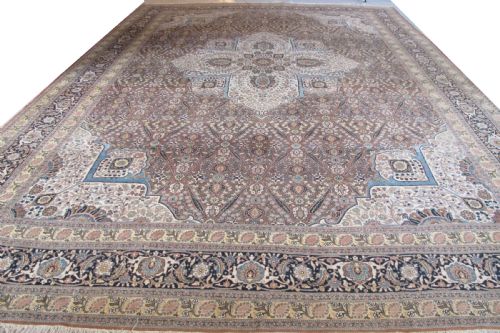


Cream Tabriz Medallion Rug
A cream tabriz medallion rug offers fine Persian knotwork and balanced floral design, anchoring a room with subdued elegance and lasting warmth.
Cream Tabriz Medallion Rug
A cream tabriz medallion rug brings together traditional Persian artistry and soft, light palettes suited to formal and country house interiors alike. These floor coverings originate from North-West Persia, displaying precise craftsmanship developed across decades.
The pieces available on this page span from the late nineteenth century to the early twentieth century, specifically covering the 1890s through to 1930. Buyers will frequently encounter roomsize carpets alongside smaller rugs, all sharing the characteristic central medallion motif.
Makers such as Benlian and Hajji Jalili emerge in the evidence, representing the skilled workshops of the region. These works utilise traditional floral medallion designs set against pale neutral grounds.
Materials and construction methods
These carpets and rugs employ durable wool pile foundation paired with cotton structural elements. Weavers in North-West Persia knotted fine wool by hand onto cotton warps and wefts to achieve intricate detail.
The reliance on natural materials allowed workshops to produce dense, resilient piles that withstand generations of use. Soft pastel colours and cream tones dominate the palette, achieved through traditional dyeing techniques.
Cream Tabriz Medallion Rug Retail Price Guide 2026
Typical asking prices for cream tabriz medallion rug among the pieces listed under this phrase on Sellingantiques today, from the lower quarter to the upper quarter. They describe what is for sale here now, not the wider market.
Several carpets carry the proud legacy of country house floors, having walked under decades of muddy boots and stately tea parties.
Judging quality in Tabriz weaving
Knot density and the precision of the central medallion define the upper tier of these Persian carpets. Finer execution allows complex floral motifs to maintain crisp outlines against the cream background.
Workshop attribution plays a part, as pieces associated with master producers like Hajji Jalili or Benlian display superior balance in composition and subtlety in pastel shading.
Benlian·Hajji Jalili
The Cream Tabriz Medallion Rug Glossary
- Tabriz
- A major carpet-weaving centre in North-West Persia known for producing finely knotted rugs with intricate floral and medallion designs. Pieces from this region often incorporate distinctive workshop signatures.
- Medallion
- A large central ornamental design placed symmetrically in the middle of the rug field. This focal point anchors the surrounding floral and geometric motifs.
- Warp
- The vertical threads stretched tightly on the loom that form the structural foundation of the rug. The exposed fringe at the ends of a carpet consists of these parallel threads.
- Weft
- The horizontal threads passed alternately over and under the warp threads to lock the knots in place. Together with the warp, they create the stable grid of the textile.
Cream Tabriz Medallion Rug: Frequently Asked Questions
How do I date a Tabriz rug?
Dating relies on stylistic markers, structural analysis, and records associated with specific workshop production periods. Pieces in this category generally span the late nineteenth century to the interwar years.
Examining the dye palette and the wear patterns on the wool pile helps confirm the age and origin of the carpet.
Where were these rugs made?
These carpets originate from Tabriz in North-West Persia, a historic hub for skilled textile artisans. Workshops in this city supplied both domestic and international markets with finely knotted floor coverings.
Production methods remained consistent across generations, maintaining regional design traditions.
How should I clean a wool rug?
Gentle surface cleaning and regular vacuuming without a beater bar protect the delicate wool pile. Professional rug cleaners experienced in antique Persian textiles should handle deep washing.
Avoiding excessive moisture prevents damage to the cotton foundation threads.