
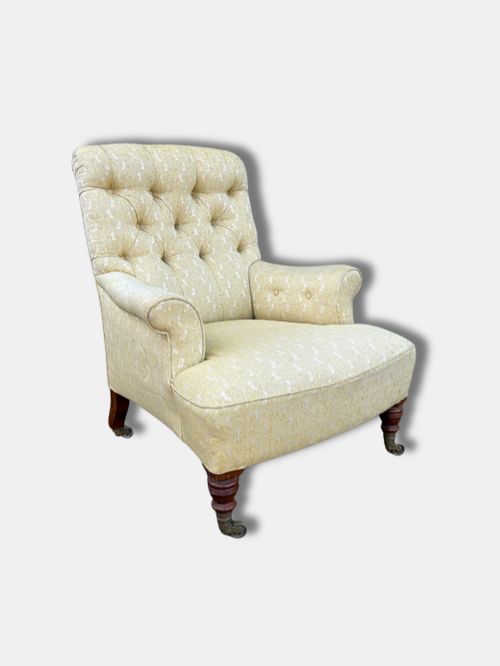


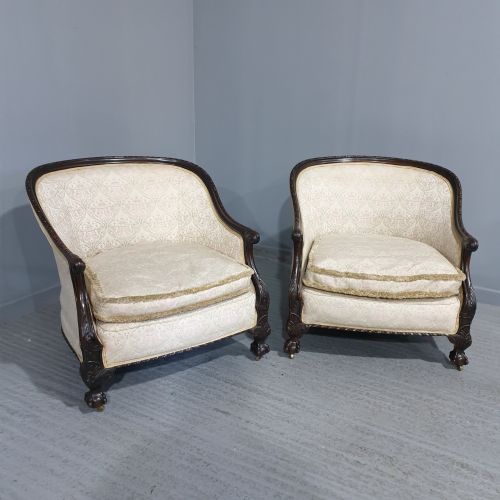


Cream Damask Easy Chair
These cream damask easy chairs offer deep upholstery and sturdy frames, bringing period comfort and traditional seating into the room.
Cream Damask Easy Chair
A cream damask easy chair provides traditional seating through generous armchairs and winged forms, often seen in nineteenth century and early twentieth century examples. These pieces combine deep upholstery with wooden frames, ranging from Victorian drawing room chairs to Edwardian library seating.
The selection here includes button upholstered designs, hoop backed easy chairs, and barrel backs alongside Chippendale and Carolean revival styles. Mahogany frames and exposed carved wood frequently support the damask fabric upholstery.
Makers such as Howard and Sons and retailers like Harrods appear in the listings alongside unbranded period seating. Buyers will find both pairs and single armchairs suited to traditional interiors.
How they were made
Frames rely principally on mahogany and general wood construction, often shaped with hand carving to form the legs, arms, and wings of the chair. Cabinetmakers employed traditional joinery to ensure stability beneath the heavy padding required for easy chairs.
Upholstery techniques involve buttoning, ribbed backing, and barrel shaping covered in damask fabric. Brass details and exposed polished wood complement the textile finish on Victorian and Edwardian examples.
Listings feature items spanning the nineteenth century, the eighteen-eighties, the Victorian era, and nineteen-ten.
What varies in quality
The distinction between standard commercial seating and top tier commissions rests on the sophistication of the frame carving and the pedigree of the maker. Pieces bearing stamps from established London firms or houses demonstrate superior cabinetwork compared to uncredited workshop output.
Fabric choice and upholstery execution dictate the visual success of the piece, with complex buttoning and well-tensioned damask elevating the textile finish. The integration of period revival styling, such as Carolean or Chippendale motifs, marks out the more ambitious examples.
Howard and Sons·Harrods, London
The Cream Damask Easy Chair Glossary
- Damask fabric
- A reversible figured textile traditionally woven on a drawloom with patterns formed by contrasting warps and wefts. It provides the characteristic patterned upholstery surface seen on these chairs.
- Wing chair
- An armchair with side panels or wings attached to the back, designed to shield the sitter from drafts. This form frequently appears in Victorian and revival styles.
- Button upholstery
- A technique where deep tufting is secured with twine and buttons pulled tight into the padding. This method creates regular geometric indentations across the backrest.
- Carolean revival
- A nineteenth century stylistic return to the carved walnut and rich textiles of the late seventeenth century. Pieces in this style feature elaborate woodwork and scrolling details.
- Hoop backed
- A chair design where the backrest forms a continuous curved loop rather than meeting at sharp right angles. This shape offers an ergonomic curve for the sitter.
Cream Damask Easy Chair: Frequently Asked Questions
What defines a cream damask easy chair?
These armchairs combine fully upholstered bodies covered in patterned damask fabric with timber frames, originating primarily from the nineteenth and early twentieth centuries. They are built for comfort, featuring high backs, padded arms, and substantial proportions.
They appear in various revival styles, including Chippendale and Carolean, offering deep seating tailored for libraries and drawing rooms.
How do I identify a Victorian easy chair?
Victorian examples often display darker mahogany frames, button upholstery, and distinct revival detailing such as carved cabriole legs or winged backs. The proportions tend to be heavy and robust to support deep padding.
Makers' marks or stamps from prominent London retailers can occasionally be found on the frame beneath the upholstery.
Where should I place an easy chair?
These armchairs suit sitting rooms, studies, and libraries where traditional furniture creates a classic interior. Their substantial size requires adequate floor space to allow the carved wood and damask fabric to be viewed properly.
Pairing them with low reading tables or placing them near a fireplace highlights their original domestic function.
What is Edwardian upholstery style?
Edwardian easy chairs generally present slightly lighter proportions than their Victorian predecessors while retaining deep, comfortable padding. Woodstock style and hoop backed variants are typical of this period.
The woodwork often shows refined carving, and the damask fabric reflects early twentieth-century interior preferences for lighter, elegant tones.