



Cranberry Glass Bonbon Dish
These cranberry glass bonbon dish examples bring rich pink and ruby tones to table settings through colourful glass paired with silver mounts.
Cranberry Glass Bonbon Dish
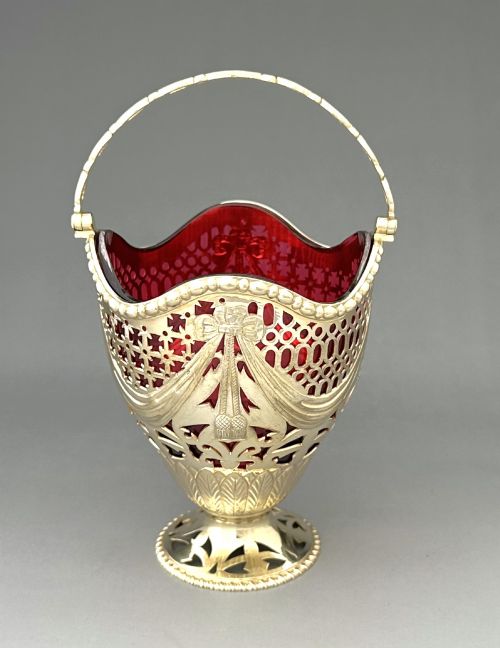
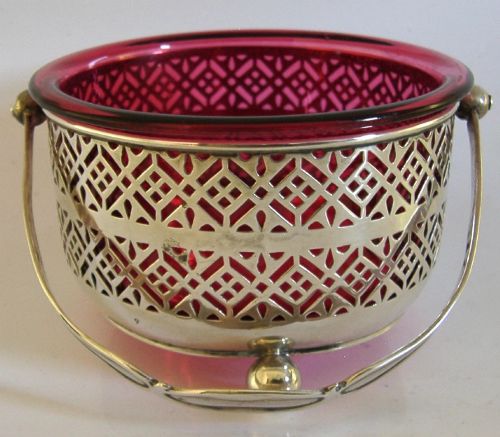
A cranberry glass bonbon dish combines a vibrant pink or ruby glass insert with a metal stand, frame, or swing handle. Buyers looking at these items will find forms spanning sugar baskets, preserve dishes, decorative bowls, and serveware.
The pieces on this page originate predominantly from the Victorian and Edwardian eras, alongside specific dates from eighteen-sixty to nineteen-ten. Victorian examples tend to feature frilled glass edges and heavy stands, while Edwardian pieces often display lighter mounts.
Art Nouveau influences also appear in the selection through fluid metalwork framing ruby glass inserts. Most items function as open vessels designed for sweets, preserves, or table presentation.
Materials and construction methods
Makers produced the glass inserts using gold oxide in the molten batch to achieve the characteristic pink or ruby colouration. Craftsmen then shaped the vessels by hand, frequently creating frilled rims or optic-blown patterns.
Metal mounts were manufactured from sterling silver, silver-gilt, silver plate, or pewter to support the fragile glass bowls. Piercing techniques and swing handles were frequently utilised on the frames during the late nineteenth and early twentieth centuries.
Cranberry Glass Bonbon Dish Retail Price Guide 2026
Typical asking prices for cranberry glass bonbon dish among the pieces listed under this phrase on Sellingantiques today, from the lower quarter to the upper quarter. They describe what is for sale here now, not the wider market.
Some preserve dishes come equipped with swing handles designed purely for dramatic effect rather than actual lifting.
Distinguishing quality across the range
Quality rests upon the depth and uniformity of the glass colour, as well as the crispness of any applied frills or ribbing. Richer pink tones and heavier metal plating or solid silver mounts elevate a piece above standard production.
The harmony between the glass liner and its metal basket determines the success of the design. Pierced metalwork that complements rather than overpowers the glass indicates careful workshop execution.
WMF
The Cranberry Glass Bonbon Dish Glossary
- Cranberry glass
- A transparent pink glass coloured by the addition of gold chloride to the molten metal. It gained widespread popularity during the Victorian period for tableware and decorative objects.
- Silver-gilt
- Silver that has been coated with a thin layer of gold on its surface. This technique provides a rich golden appearance while utilising a silver base structure.
- Swing handle
- A movable arched handle attached to the sides of a basket or dish by pivots. It allows the user to lift the vessel easily and folds down when placed on a table.
- Ruby glass
- A deep red glass produced using copper or gold in the batch formulation. It shares technical similarities with cranberry glass but displays a darker, more saturated tone.
- Pierced work
- Metalwork decorated by cutting or piercing patterns through the surface. This method lightened the weight of silver and silver-plated stands while creating intricate decorative motifs.
Cranberry Glass Bonbon Dish: Frequently Asked Questions
What were cranberry glass bonbon dishes used for?
These vessels served primarily on dining tables and sideboards to hold small sweets, sugar, or fruit preserves during formal meals and afternoon tea.
Their bright colour and decorative metal mounts also made them suitable as ornamental display pieces in Victorian and Edwardian drawing rooms.
How do I care for a glass insert?
Wash the glass gently by hand using lukewarm water and mild soap to protect the surface and any delicate coloured layers.
Avoid abrasive sponges and harsh chemical cleaners that might scratch the vintage glass or damage associated metal mounts.
How can I tell Victorian from Edwardian pieces?
Victorian examples often feature heavier, ornate frames with frilled glass rims and deep pink colouration typical of the late nineteenth century.
Edwardian items frequently lean towards lighter pierced silver stands and sleeker outlines reflecting early twentieth-century tastes.
Are the metal stands usually silver?
The metal components vary across the selection between solid sterling silver, gold-plated silver, silver plate, and occasional pewter.
Marks on the metal often indicate the specific silver standard or plating technique employed by the maker.