
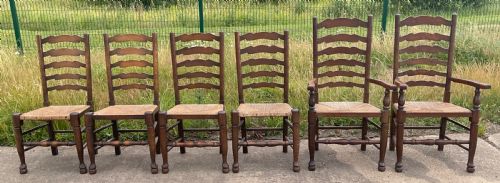
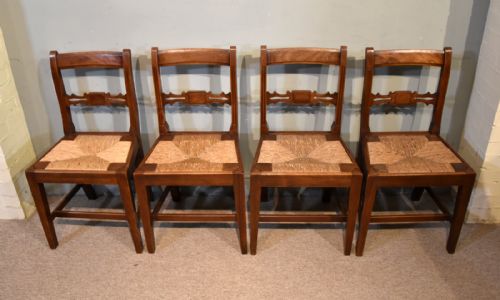


Country House Rush Chair
These country house rush chair examples are honest vernacular seating built from native timbers to last generations in working kitchens and parlours.
Country House Rush Chair
A country house rush chair combines traditional regional joinery with domestic utility, appearing in forms from modest side chairs to substantial armchairs and rocking chairs. The selection spans straightforward ladderback dining chairs alongside spindleback designs produced in local English workshops.
Makers utilised native woods such as beech, elm, ash, fruitwood, and mahogany for frames, pairing them with woven rush or sea grass seats. Pieces date from the Georgian and Regency eras through the nineteenth century into the early twentieth century.
Domestic seating ranges from single pieces like children's armchairs and commode elbow chairs to matched sets intended for farmhouse kitchens and dining rooms. English country vernacular traditions dictate the understated aesthetic of these functional domestic seats.
How country house rush chairs were constructed
Local joiners turned and shaped native hardwoods like elm, beech, and ash to form uprights, stretchers, and ladder backs. Frames were constructed using pegged mortise and tenon joints designed to withstand heavy daily use.
Seats were woven tightly by hand using natural rush or sea grass to create a supportive, resilient surface suspended between the lower rails. Some examples retain traces of original surface paint applied to protect and finish the timber frame.
The documented objects span rocking chairs, dining chairs, armchairs, and children's seating.
What separates fine examples from standard pieces
The choice of timber and the complexity of the turned spindles or ladder backs dictate the distinction between everyday utility seating and finer vernacular work. Timber selection ranges from common beech and elm to choice fruitwood and figured mahogany.
The integrity of the original rush weaving and the retention of early or original paint surfaces elevate an individual chair above standard workshop production. Proportions, regional characteristics, and the survival of matching sets shape the standing of these pieces.
The Country House Rush Chair Glossary
- Rush
- A marsh plant used for centuries to weave resilient, flexible seat bases. Traditional weavers twist the dried stems into cords before hand-weaving them tightly across the chair frame.
- Spindleback
- A chair design featuring a backrest composed of multiple thin, turned wooden rods or spindles. This construction method offers lightweight strength typical of regional vernacular furniture.
- Ladderback
- A chair style characterised by horizontal wooden slats set between the upright rear posts. The graduated rails provide ergonomic support for the back.
- Vernacular
- Furniture made by local tradespeople for everyday use rather than following strict high-style metropolitan fashions. These pieces rely on regional materials and practical construction methods.
- Commode
- A piece of seating furniture incorporating a concealed chamber pot or sanitary pan beneath the seat. In country houses, these were disguised as standard armchairs or elbow chairs.
Country House Rush Chair: Frequently Asked Questions
What woods were used for country house rush chairs?
Craftsmen built these chairs from native British hardwoods readily available to local workshops, including elm, beech, ash, fruitwood, and mahogany. Frames often combined two different timbers, such as elm seats paired with beech or ash uprights.
Secondary woods were chosen purely for strength and availability rather than display, supporting the heavy daily demands of kitchen and dining use.
How do I date a country house rush chair?
Dating relies on observing construction marks, turning styles, and timber characteristics across Georgian, Regency, and nineteenth-century periods. Subtle shifts in spindle shapes and ladder back profiles help place a chair within its era.
Archival examples and dated comparables from regional English traditions provide a reliable baseline for establishing the period of manufacture.
Are original rush seats common?
Natural rush and sea grass are organic materials that wear down through generations of sitting, meaning many surviving chairs have been re-woven. Finding an early seat in intact condition is uncommon.
When historical rush remains, it shows dry, tight tension and warm patination accumulated over decades of domestic use.
Where were these chairs used in a country house?
These practical seats served working spaces such as farmhouse kitchens, sculleries, nurseries, and casual dining areas rather than formal drawing rooms. Rocking chairs and child's armchairs provided comfortable seating in family quarters.
Their robust construction and unpretentious materials suited the bustling, utilitarian areas of large historic estates.