


Country House Buffet Table
These country house buffet table pieces offer robust utility and stately presence, giving rooms a grounded focal point built for serving.
Country House Buffet Table
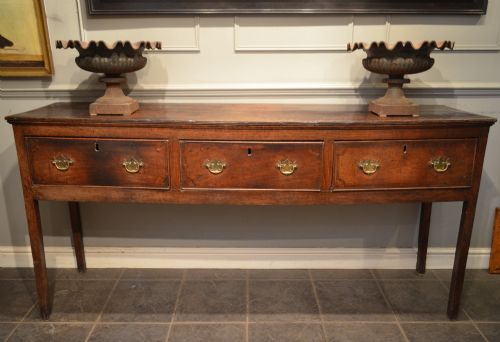
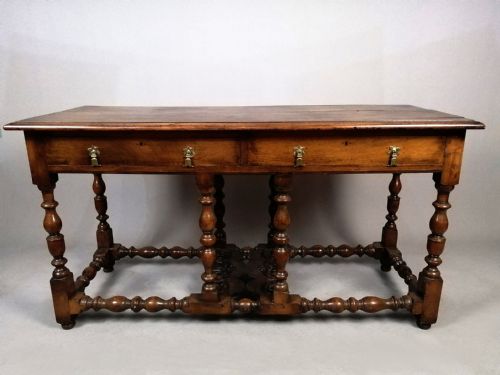
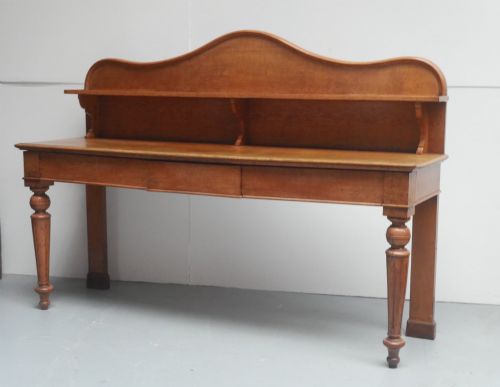
When you search for a country house buffet table, you encounter substantial serving furniture built to anchor large dining spaces. These pieces encompass sturdy dresser bases, serving tables, sideboards, and occasional dumb waiters originating from domestic contexts.
The versions most commonly met on this page span the Georgian and 19th Century periods, constructed with utilitarian proportions. They combine the practical storage of deep drawers with long surface tops designed for food preparation and display.
Makers shaped these forms from regional timbers to suit domestic interiors, resulting in both unpretentious English country pieces and grander Regency expressions. Their forms reflect generations of household use, retaining utilitarian integrity beneath decorative veneers and patinated surfaces.
Materials and construction methods
Cabinetmakers built these items primarily using solid oak, mahogany, and walnut, often applying flame mahogany veneer to prominent drawer fronts and surfaces. Secondary timbers appear in drawer linings and internal framing, demonstrating traditional carpentry techniques suited to heavy daily loads.
Decorative detailing relies on inlaid timber work, painted finishes, and polished brass handles that punctuate the darker wood surfaces. Marble tops also feature on select continental-influenced forms, introducing contrasting texture to the timber frames.
The current selection spans multiple centuries, incorporating periods from the 18th Century through to the 1920s alongside Jacobean Revival and Louis XVI styles.
What separates the finest examples
The distinction between standard utility items and exceptional pieces rests upon the quality of timber selection and surface patination. Grain matching across drawer fronts and the depth of colour achieved through centuries of waxing signal superior workshop standards.
Structural integrity and the retention of original brass hardware elevate certain examples above those altered by later restorations. Untouched surfaces displaying authentic wear distinguish pieces that have retained their character over generations.
The Country House Buffet Table Glossary
- Dresser base
- A low cabinetry unit featuring drawers and sometimes a lower shelf, designed for domestic storage and serving. These pieces form a primary category within country house dining furniture.
- Flame mahogany veneer
- A thin slice of wood cut from where branches join the main trunk, displaying a fiery, undulating grain pattern. Cabinetmakers applied this to prominent surfaces for visual impact.
- Potboard
- An open lower shelf fitted between the legs of a dresser base, traditionally used for storing pots and heavy kitchen utensils. It provides structural stability while offering open display space.
- Dumb waiter
- A tiered serving table featuring multiple revolving or fixed shelves on a central column or legs. It allowed diners to serve themselves without the presence of domestic staff.
Country House Buffet Table: Frequently Asked Questions
Where were these tables used?
These items stood primarily in large dining rooms, serving as practical surfaces for food service and tableware storage during large gatherings.
Servants utilised the deep drawers and lower shelves to organise linens, cutlery, and heavy serving platters before bringing them to the main dining table.
How do I care for antique timber?
Maintain the wood by applying natural beeswax periodically to nourish the grain and protect the historical finish from drying out.
Keep these surfaces away from direct heat sources and strong sunlight to prevent timber splitting and fading of the polished finish.
What defines the Georgian style?
Georgian design emphasises classical symmetry, balanced proportions, and restrained ornamentation that respects the natural beauty of the timber.
Pieces from this era rely on architectural lines and subtle details rather than excessive carving to achieve their formal presence.
How do I spot a replacement top?
Examine the underside of the surface for mismatched timber species and modern fixing methods that differ from the primary carcass construction.
Differences in colouration and wear patterns between the top board and the base frequently indicate later replacements or substantial timber repairs.