


Country Field Oil Painting
These country field oil painting works capture British rural life and agricultural scenes, offering collectors a direct window into pastoral history.
Country Field Oil Painting
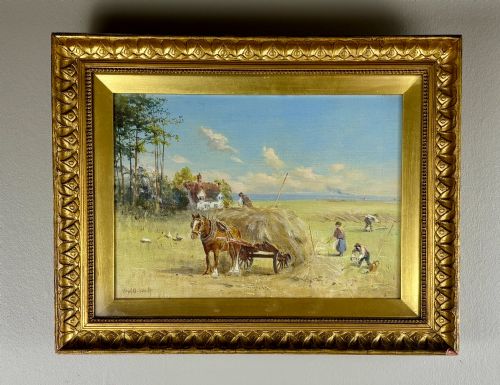
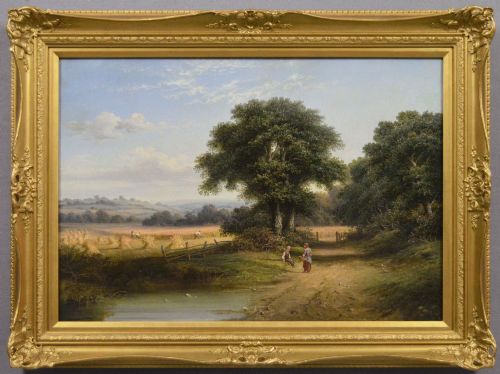
A country field oil painting represents rural landscapes, agricultural labour, and pastoral views, often featuring harvest scenes, ploughing horses, and grazing sheep. These works span periods from the nineteenth century through the early and mid twentieth century, reflecting shifting approaches to landscape and rural naturalism.
You will encounter pieces in traditional country and impressionist styles, ranging from expansive valley views to intimate studies of farm work. The subjects celebrate British and Scottish countryside traditions, executed by artists working within regional pastoral and sporting art movements.
How they were made
The primary technique relies on oil paint applied to canvas, often stretched over wooden frames, allowing for rich textures and layered colour mixing. Artists built up their compositions using traditional brushwork to render the play of light across fields and skies.
Many works retain their original frames, which frequently utilise wood, giltwood, or composite moulding to complement the depth and tone of the canvas within.
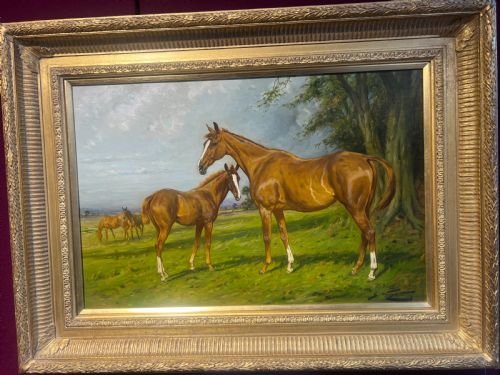
Several canvas scenes feature patient sheep and hardworking shire horses observing the painter from their pasture.
What varies in quality
Quality rests upon the artist's command of light, atmosphere, and anatomical proportion, particularly in works featuring horses, livestock, or human figures engaged in farm labour. Superior pieces display confident, expressive brushwork rather than rigid or formulaic reproduction of scenery.
The handling of the palette and the preservation of the original paint surface significantly influence the visual impact. Works that retain their unblemished impasto and harmonious tonal balance command greater appreciation among collectors.
Walter Heath Williams·George Wright·William Greaves·William Grant Murray·Arthur Walker Redgate·Herbert Royle·Frederick J. Knowles·A Davis·Dean Wolstenholme·Kershaw Schofield
The Country Field Oil Painting Glossary
- Oil on canvas
- A painting medium where pigments are bound with drying oils and applied to a woven fabric support. This combination allows for exceptional blending and durability over centuries.
- Impressionism
- An art style focused on capturing the visual impression of the moment, particularly shifting light and open-air conditions. British variants often apply these loose techniques to familiar pastoral landscapes.
- Giltwood
- Wood that has been coated with a thin layer of gold leaf or gilt powder. It is commonly found on traditional picture frames accompanying period canvases.
- Pastoral
- A genre of art depicting rural life and agricultural scenes in an idealized or peaceful manner. These compositions frequently centre on harvest work, meadows, and livestock.
Country Field Oil Painting: Frequently Asked Questions
What periods do these paintings cover?
The available works span from the nineteenth century through the mid twentieth century, encompassing Victorian pastoral, Edwardian pastoral, and impressionist movements.
This broad chronological range records how artists interpreted rural and agricultural life across successive generations.
How should I care for an oil painting?
Keep the canvas away from direct sunlight and dramatic fluctuations in temperature and humidity to prevent the paint surface from cracking.
Dust the frame gently with a soft, dry cloth and avoid applying any liquid cleaners directly to the painted surface.
Are these paintings signed by the artists?
Many of the works are attributed to named painters and carry signatures or established provenances linking them to specific studios and regional art traditions.
Attributions are supported by stylistic evidence and period documentation associated with each piece.
What framing is typically found on these pieces?
The artworks frequently feature period frames constructed from wood, giltwood, or composite moulding, designed to match the aesthetic of the canvas.
These surrounds often show the minor patination expected from nineteenth and twentieth century items.