
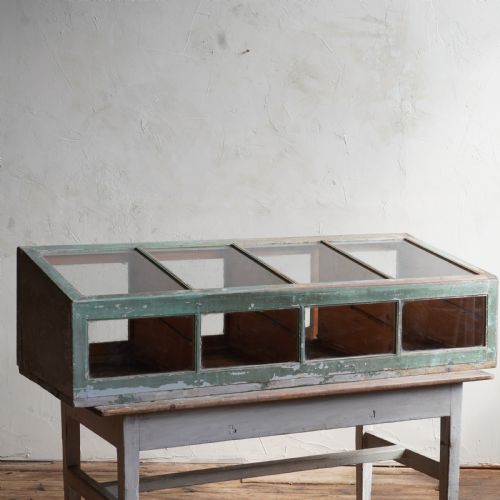


Countertop Shop Display Cabinet
A countertop shop display cabinet brings utilitarian retail heritage into the home, offering glazed protection for small collections.
Countertop Shop Display Cabinet
A countertop shop display cabinet sits on counters and tables to present small retail goods directly to buyers. These pieces originate from commercial settings spanning the Victorian, Edwardian, and Art Deco eras, alongside the 1910s, 1920s, and 1930s.
The versions most commonly found here include table top cabinets, glazed display cases, haberdashery drawers, and specialist sweet shop or apothecary boxes. They range from utilitarian trade pieces bearing advertising to refined tabletop bijouterie cases.
Makers and merchants utilised these glazed timber or brass frames for products such as sewing cottons, chocolates, tobacco, and jewellery. Their domestic repurposing today provides practical desktop or sideboard storage with clear viewing panes.
Materials and Construction
Frames are constructed primarily from timber such as oak, mahogany, and walnut, alongside ebonised wood, hardwood, and brass. Glazing provides the primary viewing barrier, enclosing the contents securely on tabletops and counters.
Interior surfaces often incorporate mirror glass, felt, or fabric linings to reflect light or cushion delicate items. Structural hardware includes brass fittings, while exterior surfaces occasionally display period paint finishes or hand sign-written commercial advertising.
Listings feature oak, mahogany, and brass frames spanning the Victorian, Edwardian, and Art Deco periods.
Distinctions in Quality
Superior examples display precise cabinetmaking joinery in timbers like figured mahogany or quarter-sawn oak, fitted with original glass panels and robust hardware. Lower tiers often involve simpler softwood construction or heavy replacement components.
The presence of original trade markers, maker plaques, and authentic sign-written advertising elevates the commercial historical integrity. Plain utilitarian boxes lack these specific retail identifiers, representing a more functional standard of manufacture.
John Stow Ltd of Bradford·Manoah Rhodes & Sons Ltd·F. Sage & Co. London·J.C. King Ltd, London
The Countertop Shop Display Cabinet Glossary
- Bijouterie case
- A glazed tabletop display box traditionally used for small luxury items, jewellery, or trinkets. These tend to feature hinged glass lids and velvet or mirrored bases.
- Haberdashery cabinet
- A retail storage unit with shallow drawers designed for sewing goods, ribbons, and small notions. Many include glass fronts or transparent drawer panels to display contents.
- Ebonised
- Timber treated with a dark stain or finish to imitate the appearance of ebony wood. This technique appears frequently on nineteenth and early twentieth century display frames.
- Sign-written
- Lettering applied by hand to glass or timber surfaces for commercial branding and advertising. Examples in this category display period confectionary and provisions branding.
Countertop Shop Display Cabinet: Frequently Asked Questions
What were these cabinets used for?
Merchants used countertop display cabinets to hold and showcase small retail goods directly to customers across Victorian and interwar shops.
Items such as sewing cottons, chocolates, tobacco, and jewellery sat inside these glazed enclosures to encourage point-of-sale purchases.
How do I date a display cabinet?
Dating relies on timber choices, construction techniques, and stylistic markers associated with periods like the Victorian era, Edwardian period, or Art Deco.
Maker plaques, original trade lettering, and hardware styles also provide clear chronological indicators for these commercial pieces.
How should I clean the glass?
Cleaning requires mild glass cleaner applied to a soft cloth rather than directly onto the frame, protecting historic timber and painted surfaces.
Care must be taken around hand sign-written advertising to avoid rubbing away historic lettering and paint.
Where should I place one?
These cabinets suit tabletops, sideboards, and desks where their glazed panels can protect and display small collections or personal items.
Placing them away from direct sunlight helps preserve original timber finishes, fabric linings, and painted advertising.