
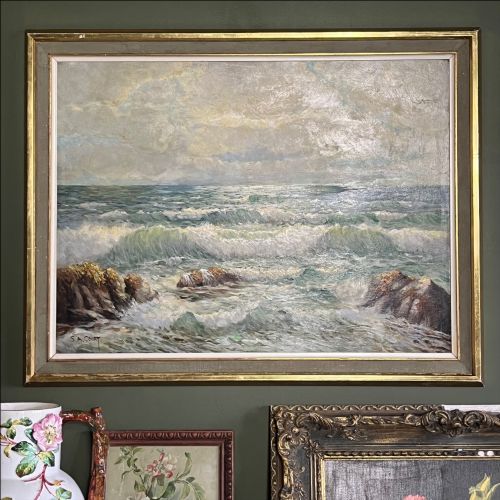


Cornwall Marine Oil Painting
A cornwall marine oil painting captures the rugged cliffs, bustling harbours and shifting coastal light of the south-west peninsula.
Cornwall Marine Oil Painting
When searching for a cornwall marine oil painting, a buyer seeks works depicting the distinctive maritime scenery and coastal topography of the region. These pieces range from eighteenth-century maritime views and nineteenth-century Victorian coastal scenes to twentieth-century Impressionist interpretations.
The most common examples on this page span the Victorian and Edwardian periods, alongside mid-century interpretations. Subjects frequently include specific locations such as St Michael's Mount, Polperro, Mevagissey Harbour and Penzance.
Makers and artists represented across the listings include Charles Napier Hemy, William Pitt, William Lambert Bell, Jack R Mould, Herbert James, William Edward Webb, Arthur Joseph Meadows and Sidney A. Court. Styles extend from British Impressionism and Edwardian Realism to Newlyn School and Georgian Maritime.
Materials and Construction
These works are executed using oil paint applied to canvas or wood supports. Many are housed in traditional frames finished with gesso and gilt wood.
Techniques range from studio compositions to en plein air painting, capturing direct observations of coastal light and weather conditions. The physical application of oil paint varies from smooth academic realism to visible, textured brushwork characteristic of impressionist methods.
The listings span from the eighteenth century through the Victorian and Edwardian eras to the mid-twentieth century, employing canvas, wood, oil paint and gilt wood.
Assessing Quality and Merit
Quality in these coastal works rests upon the artist's ability to render the specific atmospheric conditions and topography of the Cornish littoral. Stronger examples demonstrate confident brush handling, particularly in capturing the movement of water and the play of light on cliffs and vessels.
Provenance and attribution also distinguish individual works, with documented authorship by established regional painters commanding greater attention. The preservation of the original oil surface and the harmony of the framing contribute significantly to the overall standing of a piece.
Sidney A. Court·Charles Napier Hemy·William Pitt·William Lambert Bell·Jack R Mould·Herbert James·William Edward Webb·Arthur Joseph Meadows
The Cornwall Marine Oil Painting Glossary
- En plein air
- Painting outdoors to directly capture the transitory effects of light and weather. This method was widely adopted by artists working along the coast to record immediate visual impressions.
- Gesso
- A plaster-like preparation applied to wood or canvas as a base for painting or used to form moulded ornamentation on frames. It provides a smooth, stable surface for subsequent layers.
- Newlyn School
- An art colony based in the Cornish fishing village of Newlyn during the late nineteenth and early twentieth centuries. Artists associated with this movement painted realist scenes of local life and coastal subjects, often directly from nature.
- Maritime
- Pertaining to the sea, navigation, shipping and coastal views. In painting, this genre encompasses both open ocean scenes and depictions of harbours, estuaries and shorelines.
Cornwall Marine Oil Painting: Frequently Asked Questions
How do I identify a Newlyn School painting?
Works associated with the Newlyn School typically depict coastal life, local fishermen or harbour scenes with a strong emphasis on naturalism and outdoor lighting. They reflect the influence of French plein air practices brought to the Cornish coast.
Examination of the signature and the recorded working period of the artist helps confirm attribution to this specific regional movement.
What subjects are most common in these coastal artworks?
Common subjects include prominent landmarks such as St Michael's Mount, bustling harbours like Mevagissey and Polperro, and open coastal waters. Artists frequently focused on the interplay between traditional shipping and the dramatic Cornish cliffs.
These depictions range from quiet tidal inlets to turbulent maritime scenes featuring vessels making for home.
How should I care for an oil painting on canvas?
Oil paintings require stable environmental conditions away from direct sunlight, excessive heat and sudden humidity fluctuations. Keeping the canvas clear of dust with a soft, dry brush preserves the integrity of the paint surface.
Avoid using liquid cleaners or attempting repairs on the paint layer or gesso frame without professional conservation guidance.
What distinguishes Victorian marine art from later periods?
Victorian marine art often adheres to more formal compositional structures and precise draughtsmanship, particularly when detailing shipping and maritime architecture. The focus tends toward narrative clarity and documentary accuracy.
By contrast, Edwardian and mid-century works often embrace looser brushwork and a greater emphasis on atmospheric light, as seen in impressionist treatments of the coast.