

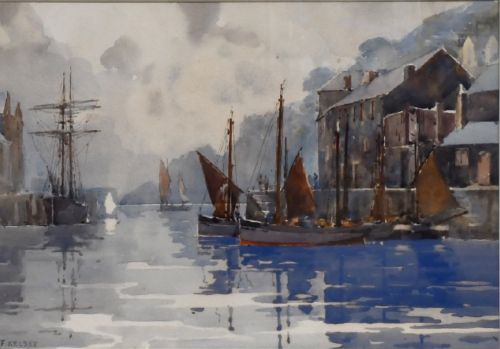


Cornish Harbour Scene Painting
A cornish harbour scene painting brings the salt air, shifting light and historic fishing fleets of the southwest directly into your room.
Cornish Harbour Scene Painting
A cornish harbour scene painting captures the maritime life, quaysides and fishing vessels of locations such as St Ives, Newlyn, Mousehole and Polperro. These works record the bustling coastal communities and dramatic coastal geography of the West Country across various periods.
You will most frequently encounter works executed in watercolour on paper or oil paint on canvas, dating from the late nineteenth century through to the mid-twentieth century. The selection ranges from detailed Victorian depictions to looser twentieth-century impressions reflecting regional artistic movements.
The subjects focus heavily on working harbours, local luggers, fisherfolk and the distinct architectural character of Cornish coastal villages. These pieces offer a direct window into the maritime heritage of the region as recorded by artists working on location.
Materials and technique
Artists relied primarily on oil paint applied to canvas or wood panels, alongside watercolour pigment worked onto paper supports. Pastel drawings also appear within the selection, offering a softer textural quality suited to coastal mists and gentle light.
Watercolour works typically employ fluid washes combined with pencil underdrawing to map out harbour buildings and rigging. Oil paintings utilise confident brushwork and rich pigment layers to capture the interplay of light on water and weathered stonework.
Framing often involves traditional wood or gilt wood mouldings that complement the palette of the marine subject matter. These frames protect the delicate paper works under glass or secure the stretchers of canvas paintings.
Listings span the nineteenth century through to the nineteen-sixties, featuring oil paint, watercolour, and pastel on paper, canvas, and wood.
Factors determining quality
Quality rests significantly upon the artist's ability to handle atmospheric light and capture the specific topographical character of the harbour. The most accomplished works demonstrate a confident command of tone and composition, bringing the bustling quayside or calm anchorage to life with economy and precision.
The handling of the medium dictates the visual impact, whether through the transparent luminosity of a skilled watercolour wash or the textural depth of an oil painting. Stronger pieces show deliberate brushwork and a convincing sense of movement in the water and sky rather than stiff, formulaic rendering.
William Banks Fortescue·Frank Kelsey·George F Pennington·Richard Harry Carter·Gyrth Russell·George Turland Goosey·Ernest F Hill·Frederick Stuart Richardson·William Lambert Bell·Ralph Todd·Jack R Mould·William Lee Hankey·Walter Sweet·Hendrik Yan Wolter·William Edward Webb
The Cornish Harbour Scene Painting Glossary
- Newlyn School
- An art colony based in the Cornish fishing village of Newlyn from the late nineteenth century onwards. Artists focused on plein air painting, capturing local fisherfolk and maritime life with naturalistic light.
- Watercolour
- A painting method in which the paints are made of pigments suspended in a water-based solution. It is applied to paper supports to create translucent washes of colour.
- Lugger
- A traditional two-masted fishing vessel carrying lug sails, frequently seen in West Country maritime artworks. These boats formed the backbone of the Cornish fishing fleet depicted by period artists.
- Impressionism
- A style of painting that focuses on the accurate depiction of light and its changing qualities. British interpretations of this movement appear frequently in twentieth-century coastal works.
Cornish Harbour Scene Painting: Frequently Asked Questions
Which Cornish harbours appear most often?
St Ives, Polperro, Mousehole and Mevagissey are the locations that surface most frequently in these coastal works. Artists were drawn to their tight architectural layouts and active fishing fleets.
These specific ports offered varied viewpoints of stacked cottages, stone piers and working boats against the Atlantic backdrop.
How do I date a watercolour painting?
Dating relies heavily on artist signatures, biographical dates, framing styles and paper watermarks. Stylistic clues within the clothing of depicted figures also help narrow down the decade.
Victorian and Edwardian works often feature tighter detail, whereas mid-century examples tend towards looser, more expressive brushwork.
How should I frame and hang these watercolours?
Watercolour paintings on paper require conservation mounting with acid-free board and protective glass to prevent fading from light exposure. They should be hung away from direct sunlight and damp environments.
Oil paintings on canvas are more robust but still benefit from stable indoor humidity and careful placement away from direct heat sources.
What defines the Newlyn school style?
The Newlyn style is characterised by plein air observation, capturing the daily routines of fisherfolk and the natural light of the Cornish coast. Artists worked directly from life to record authentic local colour and atmospheric conditions.
This approach resulted in works that feel immediate, grounded in the realities of coastal industry rather than romanticised invention.