

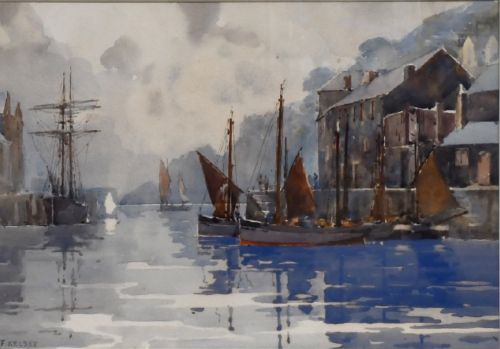


Cornish Harbour Painting
A cornish harbour painting captures the distinct light and maritime life of fishing villages through traditional watercolours and oils.
Cornish Harbour Painting
A cornish harbour painting brings home the coastal topography and maritime industry of villages like St Ives, Polperro, and Mevagissey. These works record local luggers, stone quays, and tidal flats under changing coastal light.
The pieces on this page span from the late nineteenth century through to the mid-twentieth century, capturing the evolution of regional artist colonies. Watercolours on paper and oils on canvas predominate, reflecting the mediums favoured by plein air painters working along the shore.
Most examples concentrate on specific local landmarks, naming individual ports in the titles or signatures. Buyers encounter both intimate watercolours intended for domestic interiors and larger oil paintings executed by members of recognised regional schools.
Materials and Techniques
Painters recorded coastal scenes using oil paint on canvas or wood panels, alongside transparent watercolour applied to heavy paper sheets. These materials suited outdoor work in variable weather conditions.
Brushed application ranges from tight, descriptive nineteenth-century detail to looser, impressionistic strokes developed by twentieth-century practitioners. Framing typically involves wood moulding, occasionally glazed to protect paper supports.
The selection includes depictions of St Ives, Polperro, Mevagissey, Mousehole, and Looe.
Quality and Execution
Execution depends upon the artist's command of maritime atmosphere, spatial depth, and light reflecting off water. Stronger works convey the specific weight of fishing vessels and the texture of granite harbour walls rather than relying on formulaic formulas.
Condition dictates much of the visual success, particularly with paper watercolours that are vulnerable to fading or foxing. Original wooden framing and clear artist signatures or inscriptions further distinguish accomplished regional output from lesser decorative copies.
William Banks Fortescue·Frank Kelsey·George F Pennington·Edward Matthew Elliott·Richard Harry Carter·Gyrth Russell·George Turland Goosey·Ernest F Hill·Frederick Stuart Richardson·Ralph Todd·Jack R Mould·William Lee Hankey·Walter Sweet·Hendrik Yan Wolter·S J Lamorna Birch·William Edward Webb
The Cornish Harbour Painting Glossary
- Newlyn School
- A colony of artists based in Cornwall who painted plein air subjects focusing on local fisherfolk and coastal daily life.
- Lugger
- A traditional two-masted fishing boat commonly featured in West Country maritime art.
- Plein air
- Painting executed outdoors directly in front of the subject to capture natural light and transient weather effects.
- Woodblock print
- An image printed from a carved wooden block, occasionally found alongside watercolours in early twentieth-century portfolios.
- Watercolour
- A paint medium consisting of water-soluble pigments applied to paper, widely used for rapid coastal sketches.
Cornish Harbour Painting: Frequently Asked Questions
What subjects appear in these paintings?
Artists focused on working fishing ports, tidal harbours, and coastal craft such as trawling luggers.
Views frequently centre on specific Cornish locations including St Ives, Polperro, Mousehole, and Mevagissey.
How do I date a cornish harbour painting?
Dates rely upon artist biographical spans, framing styles, and inscriptions written verso or on the mount.
Victorian and Edwardian works often show tighter academic detail, while mid-century pieces adopt looser impressionistic brushwork.
Where were these artists working?
Painters congregated around coastal settlements that offered dramatic tides, wooden fleets, and established art communities.
Newlyn and St Ives acted as the primary hubs where visiting and resident painters set up studios.
How should I frame and display works on paper?
Watercolours require conservation mounting under glass to protect the paper support from ultraviolet light and humidity.
Keep framed works away from direct sunlight and damp coastal environments to preserve the pigments.