




Copper Silver Candle Holders
Copper silver candle holders bring a dual-metal warmth to a room, pairing rich copper bodies with bright silver plate or solid highlights.
Copper Silver Candle Holders
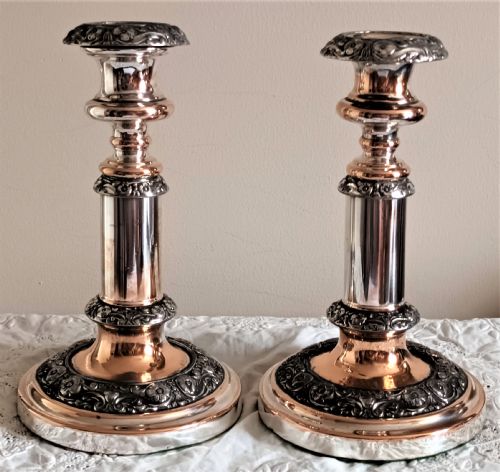
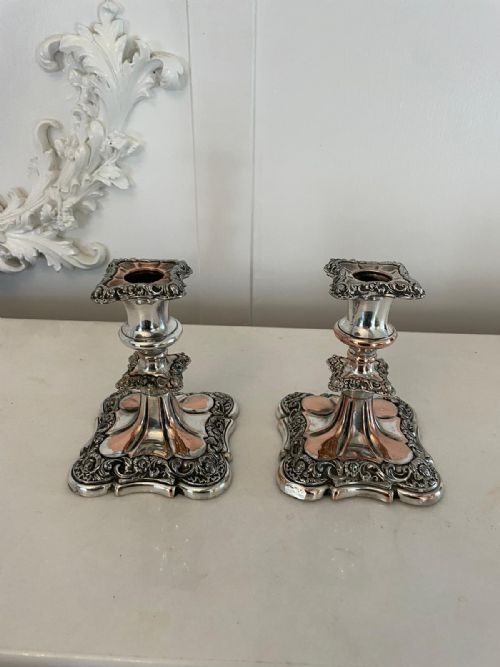
When searching for copper silver candle holders, buyers encounter paired candlesticks, telescopic designs, chamber candlesticks, and larger candelabra. The selection relies heavily on Georgian and Victorian production, drawing on styles from the eighteenth and nineteenth centuries.
The dominant forms on this page are paired sticks featuring Old Sheffield Plate, alongside Arts and Crafts creations and occasional Paktong alloy pieces. These objects serve both practical lighting and decorative display across formal and domestic interiors.
How they were made
Maker techniques utilise copper as a primary structural body, fused with silver or Old Sheffield Plate layers to create a durable dual-metal finish. Certain domestic examples incorporate turquoise ornamentation or employ the bright copper-zinc-nickel alloy known as Paktong.
Telescopic mechanisms allow adjustable heights in specific Georgian and Victorian sticks, requiring precise metal-working to ensure smooth movement within the shaft. Surface finishing ranges from ornate chased details to simple polished cylindrical forms.
A telescopic stick lets you adjust the candle height for dramatic lighting effects or lower it before someone knocks the table.
What varies in quality
Quality separates standard production wares from the finest examples through the crispness of chased ornamentation and the integrity of the silver plating over the underlying copper. Proportion and mechanical precision in telescopic mechanisms also distinguish superior pieces.
The weight of the metal and the complexity of the design define the higher tier, particularly in large Victorian candelabra or early Arts and Crafts interpretations.
The Copper Silver Candle Holders Glossary
- Old Sheffield Plate
- A fused composite material made by applying a thin sheet of silver to a thicker copper ingot. This technique predates modern electroplating and remains a hallmark of Georgian and early nineteenth-century manufacture.
- Telescopic
- A design feature allowing the candlestick shaft to extend or contract in height. This mechanism is frequently found in Georgian and Victorian examples.
- Paktong
- A copper-zinc-nickel alloy imported from China, valued for its bright metallic appearance and used for eighteenth-century chamber candlesticks.
- Candelabra
- A branched lighting fixture designed to hold multiple candles simultaneously. These pieces often feature ornate arms and substantial proportions.
Copper Silver Candle Holders: Frequently Asked Questions
What are copper silver candle holders?
These items are lighting fixtures constructed from copper and finished with silver plate, solid silver highlights, or specialised plating techniques. They appear primarily as pairs of candlesticks, chamber sticks, and candelabra.
Most examples date from the Georgian and Victorian eras, reflecting the domestic lighting requirements and decorative tastes of those periods.
How do I date these holders?
Dating relies on stylistic clues, manufacturing methods such as Old Sheffield Plate, and recorded period markers. Georgian items often show restrained classical lines, whereas Victorian pieces lean toward ornate decoration.
Design variations like telescopic stems and Arts and Crafts influences help narrow the window of origin alongside material analysis.
Were these used daily?
Original usage involved providing moveable light through domestic rooms before the widespread adoption of gas and electric lighting. Chamber candlesticks were specifically carried to illuminate bedrooms at night.
Many surviving pieces show evidence of period domestic utility alongside formal table placement.
How do I clean them?
Maintenance requires gentle cleaning suitable for silver plate and exposed copper surfaces, avoiding abrasive polishes that remove the historic metal layer. Careful attention preserves the underlying base metal beneath the silver.
Proper storage away from damp environments prevents corrosion of the copper and tarnishing of the silver components.