
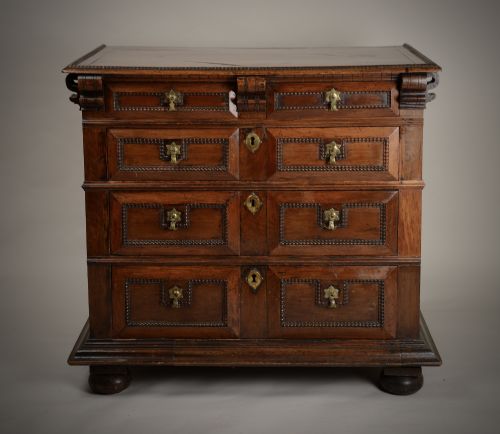
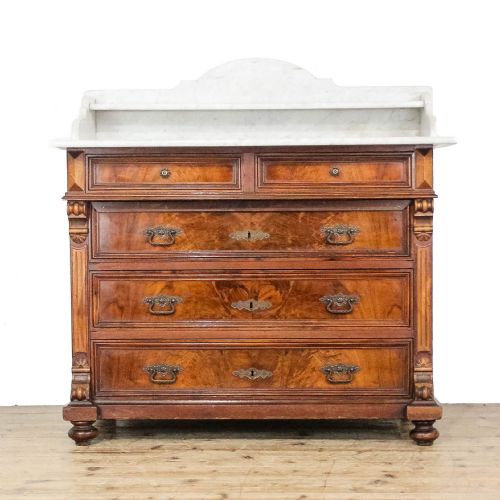
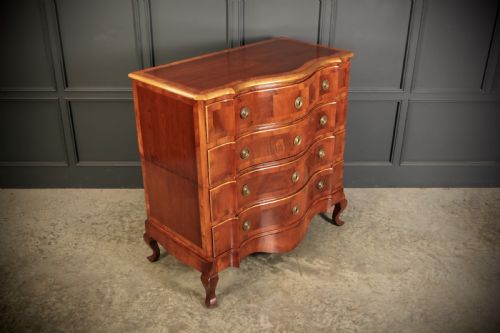


Continental Walnut Dresser
A continental walnut dresser brings rich timber grain and regional European cabinet-making traditions into a room, offering substantial storage alongside striking decorative presence.
Continental Walnut Dresser
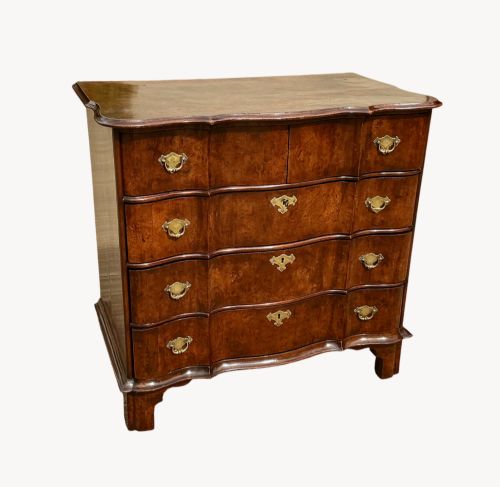
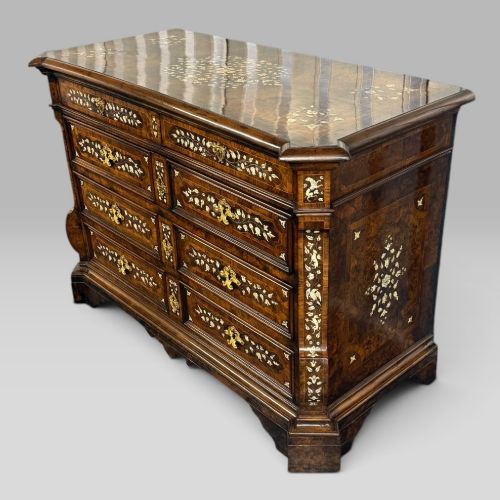
A continental walnut dresser encompasses large storage furniture originating from European workshops, including chests of drawers, commodes, cabinets, and bookcases spanning the seventeenth to the nineteenth centuries. These pieces display diverse regional aesthetics, from the sweeping curves of Dutch and Italian Baroque designs to the restrained geometric lines of Biedermeier examples.
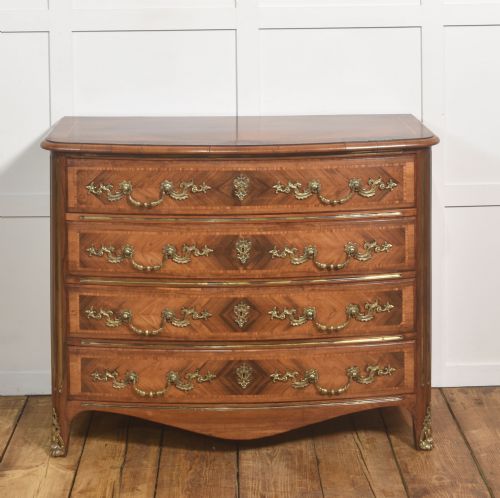
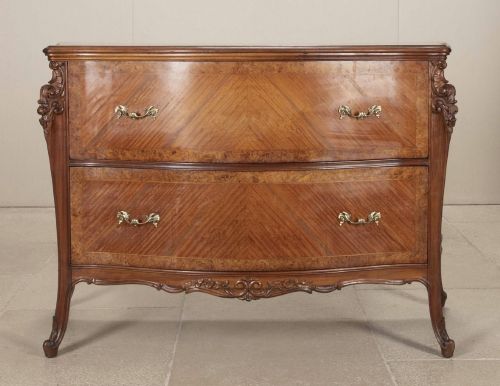
The version most commonly encountered on this page is the continental walnut commode or chest of drawers, often constructed with serpentine or bombé profiles. Eighteenth-century examples frequently showcase figured burr walnut veneers, while nineteenth-century pieces range from blonde Biedermeier surfaces to revival styles incorporating marquetry.
Materials and construction
Cabinet-makers relied heavily on solid walnut and decorative burr walnut veneers applied over secondary carcassing timbers such as oak, pine, and birch. These veneers created dramatic figural patterns across drawer fronts, particularly on pieces originating from Dutch, German, and Italian workshops.
Structural embellishments frequently involved contrasting fruitwoods, satinwood, and olive-wood for marquetry details, complemented by cast brass or ormolu handles, escutcheons, and mounts. Structural integrity relied on traditional joinery housed within sturdy frames, supporting heavy marble tops on select nineteenth-century commodes.
Listings feature continental walnut pieces spanning the seventeenth, eighteenth, and nineteenth centuries, incorporating styles from Italian Baroque to Biedermeier.
Assessing quality and execution
Quality reveals itself in the selection and matching of timber veneers, where superior examples exhibit continuous, symmetrical grain patterns across multiple drawer fronts rather than disjointed patches. The sophistication of the carving, the crispness of serpentine contours, and the integration of marquetry inlay distinguish master workshops from regional vernacular production.
Internal construction standards similarly separate grades of execution, visible in the dovetailing of drawer linings, the retention of original secondary woods like oak, and the survival of period brass or ormolu hardware without modern alterations.
Grand Ducal Workshops
The Continental Walnut Dresser Glossary
- Bombé
- A swelling, outward-curving chest profile characteristic of eighteenth-century Dutch and continental furniture design. This convex shaping requires advanced veneering and carpentry skill to follow the complex three-dimensional curves.
- Serpentine
- A front profile characterised by a central concave curve flanked by two convex sweeps. It demands precise shaping of both the solid timber frame and the fitted drawer fronts.
- Marquetry
- Decorative patterns formed by fitting together thin veneers of various coloured woods. Artisans use this technique to create elaborate floral or geometric designs across drawer and cabinet surfaces.
- Biedermeier
- A Central European style dating from the early nineteenth century favouring clean lines and blonde wood grains. It emphasises domestic comfort and highlights the natural figure of walnut over applied ornamentation.
- Commode
- A low chest of drawers or cabinet introduced in the seventeenth century and widely adopted across European salons and bedrooms. The term frequently applies to continental drawer units with decorative mounts.
Continental Walnut Dresser: Frequently Asked Questions
What is a continental walnut dresser?
A continental walnut dresser or commode is a storage chest or cabinet built in European mainland workshops using walnut timber and veneers. These pieces range from seventeenth-century Baroque cupboards to nineteenth-century Biedermeier and revival chests.
They serve as functional storage furniture while providing a strong decorative focal point through figured grain patterns and shaped silhouettes.
How do I date a walnut commode?
Dating relies on examining construction methods, secondary timbers, hardware fixings, and overall stylistic characteristics. Seventeenth and eighteenth-century examples often display hand-cut joinery and heavy mouldings, while nineteenth-century pieces may incorporate machine-sawn elements or revival motifs.
Secondary woods like oak, pine, or birch found inside the carcase also offer clues regarding the likely region and era of production.
Where were these pieces made?
These pieces originated across mainland Europe, with distinct regional schools developing in Italy, France, Germany, Austria, and the Netherlands. Each region imparted specific aesthetic qualities, such as Dutch bombé curves or Italian Baroque carving.
Local timber availability heavily influenced construction, with walnut and burr walnut frequently supplemented by native fruitwoods and olive-wood.
How do I care for antique walnut furniture?
Antique walnut requires stable indoor humidity and protection from direct sunlight to prevent timber shrinkage and veneer lifting. Maintaining a consistent room climate preserves the structural stability of the carcase and the integrity of the polish.
Regular dusting with a soft, dry cloth is sufficient for routine upkeep, avoiding silicone-based polishes that can degrade historic finishes over time.