


Compact Wooden Tea Table
These compact wooden tea table pieces are practical drop-leaf designs intended for small spaces and afternoon entertaining.
Compact Wooden Tea Table
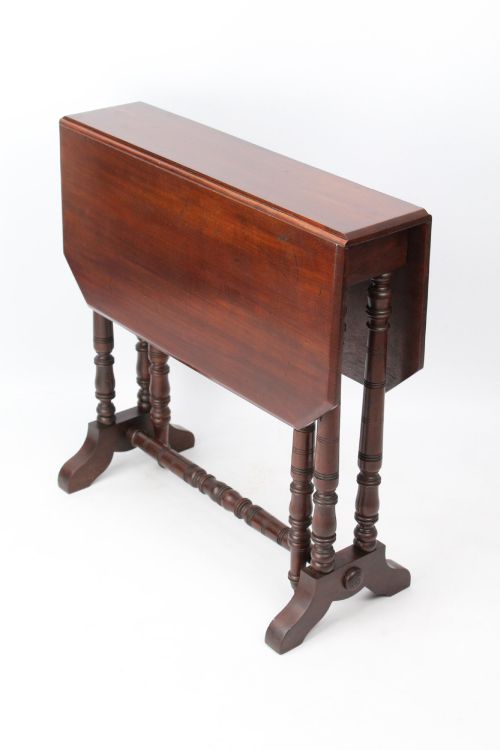
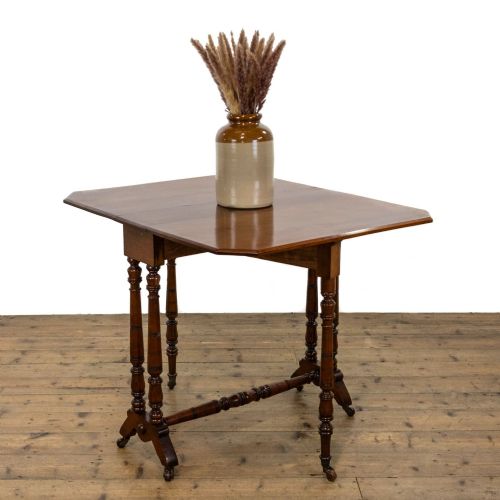
A compact wooden tea table is primarily represented here by Sutherland tables, gateleg designs, and drop-leaf occasional tables. These pieces date across the Victorian, Edwardian, and Georgian periods, spanning the nineteenth and early twentieth centuries.
Most examples function as occasional or side tables with folding leaves supported by swinging gate legs. The selection draws heavily on Edwardian mahogany and Victorian walnut variants designed for flexible placement in domestic rooms.
Buyers encounter forms ranging from small baby Sutherland tables to oval drop-leaf coffee tables and occasional tea tables. The physical evidence shows persistent emphasis on space-saving drop-leaf mechanisms across multiple eras.
How they were made
Construction relies on solid timbers like mahogany, walnut, oak, and rosewood, shaped into folding drop-leaf frames. Cabinetmakers utilised brass hardware for hinges and castors, ensuring stability when the leaves lift into position.
Surface decoration frequently involves satinwood inlay, boxwood stringing, and crossbanding to accent the timber grain. Tables finished in the Edwardian Sheraton Revival style often display detailed banded borders along the table top edges.
Listings span the Georgian, Victorian, and Edwardian periods, utilising materials such as mahogany, walnut, satinwood, burr walnut, and oak.
What varies in quality
Construction integrity separates standard utility items from finer examples, specifically regarding the alignment and movement of the drop-leaf gate legs. Superior pieces maintain rigid joints and smooth leaf pivots even after extended use.
Materials and decorative flourishes determine the tier of craftsmanship, such as the selection of burr walnut or figured mahogany veneers. Finely executed satinwood inlay and crisp crossbanding indicate a higher level of workshop output.
The Compact Wooden Tea Table Glossary
- Sutherland table
- A narrow drop-leaf table with exceptionally slender gate legs that support the folding leaves. This form originated in the nineteenth century for tea and occasional use.
- Gateleg table
- A table with hinged leaves supported by legs that swing outward like a gate. It provides an expandable surface while remaining compact when folded.
- Crossbanding
- A border of veneer laid with the grain running perpendicular to the main surface. It frames the perimeter of table tops on Edwardian and Victorian pieces.
- Satinwood inlay
- A contrasting light yellowish wood inset into darker timbers for decorative effect. It appears frequently on Edwardian occasional tables.
- Drop-leaf table
- Any table fitted with hinged flaps that fold down at the sides. This mechanism allows the furniture footprint to adjust according to daily requirements.
Compact Wooden Tea Table: Frequently Asked Questions
What is a Sutherland table?
A Sutherland table is a specific type of drop-leaf table distinguished by its very narrow central fixed top and particularly slender folding gate legs. The design folds down flat enough to stand against a wall when not in use.
Victorian and Edwardian makers produced these pieces in various scales, ranging from standard afternoon tea sizes down to small baby models intended for compact rooms.
How do I identify an Edwardian table?
Edwardian tables often display lighter timbers, satinwood inlay, and boxwood crossbanding reflecting the Sheraton Revival style popular around nineteen hundred. The framing tends to be slender and refined compared to heavier Victorian counterparts.
Cabinetmakers of this era frequently produced mahogany drop-leaf and Sutherland forms designed for flexible placement in drawing rooms.
Were these tables used for tea?
These drop-leaf designs served as convenient surfaces for afternoon tea service, easily expanding when cups and pots were brought into the room. The folding leaves allowed households to clear floor space quickly after use.
Many period titles specifically designate these items as afternoon tea or occasional tables due to this domestic function.
How do I care for a mahogany tea table?
Keep wooden tea tables away from direct heat sources and strong sunlight to protect the polish and prevent timber shrinkage. Regular dusting with a soft cloth maintains the finish without needing heavy chemical polishes.
Take care when operating the drop-leaf hinges to ensure the gate legs support the weight evenly on both sides.