






Colonial Pedestal Desk
A colonial pedestal desk offers substantial workspace coupled with deep provenance, bringing robust campaign practicality and intricate Anglo-Indian carving into the modern study.
Colonial Pedestal Desk
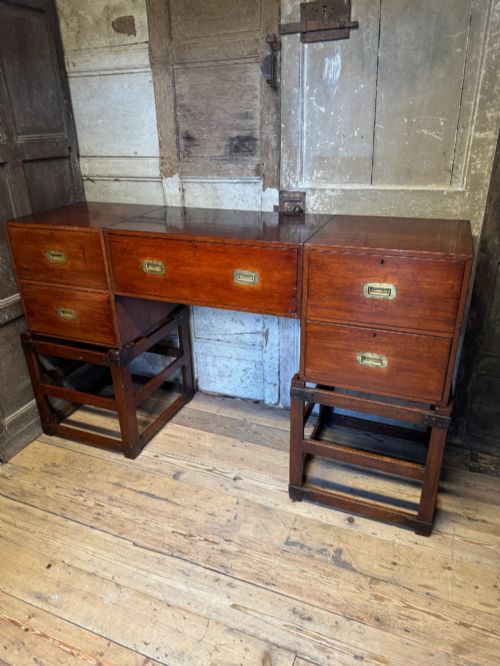
A colonial pedestal desk is a heavy functional writing workstation built for administrative life overseas during the nineteenth century. These items typically emerge from Victorian military and Anglo-Indian traditions, combining pedestal configurations with modular campaign construction.
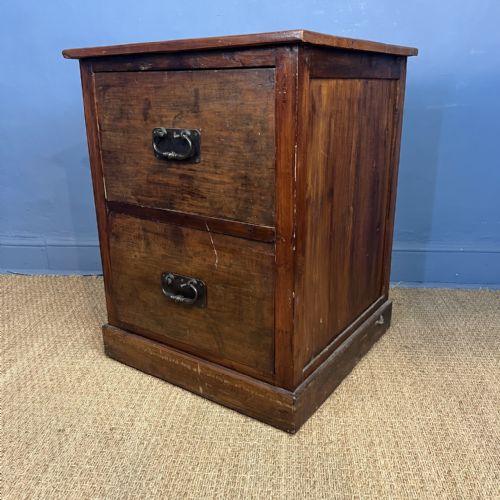
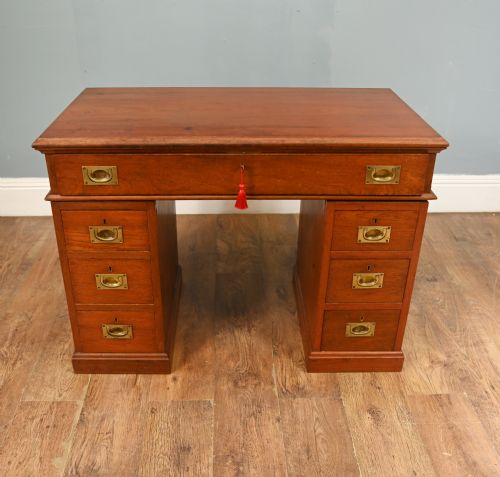
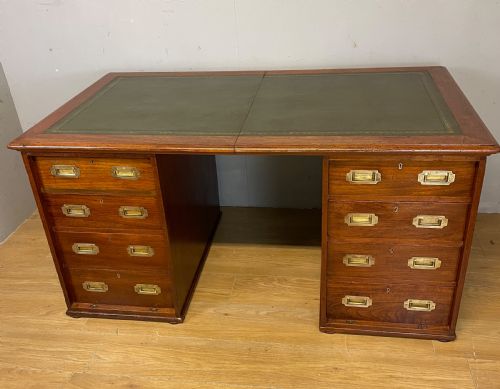
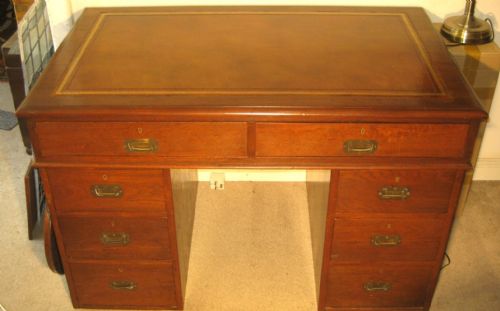
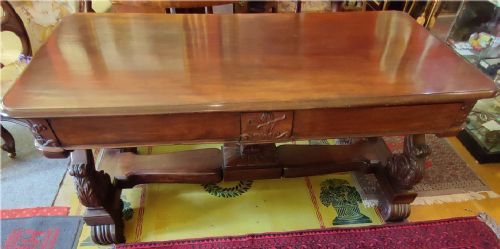
The versions most frequently met on this page are substantial pieces fashioned from dense tropical hardwoods. They feature twin pedestals flanking a central drawer, often paired with carved details or plain inset leather writing surfaces designed for heavy daily use.
How they were made
Cabinetmakers utilised heavy tropical timbers such as teak, padauk, and mahogany to withstand humid climates and rigorous transport. These dense woods were joined with robust construction methods to ensure stability across long journeys.
Brass hardware, including flush handles, corner brackets, and locks, was integrated to protect vulnerable edges and secure compartments. Leather was commonly inset into the upper writing surface to provide a smooth, durable plane for ink and paper.
Secret compartments occasionally emerge behind hidden drawers, designed to safeguard private documents during rough nineteenth-century ocean voyages.
What varies in quality
The standard of a colonial pedestal desk depends significantly upon the crispness and depth of the hand-carving applied to the timber surfaces. Plain campaign variants rely on precise flush-fitting brasswork and flawless timber selection rather than decorative motifs.
Internal secondary woods and the integrity of the original locking mechanisms dictate the overall grade of the piece. Superior examples maintain structural tightness in the pedestals and retain their original patination across the hardwood surfaces.
The Colonial Pedestal Desk Glossary
- Pedestal desk
- A freestanding desk comprising two supporting banks of drawers beneath the main writing surface. This form provides substantial storage capacity while maintaining a formal presence in the room.
- Campaign furniture
- Portable furnishings constructed in modular sections with recessed brass fittings designed for military officers on active service. These pieces dismantle easily for transport without sacrificing structural rigidity.
- Padauk
- A heavy, durable reddish-brown tropical hardwood native to Asia and Africa. Cabinetmakers favoured this dense material for intricate carving and export furniture.
- Teak
- A remarkably durable tropical hardwood prized for its natural oils and resistance to environmental extremes. This material forms the primary structure of many heavy colonial desks.
- Partners desk
- A large double-sided desk designed to accommodate two people working opposite one another simultaneously. Such configurations feature drawers and cupboards accessible from both long sides.
Colonial Pedestal Desk: Frequently Asked Questions
What is a colonial pedestal desk?
A colonial pedestal desk is a nineteenth-century administrative workstation combining twin drawer pedestals with tropical hardwoods and often Anglo-Indian carving. They were built for officials and officers operating overseas.
These pieces range from plain modular campaign units to heavily carved stationary desks designed for permanent offices. Their heavy construction ensures longevity in diverse climates.
How do I live with one?
Integrating a colonial pedestal desk into a modern room requires allowing adequate floor space for its substantial twin pedestals and chair clearance. The deep timbers and brass details anchor the surrounding decor.
Keep the hardwood nourished with appropriate wax and protect inset leather surfaces from direct sunlight. Their durable construction makes them practical for daily writing and computer work.
How are campaign desks different?
Campaign desks are built in multiple modular sections with removable legs or stacking pedestals intended for easy disassembly during transit. They feature recessed brass handles and corner plates to prevent snagging.
Standard pedestal desks are fixed, solid structures designed for stationary use rather than frequent relocation. Both share the same robust colonial material palette.
How do I identify the wood?
Padauk typically displays a rich reddish-brown hue that deepens with age, while teak is a medium golden-brown with an oily lustre. Mahogany offers a straight grain and a rich, warm tone.
Examining the underside or drawer interiors reveals the unpolished timber grain and weight characteristics. These dense tropical hardwoods feel significantly heavier than standard European furniture woods.