
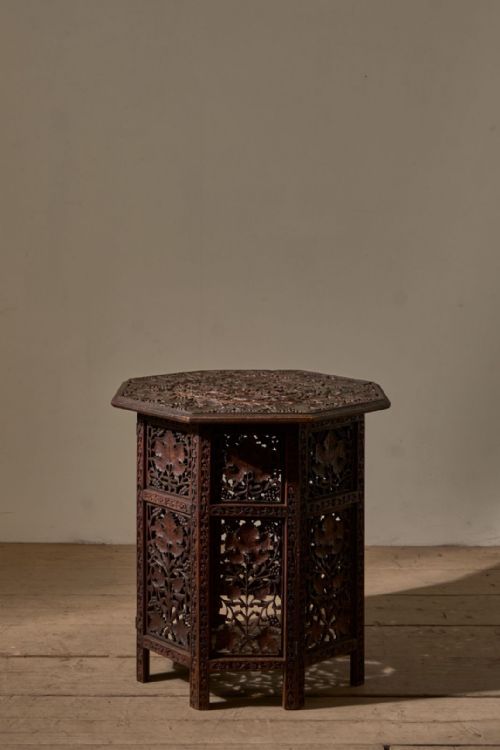


Colonial Carved End Tables
These colonial carved end tables bring intricate woodwork and rich timbers into a room, offering surface space with distinct character.
Colonial Carved End Tables
Colonial carved end tables encompass low side tables, lamp tables, and occasional tables originating from nineteenth-century and early twentieth-century production.
The selections here frequently display Anglo-Indian or Anglo-Burmese colonial styles, often taking the form of specific animal motifs or botanical leaf designs.
Buyers encounter forms ranging from simple round occasional pieces to specialised novelty pieces like camel tables and elephant tables.
Materials and construction
Workshops utilised dense tropical hardwoods such as teak, rosewood, padauk, and ebonised wood to handle deep chisel work.
Artisans applied intricate surface decoration through relief carving, turning, and occasional bone inlay to create high-contrast geometric and naturalistic patterns.
Current listings feature pieces spanning the nineteenth century up to 1930, utilising teak, rosewood, padauk, and bone inlay.
Assessing quality and execution
The depth and crispness of the hand-carved detail separate ordinary production from superior examples, particularly on figurative works like camel and elephant tables.
The selection of timber, such as heavily figured rosewood or dense padauk, dictates the visual weight and stability of the table.
The Colonial Carved End Tables Glossary
- Anglo-Indian
- Descriptive term for furniture made in India during the British period, combining British furniture forms with local carving traditions. These pieces often feature dense foliage and animal motifs.
- Padauk
- A heavy, durable reddish-brown tropical hardwood favoured for fine nineteenth-century carving. It darkens gracefully with age.
- Bone inlay
- The technique of setting small pieces of carved bone into timber surfaces to form geometric or floral patterns. It provides a striking pale contrast against dark hardwoods.
- Tilt top
- A tabletop mechanism allowing the surface to pivot to a vertical position when not in use. This was common on nineteenth-century occasional tables for ease of storage.
- Ebonised wood
- Timber treated to imitate ebony, giving a dense black finish. It was frequently utilised to highlight bright inlay work or intricate carvings.
Colonial Carved End Tables: Frequently Asked Questions
What rooms suit colonial carved end tables?
These tables function well as small lamp stands or side tables in sitting rooms where intricate woodwork adds texture.
Their compact footprints also allow them to serve as occasional surfaces beside chairs or sofas in studies.
How do I identify an Anglo-Indian table?
Look for dense hand-carved foliage, leaf motifs, or figurative elements such as elephants and camels integrated into the base and legs.
The use of tropical hardwoods like teak and padauk further points to colonial workshops in the Indian subcontinent.
Are these tables sturdy enough for daily use?
Solid hardwood construction provides inherent strength, though the heavy surface carving requires careful handling.
Placing them away from direct heat sources helps protect the dry timber and intricate joints over time.
What is a camel table?
A camel table is a nineteenth-century occasional table featuring a carved wooden support shaped in the form of a camel.
These novelty pieces often include folding or removable tray tops supported by the animal figure.