


Cobalt Blue Lamps
Cobalt blue lamps combine deep colour and bright metal mounts, bringing rich tone and warm light to any room.
Cobalt Blue Lamps
Cobalt blue lamps take many forms on this page, appearing as table lamps, chandeliers, oil lamps, desk lamps, and pendant lights. You encounter pieces spanning from the mid-nineteenth century through the early twentieth century, reflecting varied international tastes.
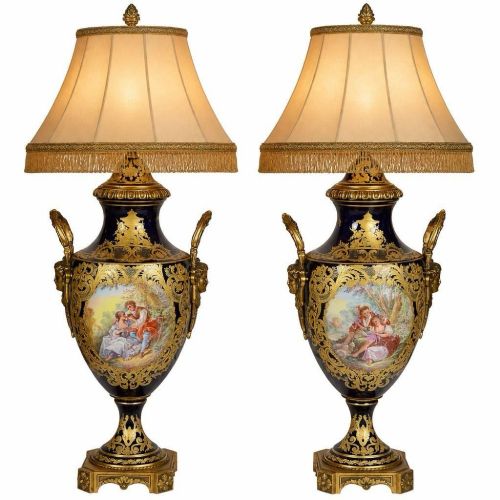
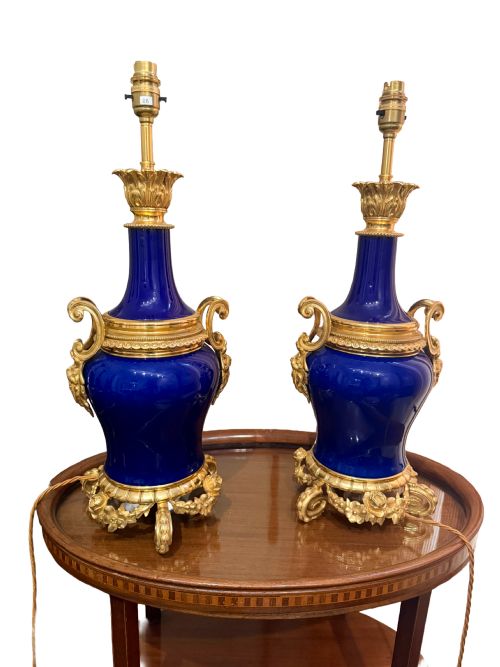
Porcelain bodies dominate the selection, often taking the shape of Chinese vases, Japanese Imari wares, or French Sevres style vessels. Converted tobacco jars and apothecary jars also provide unusual bases for lighting.
Many items originate from French workshops or Chinese kilns, showing styles ranging from Victorian and Edwardian to Chinoiserie and Louis XVI Neoclassical. Pairs frequently appear alongside single statement fixtures.
Materials and Construction
Potters achieved the characteristic deep tone by applying cobalt oxides beneath or over a clear glaze on ceramic and porcelain bodies. Artisans frequently added hand-painted details or gilt highlights directly onto the surface before firing.
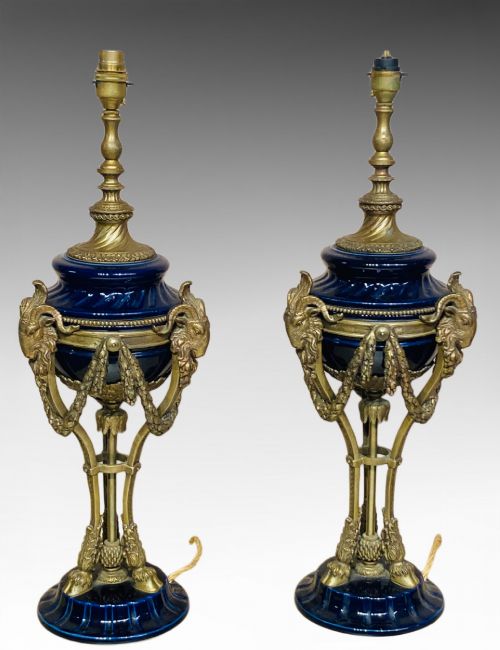
Mounters combined these ceramic and glass bodies with cast brass, ormolu, and gilt bronze. Metal collars, bases, and handles secured the fragile vessels while adding architectural weight and reflective contrast.
Glassmakers produced cut glass bodies, prisms, and leaded glass shades that manipulated light through intense blue hues. Silk and fabric elements occasionally complemented these rigid structures on shades.
Materials documented across these listings include porcelain, brass, fabric, ormolu, gilt bronze, glass, silk, and ceramic.
The Measure of Quality
The precision of the metal mounts distinguishes superior examples from simpler ones. Heavy, finely chased ormolu and gilt bronze with sharp, clean casting show greater workshop skill than flat or softly detailed brass work.
The depth and clarity of the cobalt glaze determine visual success. Rich, evenly saturated blue tones paired with crisp hand-painted decoration or precise cut glass facets elevate a piece significantly.
Royal Doulton·Sevres
The Cobalt Blue Lamps Glossary
- Ormolu
- Gilt bronze mounts applied to furniture, porcelain, and lighting. This technique involved coating cast bronze with a mercury and gold amalgam before heating.
- Sevres style
- Porcelain decoration inspired by the French Sevres factory. These pieces typically feature rich blue grounds paired with gilded accents and hand-painted panels.
- Cloisonne
- Enamelling technique where thin metal wires form raised barriers on a metal base. Artisans filled the resulting cells with coloured pastes before firing.
- Imari
- Japanese porcelain decorated in underglaze blue and contrasting enamel colours, predominantly iron red and gold. These wares were widely exported to Europe.
- Chinoiserie
- European artistic style reflecting Chinese motifs and decorative techniques. Artisans applied these imaginative interpretations to ceramics, furniture, and lighting fixtures.
Cobalt Blue Lamps: Frequently Asked Questions
How do I wire antique lamps for modern use?
Most antique lamps accommodate modern wiring through professional rewiring of the internal channels and sockets.
Conservation methods preserve the original ceramic or metal body without altering historic components.
What periods do these lamps come from?
The pieces span the nineteenth and early twentieth centuries.
Dates range from the eighteen-fifties through the nineteen-twenties, encompassing Victorian, Edwardian, and Art and Crafts eras.
Are these lamps usually found in pairs?
Matching pairs appear frequently alongside individual pieces.
Many ceramic bases started life as decorative vases or jars before conversion into balanced lighting sets.
How should I clean cobalt blue glass and porcelain?
Gentle dusting with a soft cloth maintains the glazed ceramic and glass surfaces.
Harsh chemical cleaners should be avoided to protect both the hand-painted details and the metallic ormolu mounts.